
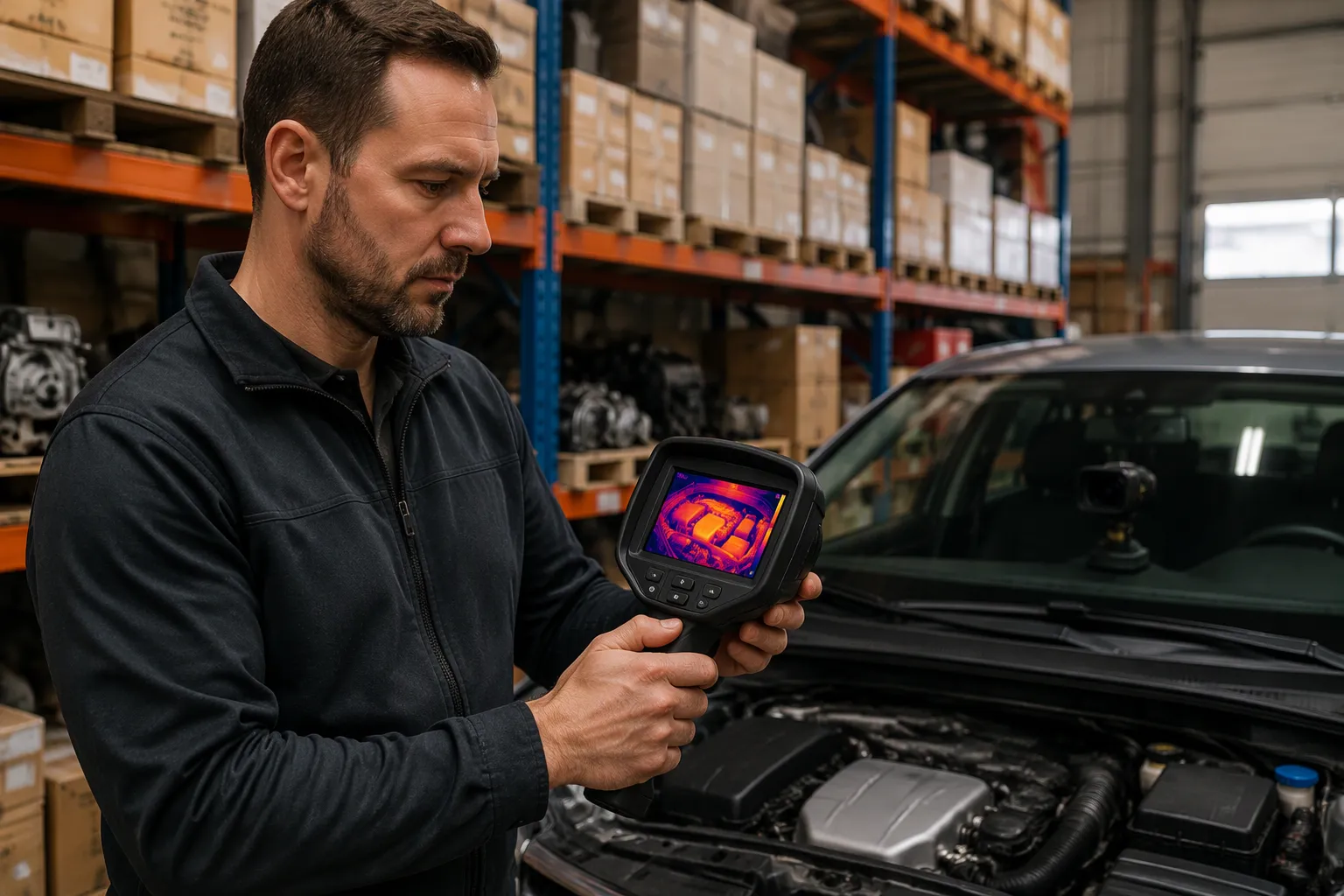
A reliable wholesale OEM car thermal camera night-vision kit supplier proves specifications, compliance, and production capacity before signing. A risky one asks distributors to trust brochures and promises. That difference decides whether a reseller builds repeat business or absorbs returns.
Distributors carry real commercial exposure. Resale margin, product reliability, and brand reputation all rest on sourcing decisions made once, often before a single unit reaches a customer. A weak kit damages every one of them.
This guide gives buyers a practical evaluation framework: specifications, application fit, compliance, cost, and supplier vetting. Each part supports a clear sourcing decision. Readers can compare candidates on evidence, not sales claims, and commit to volume with confidence.
Key Takeaways
Verify detector resolution, sensor type, and environmental ratings before choosing a kit.
Match the kit to the vehicle type and driving conditions for best performance.
Collect compliance documents like EMC test reports and declarations of conformity.
Calculate total landed cost, including freight and duties, to set a profitable resale price.
Test a sample unit on a real vehicle to confirm fit and quality before bulk ordering.
Car Thermal Camera Specifications
Resolution, Range, and Frame Rate
Detector resolution sets the level of detail a driver sees at distance. Aftermarket long-wave infrared (LWIR) systems commonly list 256 × 192, 384 × 288, and 640 × 512 detector options. The 256 × 192 class suits entry-tier kits and general night driving. Higher arrays resolve smaller objects farther out, which matters for highway speeds. Distributors should confirm the native detector resolution, not an upscaled display figure.
Detection range depends on detector, lens, and target size together. A pedestrian and a deer present very different thermal signatures at the same distance. Frame rate affects how smoothly the scene updates on the move. Buyers should request the manufacturer’s stated range for a defined target and the native frame rate, then compare candidates on identical criteria.
Sensor Type and Environmental Ratings
A product listing should state plainly whether the device uses LWIR thermal imaging or near-infrared illumination. The two technologies behave differently in total darkness, fog, and glare. Distributors who confirm the sensor type protect themselves against returns and misdescribed listings.
Vehicle-mounted cameras face vibration, temperature swings, moisture, and road debris. Ask for the ingress protection rating, the operating temperature range, and the vibration or shock test basis. Lens specification, defrost function, and vehicle fitment must be confirmed for each selected configuration. The system assists the driver; it does not operate vehicle braking or steering. Document these limits in reseller materials so end customers hold correct expectations.
Matching Kits to Applications
Passenger Cars, Fleets, and Off-Road
Passenger cars reward compact kits. A small camera unit mounts behind the grille or near the front bumper, and the display sits on the dashboard. Commuters gain a clear view of pedestrians and animals beyond the headlight beam. Fleet buyers value the same setup for vans and light trucks, where drivers cover unfamiliar routes at night. Recording and adjustable warning zones help fleet managers review incidents after the fact.
Off-road vehicles place different demands on a car thermal camera. Dust, mud, and rough terrain raise the value of sealed housings and stable mounting. A forward-facing unit helps drivers spot obstacles and animals on unlit trails. Each application fits a distinct kit tier, and no single configuration serves all three equally well. Distributors should match the kit to the duty cycle, not to the lowest price.
Mounting and Installation Fit
Mounting location changes with vehicle type. SUVs and trucks offer generous bumper and grille space, so an externally mounted camera sits low and forward for a wide view. Sedans often need a more compact unit and a shorter cable run. Installers should confirm lens choice, defrost function, and vehicle fitment for every selected configuration before shipping.
A complete aftermarket system pairs the camera with a 5-inch or 7-inch display. Manufacturers list 256 × 192, 384 × 288, and 640 × 512 detector options, plus AI recognition of pedestrians, vehicles, and animals. The system assists the driver; it does not operate vehicle braking or steering. Distributors should state this limit clearly in installation guides and reseller materials.
Thermal vs. Near-Infrared Night Vision
How the Technologies Differ
The two systems solve darkness in different ways. Near-infrared (NIR) night vision projects infrared light onto the road. An image sensor captures the reflected light and builds a visible picture. Thermal imaging works passively. A long-wave infrared (LWIR) detector reads heat emitted by people, animals, and engines. It needs no illumination at all.
That difference shapes real-world performance. NIR delivers a familiar, detailed scene, much like a bright camera view. Its reach depends on the strength of its illuminator. Thermal imaging sees through total darkness, light fog, and headlight glare, because body heat stands out against a cooler background. A product listing should state plainly which technology the device uses. Distributors who confirm this detail protect themselves against returns and misdescribed listings.
Factor | Thermal (LWIR) | Near-Infrared (NIR) |
|---|---|---|
Light source | None; reads emitted heat | Infrared illuminator |
Scene style | Heat signatures, lower detail | Detailed, camera-like view |
Best strength | Detecting people and animals in full dark | Reading signs, lanes, and shapes |
Where Each One Fits Best
North American backup-camera products increasingly advertise higher dynamic range and infrared night-vision capability. That trend shows NIR remains a strong, familiar choice for reversing cameras and low-speed maneuvering. Drivers recognize the image style, and installers know the wiring. NIR fits well where the goal is a clear, recognizable picture at short range.
Thermal imaging fits a different job. Forward-facing night driving rewards the ability to spot a pedestrian or a deer beyond the headlight beam. VERYTek’s aftermarket LWIR system pairs an externally mounted thermal camera with a 5-inch or 7-inch display. Camera options include 256 × 192, 384 × 288, and 640 × 512 detectors, with AI recognition of pedestrians, vehicles, and animals, adjustable warning zones, and recording. Distributors should confirm lens, defrost, and vehicle fitment for each configuration. The system assists the driver; it does not operate vehicle braking or steering. Both technologies are valid options, and the right pick depends on the driving task.
5-Inch and 7-Inch Complete Systems
What a Full Kit Includes
A complete system ships as a working package, not a loose camera. The box holds the thermal camera unit, a display in 5-inch or 7-inch size, the connecting cable, and mounting hardware for the chosen installation position. The display size shapes the buying decision. A 5-inch screen suits compact dashboards and tight cabins. A 7-inch screen gives drivers a larger view of the road ahead and fits vans, trucks, and SUVs with more dash space.
VERYTek’s aftermarket LWIR night-vision system shows what a full kit looks like in practice. It pairs an externally mounted thermal camera with a 5-inch or 7-inch display. Camera options include 256 × 192, 384 × 288, and 640 × 512 detectors. Distributors should confirm lens, defrost, and vehicle fitment for each configuration before ordering. The system assists the driver; it does not operate vehicle braking or steering. State this limit in every reseller listing.
AI Pedestrian and Animal Alerts
AI-driven human detection is spreading across adjacent imaging markets, from security cameras to smart doorbells. The same trend now reaches automotive night vision. Instead of asking a driver to scan a screen, the system flags a pedestrian, vehicle, or animal in the scene and draws attention to it. Adjustable warning zones let installers tune where alerts trigger, which reduces nuisance warnings on busy roads.
VERYTek’s system includes AI recognition of pedestrians, vehicles, and animals, plus adjustable warning zones and recording. Recording supports incident review after a near miss, and fleet managers value that evidence. Distributors should present AI alerts as a driver aid, not a substitute for attention. The system assists the driver; it does not operate vehicle braking or steering. Clear wording protects the reseller and sets honest expectations at the point of sale.
Automotive Compliance and Certifications
Safety and Emissions Standards
Compliance review starts with the standards that govern vehicle electronics. Electromagnetic compatibility tops the list. ECE R10 covers automotive EMC in many markets, and distributors should confirm the kit has passed relevant emissions and immunity testing. Electrical safety standards apply to the display and wiring harness. Environmental standards such as ISO 16750 describe vibration, thermal cycling, and moisture exposure for vehicle-mounted electronics, and a supplier should state which test levels the camera has met.
Emissions compliance matters even for a camera kit. The device draws power from the vehicle electrical system, so it must not disturb the onboard network or interfere with engine control modules. Market-entry rules also apply. North American buyers should look for FMVSS-relevant documentation where the product touches vehicle safety systems. European buyers need CE marking, and UK buyers need UKCA marking. RoHS and REACH declarations confirm restricted-substance compliance. A listing should also state clearly whether the device uses LWIR thermal imaging, because misdescribed technology creates both commercial and regulatory risk.
Documentation to Request
Distributors should ask for a document package, not a verbal assurance. The package typically includes the declaration of conformity, the EMC test report, environmental test reports, and RoHS and REACH statements. Request the certificate holder’s name and the report date, then check that both match the supplier’s legal entity. Expired or third-party certificates signal a gap in the supply chain.
Buyers should also request the product labeling artwork, the user manual, and the installation guide for review. These documents reveal whether the supplier understands vehicle fitment and driver-assistance limits. Confirm that lens, defrost, and vehicle fitment details appear in the manual for each configuration. The system assists the driver; it does not operate vehicle braking or steering, and compliant documentation should say so. A supplier who answers documentation requests promptly and completely usually runs a disciplined production process behind it.
Wholesale Cost and Ownership Costs
Unit Pricing, MOQs, and Volume Tiers
Unit pricing follows a tiered structure. A distributor pays a higher per-unit rate at the minimum order quantity and a lower rate as volume climbs. Suppliers publish these tiers as bands, and each band carries its own lead time and payment terms. Buyers should request the full tier sheet in writing, not a single quoted price, so they can model margin at several order sizes.
Sample orders sit alongside bulk wholesale as a validation step. A distributor buys one or two units at sample pricing, tests them, then places the bulk order against the tier that matches forecast demand. Stable supply matters as much as price here. Ask how the supplier holds component stock and whether the quoted tier price stays fixed for the order window. Configuration drives cost as well. VERYTek’s aftermarket LWIR system offers 256 × 192, 384 × 288, and 640 × 512 camera options with a 5-inch or 7-inch display, and the chosen detector and screen size move the unit price. Lens, defrost, and vehicle fitment must be confirmed for the selected configuration before the tier price is final.
Hidden and Long-Term Costs
The landed cost exceeds the unit price. Freight, insurance, import duties, and customs brokerage add to every shipment, and these charges vary by route and by declared value. Distributors should calculate landed cost per unit before setting a resale price. Returns and warranty replacements carry their own cost, including reverse freight and refurbishment.
Long-term ownership costs deserve the same scrutiny. Spare parts availability, replacement cable and mounting hardware, and firmware or software updates all affect the reseller’s support burden. A kit with a documented service path costs less to stand behind over its life. The system assists the driver; it does not operate vehicle braking or steering, and clear labeling reduces support calls and returns. Distributors who total these factors compare suppliers on true cost, not headline price.
Evaluating OEM Suppliers
Certifications, Capacity, and Warranty
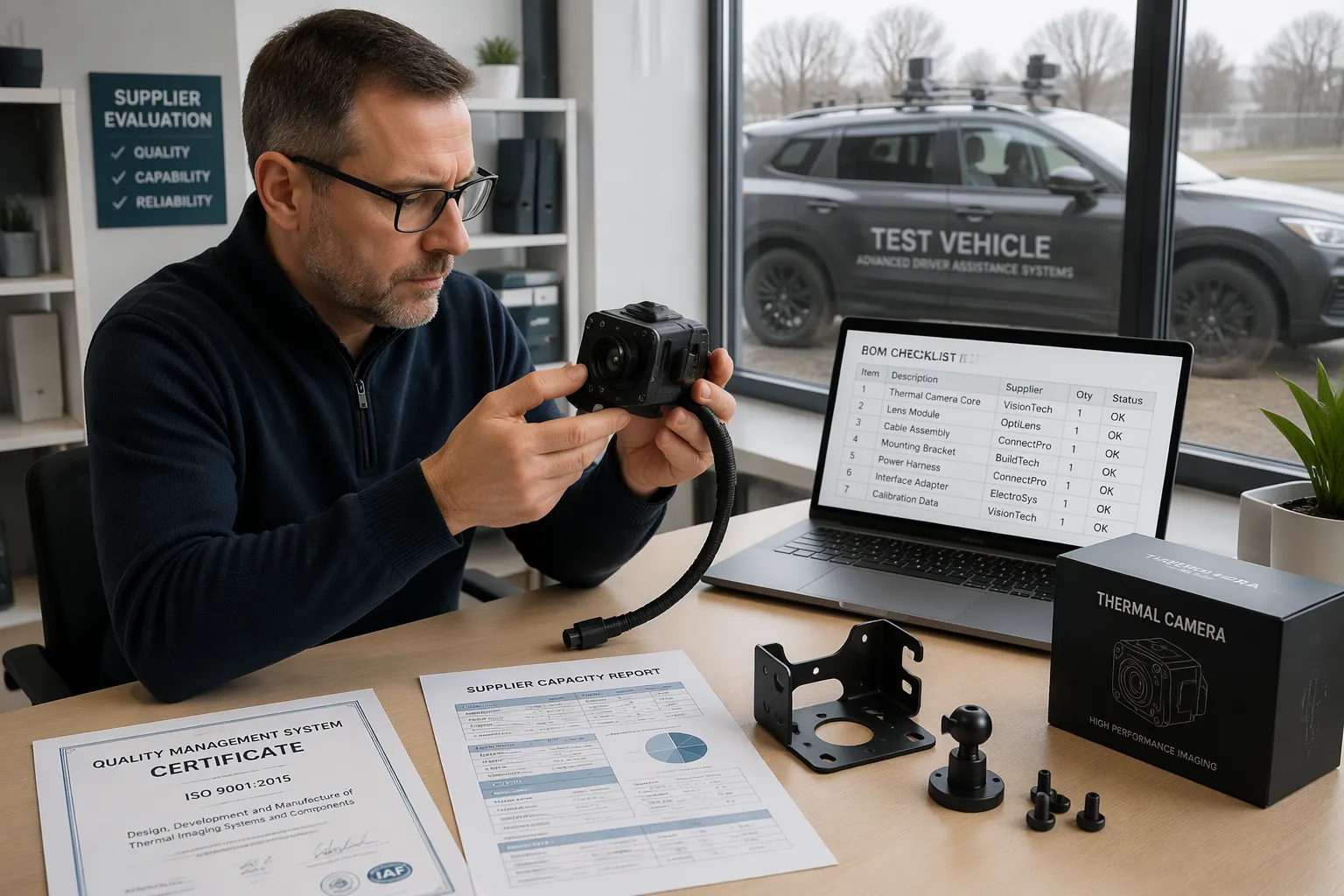
Supplier evaluation starts with paperwork a distributor can verify. Ask for the quality management certificate, the certificate holder’s legal name, and the scope of registration. Confirm that the scope covers the product category being sourced. A certificate that names a trading company rather than the factory signals a gap worth investigating.
Capacity review follows. Distributors should ask how the supplier schedules production, how it holds component stock, and what monthly output it can sustain during peak season. A supplier that quotes a lead time without describing its line capacity is guessing. Warranty terms deserve the same scrutiny. Request the warranty period in writing, the replacement or repair path, and the party responsible for reverse freight. Clear terms protect the reseller’s margin when a unit fails in the field.
VeryPCBA offers a useful reference profile for this stage. The Shenzhen-based custom PCBA manufacturer runs turnkey and consigned assembly, sources components against the buyer’s BOM, and reviews availability before procurement. Its team examines stack-up, materials, and critical dimensions before quoting, and it specializes in flex, rigid-flex, semi-flex, and HDI projects. A distributor can use that kind of documented, project-specific review as a benchmark when vetting camera kit suppliers.
Sample Testing and Quality Control
Samples reveal what brochures hide. A distributor should order one or two units, install them on a test vehicle, and check the display, the cable run, and the mounting hardware against the installation guide. Confirm lens, defrost, and vehicle fitment for the selected configuration during this trial. The system assists the driver; it does not operate vehicle braking or steering, and the sample should carry labeling that says so.
Quality control review goes deeper than the sample. Ask the supplier to describe its functional testing procedure and acceptance criteria. VeryPCBA, for example, performs functional testing according to agreed test procedures and acceptance criteria, and it uses X-ray inspection to check hidden solder joints for voids, bridging, and missing connections. Those practices show a supplier that documents decisions rather than relying on visual checks alone.
Early engineering communication separates strong suppliers from weak ones. A capable partner raises questions about stack-up, materials, and tolerances before quoting, not after the purchase order lands. Distributors should judge candidates on how quickly and completely they answer technical questions during sampling. Documented decisions, project-specific review, and clear communication at the sample stage predict how the supplier will behave during volume production. A supplier that resolves engineering questions early usually ships fewer surprises later.
Comparing Car Thermal Camera Kits
Performance, Fit, Compliance, and Cost
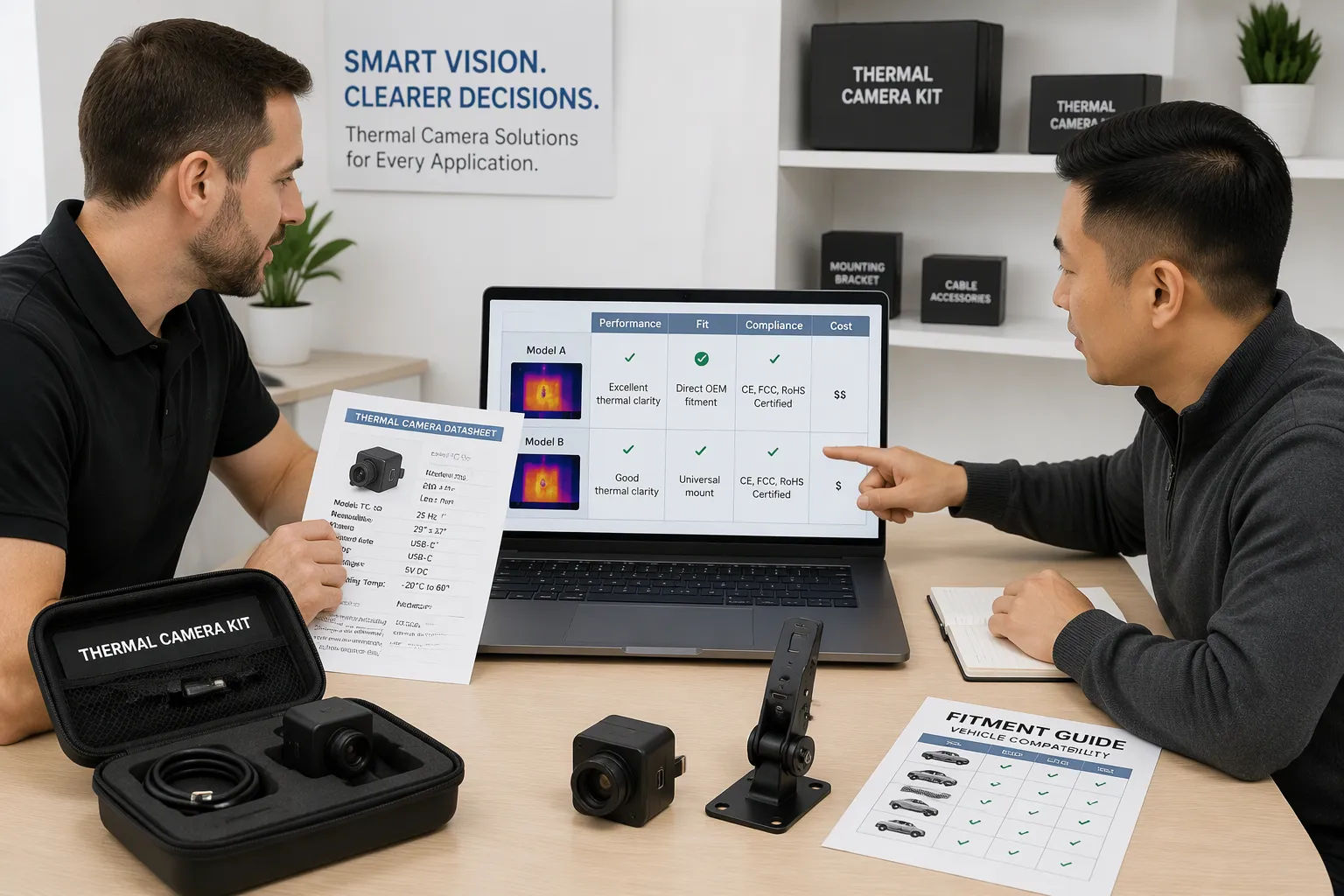
A side-by-side framework turns a crowded shortlist into a defensible decision. Distributors should score every candidate on the same four dimensions and record the evidence behind each score. The table below shows what to compare and what proof to demand.
Dimension | What to Compare | Evidence to Request |
|---|---|---|
Performance | Detector class, detection range for a defined target, native frame rate, AI alert features | Datasheet figures for identical target sizes; sample footage |
Fit | Camera size, mounting position, display size, lens and defrost options, vehicle fitment list | Installation guide; fitment confirmation per configuration |
Compliance | EMC, electrical safety, environmental testing, RoHS and REACH status | Declaration of conformity; test reports naming the supplier’s legal entity |
Cost | Tier pricing, MOQ, landed cost per unit, warranty and spare-parts path | Written tier sheet; freight and duty estimates; warranty terms |
Performance claims deserve the closest reading. A higher detector class raises detail at distance, yet it also raises unit cost. Fit decides return rates, because a camera that suits an SUV grille may not suit a sedan bumper. Compliance protects market access. Cost closes the case, but only after the first three columns pass.
Matching Kit Tiers to Markets
Kit tiers map to distinct buyer segments. A neutral, brandable OEM unit such as the Stellar T3-Mini illustrates the compact tier. It carries a 256×192 detector, touch control, and an ultra-compact design, and it ships at a minimum order quantity of 10 pieces. That profile suits distributors testing a new market, regional installers, and resellers who want low commitment before scaling. The small MOQ lowers the cost of a first order, and the neutral housing leaves room for private-label branding.
Multi-form-factor thermal lines, such as Nocpix-style monocular, binocular, and riflescope ranges, illustrate a broader tier. These lines serve sporting, outdoor, and specialty channels rather than the dashboard. A distributor with a diverse dealer network can stock one family across several product categories. The trade-off is focus: a broad line demands more SKU management and more staff training.
A third tier covers complete automotive systems with a display, cabling, and mounting hardware. Fleet buyers and aftermarket installers favor this tier because it ships ready to install. Each tier fits a different channel, and a distributor can carry more than one. The strongest portfolios pair a low-MOQ entry unit with a complete system for volume accounts. Buyers comparing a car thermal camera across tiers should weigh channel reach against inventory risk, then commit where the evidence supports demand.
Accessories, Aftermarket, and Branding
Installation Parts and Service
A kit earns repeat business long after the sale. Distributors should confirm what ships in the box and what the supplier stocks as spares. Replacement cables, mounting brackets, and display stands top the list. A reseller who cannot source a bracket six months after launch absorbs the cost of a return or a lost customer.
Aftermarket support commitments deserve a written place in the supply agreement. Ask how the supplier handles a failed unit, who pays reverse freight, and how quickly a replacement ships. Warranty terms should name the coverage period and the repair or replace path. Clear terms protect the reseller’s margin when a unit fails in the field.
Private-Label and OEM Customization
Private-label programs let a distributor build a brand rather than resell a generic box. Neutral units arrive without supplier branding, ready for the distributor’s logo, packaging, and manual. A neutral, brandable OEM unit such as the Stellar T3-Mini illustrates this path. It carries a 256×192 detector, touch control, and an ultra-compact design, and it ships at a minimum order quantity of 10 pieces. That low entry point suits a first private-label run.
Plug-and-play OEM-standard compatibility across global car models widens the addressable market. Distributors should confirm lens, defrost, and vehicle fitment for each configuration before branding a unit. VERYTek’s aftermarket LWIR system pairs an externally mounted thermal camera with a 5-inch or 7-inch display, and the manufacturer lists 256 × 192, 384 × 288, and 640 × 512 camera options. The system assists the driver; it does not operate vehicle braking or steering. Every branded listing should carry that statement, because honest labeling protects the distributor’s reputation and reduces support calls.
Next Steps for Distributors
Samples, MOQs, and Trial Pricing
A sample order turns a shortlist into a decision. Distributors should request one or two units at trial pricing, install them on a test vehicle, and check the display, cable run, and mounting hardware against the installation guide. Confirm lens, defrost, and vehicle fitment for the selected configuration during this trial. A neutral, brandable unit such as the Stellar T3-Mini shows what a low-commitment entry looks like: a 256×192 detector, touch control, an ultra-compact design, and a minimum order quantity of 10 pieces. That small MOQ lowers the cost of a first order and leaves room for private-label branding later.
Trial pricing should arrive in writing, with the sample rate, the bulk tier it converts to, and the credit terms for a follow-on order. Distributors who test before committing catch fitment problems early, when the supplier can still adjust the configuration.
Quotes and Lead Times
A quote should state more than a number. Distributors need the tier price, the MOQ attached to it, the production lead time, and the shipping window in one document. Ask how the supplier holds component stock and whether the quoted price stays fixed for the order window. VERYTek’s aftermarket LWIR system illustrates the configuration detail a quote must capture: a 5-inch or 7-inch display, camera options at 256 × 192, 384 × 288, and 640 × 512, plus AI recognition of pedestrians, vehicles, and animals, adjustable warning zones, and recording. Lens, defrost, and vehicle fitment must be confirmed for the selected configuration before the price is final.
Wholesale, OEM/ODM, and distribution inquiries typically move through direct messaging, where suppliers share specifications, quotations, and distributor details. Distributors should send a short brief covering target market, forecast volume, and branding needs, then request MOQs, trial pricing, samples, and lead times from every shortlisted supplier. The system assists the driver; it does not operate vehicle braking or steering, and every quote and listing should say so.
Distributors who verify specifications, match kits to applications, collect compliance documents, model landed cost, and check supplier track records make sourcing decisions they can defend. A car thermal camera purchase rewards that discipline. The strongest choice balances performance, compliance, and total cost. Unit price alone tells a distributor very little about margin or reputation.
Validation comes before volume. Distributors should request MOQs, trial pricing, samples, and lead times from every shortlisted supplier, then test a sample unit on a real vehicle. That step confirms fitment and exposes gaps early. Suppliers who answer quickly and document their decisions deserve the bulk order.
FAQ
How does a distributor confirm which night-vision technology a kit uses?
The listing should name the sensor type outright. A long-wave infrared (LWIR) device reads emitted heat and needs no illuminator. A near-infrared unit projects light and captures the reflection. Distributors should request the datasheet and confirm the wording before listing the product.
What ships inside a complete 5-inch or 7-inch system?
A full kit contains the thermal camera unit, the display, the connecting cable, and mounting hardware for the chosen position. Buyers should verify lens, defrost, and vehicle fitment for the selected configuration. The system assists the driver; it does not operate vehicle braking or steering.
What is the smallest order a distributor can place?
Entry-tier neutral units can carry a low minimum. The Stellar T3-Mini, for example, ships at a minimum order quantity of 10 pieces with a 256×192 detector, touch control, and an ultra-compact design. That threshold suits a first market test or a private-label trial run.
Which documents should accompany a compliance review?
Distributors should collect the declaration of conformity, the EMC test report, environmental test reports, and RoHS and REACH statements. The certificate holder’s legal name and the report date must match the supplier’s entity. Expired or third-party certificates signal a supply-chain gap.
How can a distributor verify supplier quality before volume production?
Order a sample and test it on a real vehicle. Then ask how the supplier runs functional testing and inspection. VeryPCBA, for instance, tests against agreed procedures and acceptance criteria and uses X-ray inspection to check hidden solder joints for voids, bridging, and missing connections.
See Also
Get Wholesale Motorcycle Thermal Camera Systems With 2026 Deals Today
Automotive Thermal Camera OEM Suppliers: Essential B2B Engineering Checklist Guide
Choosing High Resolution Thermal Imaging Camera Manufacturers for OEM ODM Projects
Thermal Camera Modules for Drones: Complete UAV OEM Selection Guide
Top AI Thermal Cameras for Advanced Vehicle Night Vision Systems