

You pick a high resolution thermal imaging camera thermal imaging camera manufacturers partner on eight hard criteria: detector specs, in-house ISP and algorithms, product line breadth, quality testing, OEM/ODM process maturity, certification coverage, cost structure, and verifiable evidence.
Use this scorecard before any technical call:
Detector resolution and pixel pitch
In-house ISP and image algorithms
Temperature measurement algorithms
Product line completeness, module to system
Quality and testing regime
OEM and ODM process maturity
Certification coverage
Verifiable evidence
Score each item, then shortlist three to five candidates. Every criterion below comes with verification steps, so you can test claims about any thermal camera, ir imaging camera, or wifi thermal imaging camera against documents and samples.
Key Takeaways
Use eight strict standards to judge suppliers: detector specs, in-house ISP, product line, quality testing, OEM/ODM process, certifications, cost, and evidence.
Check the technical claims with paperwork: ask for detector traceability, ISP ownership, and algorithm validation reports.
Match the supplier’s product line to your project needs, from modules to finished systems, and confirm customization limits.
Ask for a written quality plan that covers aging, temperature cycling, and dead pixel tests. Also ask for details about the OEM/ODM workflow.
Know the whole cost structure and use a standard RFQ template to compare quotes and check supplier evidence.
The 8 Hard Criteria for High Resolution Thermal Imaging Camera Manufacturers
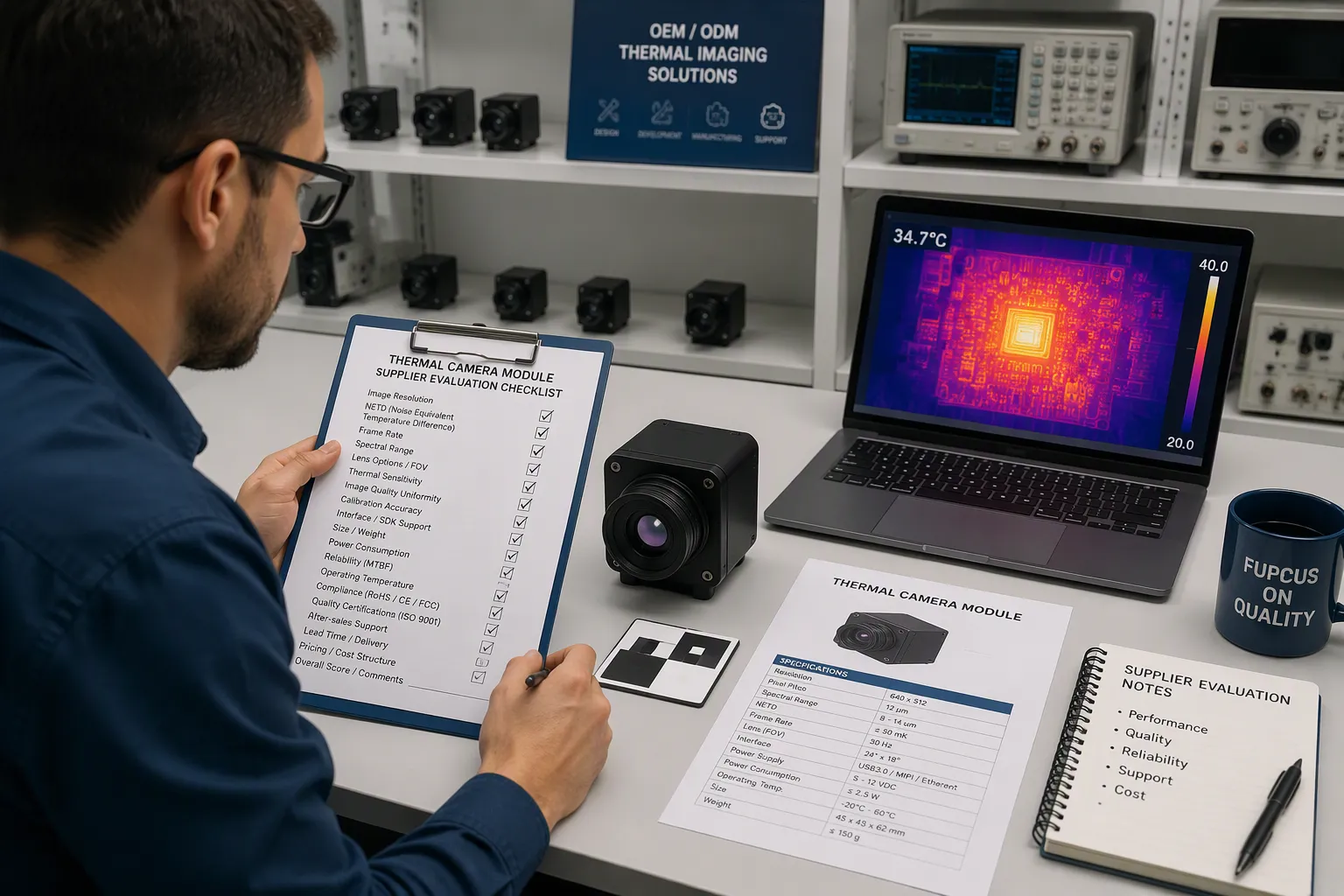
Criteria Checklist at a Glance
Use this checklist as your working scorecard. Each line is a yes-or-no question you can ask any candidate.
Detector resolution and pixel pitch: does the detector give the pixel count and pitch your application needs, with lot traceability?
In-house ISP and image algorithms: does the supplier own its image signal processing, or resell third-party firmware?
Temperature measurement algorithms: which algorithm family does the supplier use, and can it show validation reports?
Product line completeness: does the range run from module to core to finished system?
Quality and testing regime: are aging, high-low temperature, and dead pixel tests standard?
OEM/ODM process maturity: can the supplier handle branding, enclosure, firmware, and UI customization?
Certification coverage: which compliance marks apply to your target markets?
Verifiable evidence: are spec sheets, videos, and case studies available in writing?
Strong high resolution thermal imaging camera thermal imaging camera manufacturers answer all eight with documents, not adjectives. A capable industrial thermal camera manufacturer and oem/odm supplier will welcome the questions. Weak candidates deflect them.
Scoring and Shortlisting Suppliers
Turn the checklist into a weighted scorecard. Give each criterion a weight that reflects your project. A drone payload project might weight size and power heavily. A border security project might weight detector resolution and lens range. Score each candidate from one to five per criterion, multiply by the weight, and total the results.
Run this exercise before any deep technical review. Shortlist three to five candidates, then request samples and spec sheets from each. This step filters out suppliers who cannot support a thermal imaging camera oem program at scale.
Weigh the evidence behind each score. Ask for detector sourcing and consistency records, because lot-to-lot variation affects image uniformity. Request proof of self-developed ISP generations and temperature measurement algorithm families. Confirm the testing regime covers aging, high-low temperature cycling, and dead pixel mapping. Check customization depth across branding, enclosure, firmware, and UI. Demand transparent pricing with volume tiers, plus after-sales terms, RMA process, and English manuals and spec sheets. Confirm compliance coverage for your markets.
These checks separate accurate thermal imaging solutions from marketing claims. A supplier that documents its process gives you a repeatable basis for comparison across every thermal camera on your list.
Verifying Technical Capability in Thermal Imaging
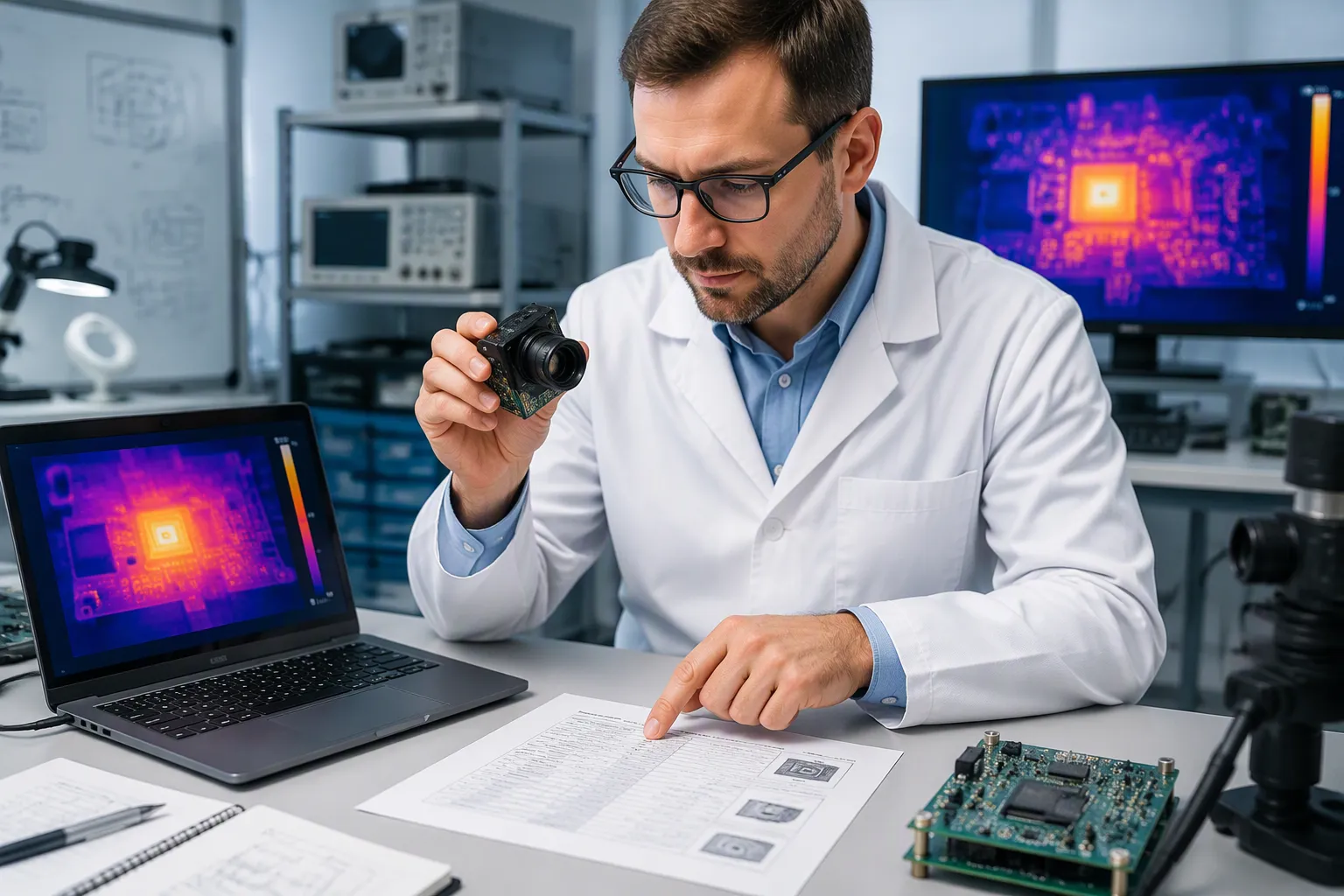
Detector, ISP, and Algorithm Checks
Read a spec sheet the way an engineer reads it. Take the UVL12 Series as a worked example. It pairs a 1280×1024 VOx uncooled microbolometer with a 12μm pixel pitch. That pitch sets how small a target the optics can resolve at distance. The noise equivalent temperature difference is ≤40mK at F1.0 and 25°C, and the module runs at 30Hz or 50Hz. Ask for each figure in writing, on a PDF spec sheet, tied to a test condition.
Sensitivity claims need a fair comparison. A 384×288 VOx device like the RIX STORM S3 lists NETD below 25mK for its resolution class, and the Thermal Master Thor002 states under 40mK. Compare candidates at the same F-number and room temperature, or the numbers mean little.
Next, test the ISP claim. Ask whether the supplier builds its own image signal processing across generations, or licenses firmware. Request a benchmark comparison of image quality and temperature measurement accuracy against a reference module. A supplier with in-house algorithms can show validation reports for its temperature measurement family. That evidence supports accurate thermal imaging solutions across the product range.
Lens evaluation comes after the detector. For MWIR and LWIR work, weigh wavelength range, detector resolution, and pixel pitch together. MWIR optics use scarce materials and cost more, yet they hold accuracy on high-temperature targets without saturation. LWIR optics use widely available materials, cost less, and suit room-temperature targets. The UVL12 accepts lenses from 8.7mm to 150mm plus continuous zoom, so confirm your chosen lens sits inside the compatibility range.
Questions That Reveal R&D Depth
Put these questions to every candidate. Which detector supplier do you use, and can you trace lots? Who owns the ISP source code? Can you share algorithm validation reports? What real-world benchmarks cover image quality and accuracy? Strong high resolution thermal imaging camera thermal imaging camera manufacturers answer with documents.
Probe the platform behind the product. Ask how many ISP generations the team has shipped and which temperature measurement algorithm families it maintains. Request sample footage from a high-quality ir imaging camera in your target scene, not a studio demo. For an ir imaging camera headed into a drone or a wifi thermal imaging camera for remote monitoring, ask for power, weight, and thermal resolution data under load.
Finally, confirm the commercial side. A mature oem partner offers transparent pricing with volume tiers, after-sales terms, an RMA process, and English manuals and spec sheets. Ask which compliance marks cover your markets. These answers separate a capable infrared thermal camera supplier from a reseller, and they give you a repeatable basis to compare every thermal camera on your shortlist.
Product Line Fit for Thermal Imaging Camera OEM Projects
From Module to System Coverage
A full product line shows that a thermal camera oem supplier in china is mature. Look for three tiers: modules, cores, and finished systems. Module families like the UVL, UVG, UVT, and UE12L series are at the component level. Core families like the UVS series add processing and interfaces. Finished products include vehicle night vision, monocular, and sight categories. Treat these as categories to map against your roadmap, not as endorsements.
Breadth matters for a practical reason. A supplier that builds modules and finished systems has already solved integration problems you will face. Ask which tier fits your project and whether the same team supports all three. A wifi thermal camera china oem supplier with this range can scale from a prototype module to a branded device without changing partners.
Customization Boundaries and UAV Fit
Map customization limits before you sign. Confirm interface options in writing: CVBS, AHD, USB3.0, CameraLink, MIPI, SDI, BT1120, HDMI, and Ethernet. Ask about lens control and auto-focus support, firmware branding, and structural fabrication for EO/IR PTZ payloads. A thermal imaging camera oem partner should state clearly where standard hardware ends and custom work begins.
For drone work, check physical limits. The UVL12 weighs ≤80g without lens and draws ≤1.6W at 30Hz. It operates from -40°C to +60°C and resists vibration and shock. Confirm weather resistance for exposed installations. These figures decide whether your ir imaging camera flies or stays grounded.
The same discipline applies to a wifi thermal imaging camera for remote monitoring or an industrial handheld thermal camera wifi build. Request a high-quality ir imaging camera sample and test it in your scene. A chinese wifi thermal imaging camera factory that documents its boundaries supports both oem and odm programs. Verify in-house ISP work, detector traceability, aging and dead-pixel testing, pricing tiers, RMA terms, English manuals, and compliance marks. That evidence turns a wifi thermal imaging camera factory claim into a working partnership. Every thermal imaging cameras shortlist deserves this check, and resolution alone will not carry it.
Quality, Testing, and Thermal Camera OEM Process
Quality and Testing Checklist
Ask for the test plan in writing. A good supplier writes down every step, and you can check each line against a sample unit.
Test stage | What it checks |
|---|---|
Incoming detector inspection | Lot tracking and even pixels before assembly |
NETD and image uniformity testing | Sensitivity and steady output across the whole view |
Temperature accuracy validation | How close readings are to a reference blackbody |
Environmental testing | Surviving heat, cold, vibration, and shock |
Burn-in and aging tests | Catching early failures before they reach you |
Final QA sampling | Making sure each outgoing unit meets the standard |
Blind pixel tests belong on this list too. A dead pixel map shows you how the factory handles detector flaws before shipping. Ask for the aging and high-low temperature records for the exact model you plan to buy. These papers prove the infrared thermal camera hits its published accuracy numbers in real production, not just on a datasheet.
OEM/ODM Workflow and Timeline
A mature thermal imaging camera oem program follows a path you can predict. Expect these stages:
Taking in your requirements
Feasibility study and locking the spec
Building a prototype and approving the sample
Pilot run
Mass production
After-sales support
Timelines change with how much you customize. A firmware rebrand moves faster than a new housing plus a custom UI. Confirm each step in writing during oem/odm requirements review, and tie payments to sample approval.
During scoping, settle optional extra functions early: picture-in-picture, hot spot tracking, external synchronization, and solar burn protection. These features affect firmware and hardware layout, so late changes cost time. A wifi thermal camera china manufacturer that plans for them upfront delivers accurate thermal imaging solutions without schedule slips. Whether you run an oem or odm project, insist on volume pricing tiers, an RMA process, English manuals, and compliance marks. That package turns a wifi thermal imaging camera build into a supply line you can trust, and it keeps your thermal imaging roadmap on track.
Cost Structure and Procurement Toolkit
Pricing, TCO, and Negotiation Levers
Unit price alone does not tell you much. Six things shape the quote: detector grade, lens choice, interface setup, how much you customize, certification needs, and order size. Detector technology matters most. Amorphous silicon detectors cost less to make on older CMOS lines, while vanadium oxide detectors give tighter noise performance and now match a-Si pricing at high yield. Packaging adds another layer, since wafer-level packaging cuts packaging cost by more than 80% compared with traditional metallic headers.
In the past, thermal imaging hardware had very high enterprise prices because of low semiconductor yields, rare raw materials, and hermetic packaging labor.
Total cost of ownership goes beyond the invoice. Count your integration work, field failure rates, and support load. A bare-board OEM core sends your whole budget to the sensing array, read-out circuit, and onboard processing instead of plastic shells and retail packaging. Export rules also shape design and cost, because high-frame-rate devices fall under Wassenaar, ITAR, and EAR oversight. Ask any wifi thermal camera china manufacturer how firmware clocks affect your target markets.
RFQ Template and Evidence Verification
Build one RFQ document you can send to every candidate. Cover resolution, lens, interface, quantity, certification needs, and timeline, then add the commercial terms that decide the deal.
RFQ Element | What to Specify |
|---|---|
Technical drawing | Dimensions, mounting holes, tolerances |
Optical performance | Transmittance, treatment, distortion limits |
Environmental scope | Temperature range, moisture, vibration |
Quantity and delivery | Sample quantity, volume, target date |
Quotation scope | Tooling charges, lead time, validity |
Check the entity before you trust the quote. Confirm the company name and official website, download spec sheet PDFs, watch product video links, and read case studies. Look for Organization Schema markup on the site. A credible wifi infrared camera oem supplier documents in-house ISP work, detector traceability, aging and dead-pixel testing, branding and firmware customization, tiered pricing, RMA terms, and English manuals. That paper trail supports accurate thermal imaging solutions and separates a real wifi thermal imaging camera factory from a trading desk. Apply the same test to every infrared camera quote, and your shortlist stays honest.
Eight criteria give you one method you can repeat: check technical skill, match the product line to your needs, review the quality process, and ask for clear costs. Use the checklist and RFQ template on your shortlist today.
Ask every candidate for sample modules and spec sheet PDFs. Test each ir imaging camera in your own scene. Check claims about accuracy and paperwork before you commit to an oem or odm partner.
Build the relationship on evidence. Strong high resolution thermal imaging camera thermal imaging camera manufacturers welcome pilot testing, and that shared proof keeps thermal imaging programs going for years. Treat every thermal camera, wifi thermal imaging camera, and infrared thermal camera quote as a starting point for checking, not a finish line.
FAQ
What should you check first in a thermal imaging supplier?
Start with where the detector comes from and whether you can trace each lot. Ask for written proof of in-house ISP work and algorithm validation reports. These papers show if the supplier controls thermal imaging quality or just resells firmware. Confirm the answers on a spec sheet PDF before you shortlist the supplier.
Can one partner handle both oem and odm programs?
Yes, a mature partner runs both tracks. An oem project puts your brand on a standard module. An odm project adds custom housing, firmware, and UI. Ask each candidate to say where standard hardware ends and custom work begins. Tie payments to sample approval for either path.
How do you test accuracy before mass production?
Request a sample module and test it in your own scene. Compare readings against a reference blackbody. Ask for the NETD figure in writing, such as ≤40mK at F1.0 and 25°C on the UVL12 Series. Review aging and dead pixel records for the exact model you plan to buy.
Which specs matter for a wifi thermal imaging camera build?
Check weight, power draw, and thermal imaging resolution together. The UVL12 weighs ≤80g without lens and draws ≤1.6W at 30Hz. Confirm the operating range of -40°C to +60°C and vibration resistance. A wifi thermal imaging camera for remote monitoring also needs Ethernet or digital output support.
What evidence should come with an infrared camera quote?
Ask for tiered pricing, RMA terms, and English manuals. Confirm compliance marks for your target markets. Request spec sheet PDFs, product videos, and case studies. A credible ir imaging camera supplier documents detector traceability and testing. Treat every thermal camera quote as a starting point for checking, not a finish line.
See Also
Key Price Drivers For Thermal Camera Modules From 256×192 To 1280×1024 In 2026