
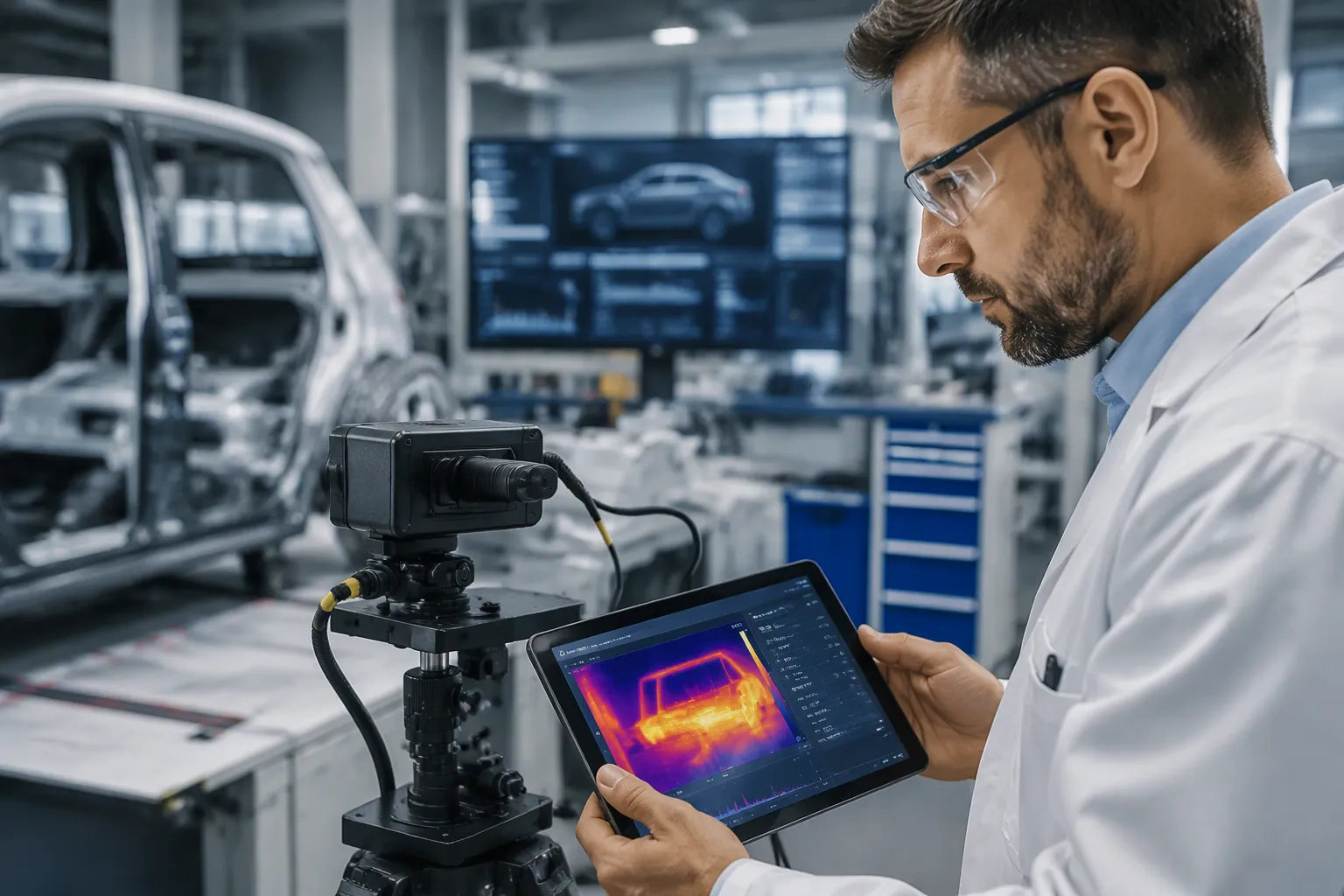
Qualifying an automotive thermal camera OEM supplier demands a structured, evidence-based checklist. Four pillars anchor that evaluation: technical performance, application fit, regulatory compliance, and cost.
Engineers should begin with the host system, target use case, and interface, not sensor pixel count alone. A 256×192 uncooled module with a suitable pixel pitch may serve better than a higher-resolution unit. Each checklist item must be verifiable through model-specific drawings and sample footage. Suppliers of thermal imaging cameras should demonstrate lwir performance, mipi or Ethernet output, and real thermal imaging data.
This checklist serves as an RFQ-preparation and design-in tool. Teams can apply it repeatably across candidate automotive thermal imaging suppliers.
Key Takeaways
Start with your host system, target use case, and interface before choosing a thermal camera supplier.
Verify every supplier claim with model-specific drawings, sample footage, and test reports.
Match the camera’s interface and AI functions to your vehicle’s architecture and ADAS needs.
Check compliance documents like PPAP, EMC/EMI reports, and cybersecurity evidence for the exact configuration.
Evaluate total cost of ownership, including integration and lifecycle support, not just unit price.
Using the Checklist
Scope and Structure
The checklist organizes verification into four pillars: technical performance, application fit, regulatory compliance, and cost. Engineers apply it supplier-by-supplier and item-by-item. A candidate may pass every technical line and still fail on compliance documentation, so no pillar carries less weight than another.
Each pillar contains discrete items. A technical item might ask for detector resolution and field of view. An application item might ask for interface variants and AI function support. A compliance item might ask for PPAP evidence. A cost item might ask for lifecycle support terms. The structure stays fixed across candidates, which makes side-by-side comparison straightforward.
Sequencing Before RFQ
The RFQ should begin with the host system, the target use case, and the interface. Sensor pixel count alone tells the buyer little about whether a module will work in a given vehicle platform. A compact uncooled 256×192 module may fit a space-constrained housing better than a larger array. An interface mismatch, such as a missing mipi or Ethernet path, can disqualify an otherwise strong candidate.
Each checklist item should map to a document, drawing, or sample the supplier can provide. Request model-specific drawings for mechanical fit. Request sample thermal imaging footage for image quality review. Request test reports for compliance claims. Datasheet-only claims do not satisfy the checklist.
This sequencing turns the checklist into a practical RFQ tool. Buyers state the host system and interface first, then ask suppliers to respond with evidence. Thermal imaging performance then gets judged against the real detection scenario, not a headline specification.
Technical Criteria for Automotive Thermal Camera Modules
Resolution and Optical FOV
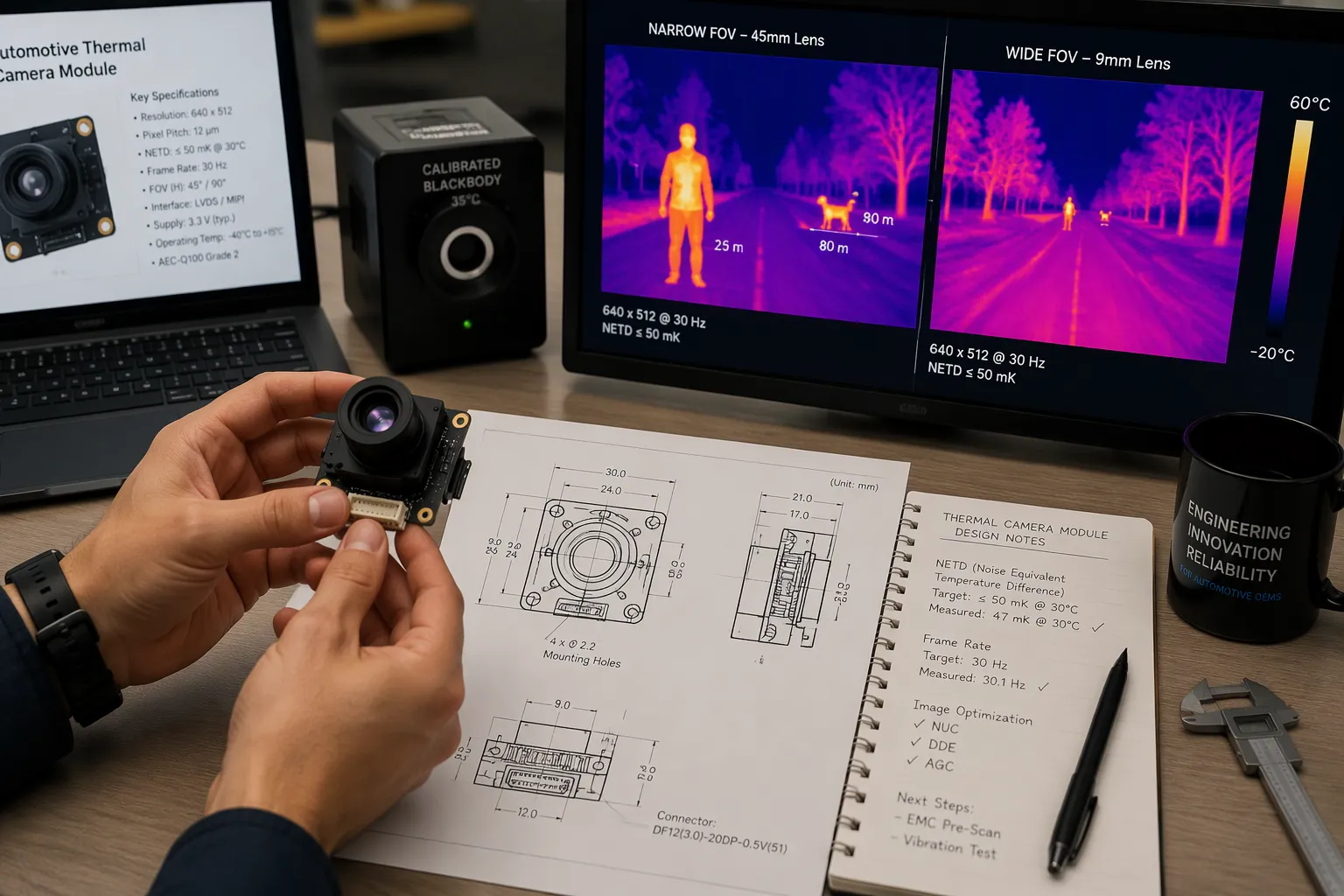
Engineers must confirm detector resolution and optical field of view as two separate line items. Display resolution and encoded video format belong to a different verification block. A module may output a high-definition stream from a modest detector, and that upscaling does not add real detail to the thermal image.
Common detector options include 256×192, 384×288, and 640×512. Compact uncooled thermal modules built on a 256×192 array suit space-limited housings and OEM-branded, bulk B2B supply. Larger arrays serve longer-range recognition tasks. The pixel pitch of the detector, together with the lens focal length, sets the instantaneous field of view and therefore the distance at which a pedestrian or animal subtends enough pixels for reliable recognition. A finer pixel pitch sensor in a small package can outperform a larger array behind a wide lens.
Buyers should request model-specific drawings and sample footage before purchase. Datasheet-only claims do not survive integration. Drawings confirm mounting points, connector position, and envelope. Footage recorded in the target scene confirms real image quality.
Sensitivity, Frame Rate, and Range
Thermal sensitivity, frame rate, and detection range each need their own verification item. Sensitivity appears as noise equivalent temperature difference, usually written NETD. A lower NETD value means the module resolves smaller temperature contrasts. State the measurement conditions alongside the figure, because NETD depends on f-number and frame rate. An uncooled microbolometer array also drifts with scene temperature, so the supplier should describe its non-uniformity correction scheme. Shutter-based NUC introduces brief image freezes; shutterless NUC relies on scene-based algorithms. Engineers should ask how often NUC calibrations occur and whether they interrupt the video stream.
Frame rate affects motion handling in ADAS functions. Confirm the delivered rate at the stated interface, not only the detector’s maximum. Detection and recognition range follow from pixel pitch, lens, and NETD together, so treat range as a derived figure and ask the supplier to show the calculation basis.
Interface selection stays tied to the host system. An oem thermal camera module may feed a MIPI channel to a fusion ECU, while a standalone automotive thermal camera streams over Ethernet. The long-wave infrared band, abbreviated LWIR, defines the sensing window for every uncooled thermal core in this class. Test thermal imaging cameras from each candidate in the same scene, at the same time, and compare the footage side by side. That comparison, plus drawings and NUC documentation, gives the technical pillar solid evidence.
Application Fit for Thermal Camera Module Integration
ADAS and Sensor Fusion
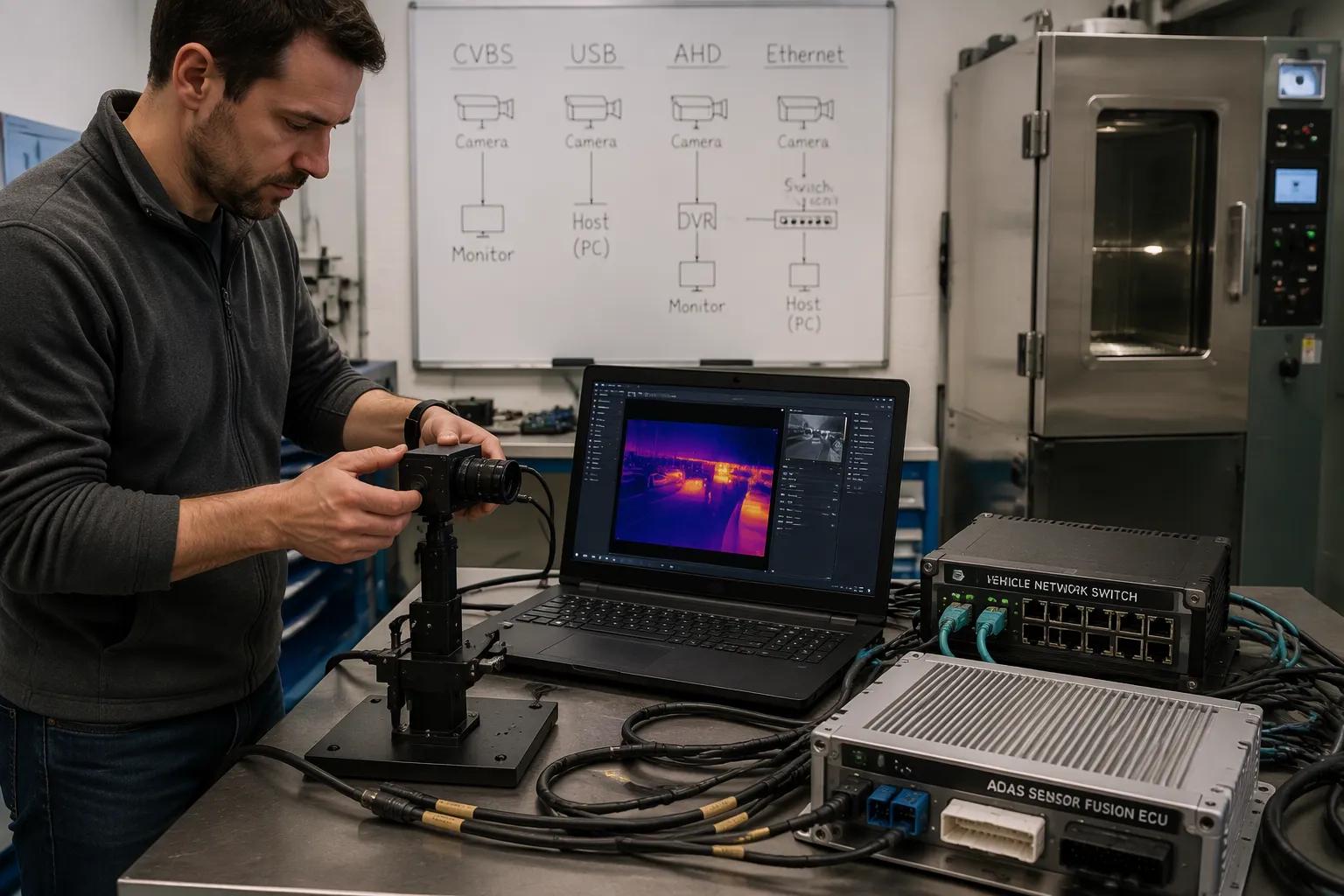
Interface variants deserve explicit verification. The TC series carries no AI functions and offers CVBS or USB output. The TA series uses AHD with RS485 for certain vehicle series. The TNV series streams over Ethernet with RTSP/ONVIF for networked units. Each path suits a different host architecture. A legacy display head unit accepts CVBS with minimal adaptation. A distributed vehicle network favors Ethernet. Interface protocol compatibility therefore becomes a first-order selection criterion, not an afterthought.
AI functions differ by model, and engineers should match them to the ADAS use case and the sensor-fusion architecture. A fusion ECU that runs its own detection algorithms needs clean radiometric video, not pre-processed overlays. A standalone warning system may benefit from on-module pedestrian detection. The thermal camera module should deliver the data format the fusion stack expects. Confirm whether the module outputs raw frames, temperature-compensated frames, or detection metadata. Ask for sample footage from each mode.
The thermal sensor choice interacts with fusion design. A mipi output feeds a nearby processor with low latency. An Ethernet unit with RTSP/ONVIF integrates across a vehicle network but adds encoding delay. Engineers should quantify that delay against the ADAS response budget. For thermal imaging cameras in collision-warning roles, latency affects the usable detection range at speed. Request latency figures at the stated frame rate and interface.
Environmental Robustness and FOV
Operating temperature, sealing, and vibration each need a documented test result. Cabin-mounted units see milder conditions than exterior-mounted ones. Exterior housings require sealing against water and dust ingress, and the supplier should state the ingress protection rating with the test basis. Vibration profiles should match the mounting location on the vehicle.
Field of view must match the target detection scenario. A wide field of view covers adjacent lanes at short range. A narrow field of view extends recognition distance for a forward-facing thermal camera module. Engineers should calculate the pixels-on-target for the smallest object of interest at the required distance, using pixel pitch and focal length. That calculation converts a vague range claim into a checkable number.
Environmental performance also affects image quality. NETD rises as optics and detector warm, and the NUC scheme determines how the module manages that drift. Uncooled thermal modules with shutterless correction avoid mechanical wear but may show artifacts in uniform scenes. Long-wave infrared sensing is stable across lighting conditions, which is the core argument for thermal imaging in ADAS. Still, engineers should review footage recorded at temperature extremes. Thermal imaging systems that hold contrast in cold and hot conditions earn their place in the design. Compare thermal cameras from each candidate under matched conditions, and tie every claim to a drawing, report, or sample clip.
Compliance for Thermal Cameras in Vehicles
Quality Standards and Safety Certifications
PPAP documentation should follow the buyer’s checklist structure and account for OEM Customer-Specific Requirements (CSRs). A generic PPAP package rarely satisfies a specific vehicle program. Engineers should map each checklist line to a document and confirm the supplier has addressed the CSRs that apply to that program.
Quality standards and safety certifications need verification at two levels: the module and the PCBA. Ask for certificates covering the assembled module and the board assembly process. The interface shapes part of the evidence trail, since a mipi link and an Ethernet port each carry their own test obligations. Suppliers of thermal imaging cameras should declare the lwir sensing band and confirm that uncooled detector behavior, including drift with scene temperature, appears in the qualification report. A pcb design checklist helps here. It lets engineers confirm that board-level decisions were reviewed before production, and it records the pixel pitch and detector configuration actually tested.
EMC/EMI and Cybersecurity
EMC/EMI test reports must cover the delivered configuration, not a laboratory variant. Request reports for the exact model, interface, and cable set the buyer will receive. An automotive thermal camera module with a networked output needs cybersecurity documentation as well. Ethernet and RTSP interfaces require interface-level security evidence: authentication, access control, and firmware update handling.
Where the supplier also provides PCBA assembly, confirm board construction review across flex, rigid-flex, and HDI builds. BOM-based sourcing should be documented, and the X-ray inspection scope for hidden solder joints agreed in writing before production. These steps keep compliance evidence tied to the actual build. Thermal cameras and thermal imaging systems earn approval through documents a buyer can check, not claims alone. Long-wave infrared performance claims belong in test reports with stated conditions. Uncooled thermal modules should show qualification data at the temperature extremes the host system will face. Every compliance item should trace back to the host system, target use case, and interface defined at RFQ, and thermal imaging evidence should match that configuration.
Cost and Lifecycle for Uncooled Thermal Modules
TCO and Scalability
Unit price alone misleads the buyer. Total cost of ownership for a thermal camera module combines module price, integration effort, interface adaptation, testing, and lifecycle support. A low-cost unit with a CVBS output may demand a converter board and extra harness work. A mipi unit may drop into an existing processor path with little rework. Engineers should price the whole chain before comparing quotes.
Scalability deserves the same scrutiny. Suppliers should confirm bulk-order readiness and offer neutral OEM-branded units for volume programs. Repeatable PCBA supply matters too, because a stable board build keeps fielded thermal imaging consistent across batches. Buyers should ask how the supplier holds quality at higher volumes.
Lifecycle and Supply Continuity
Lifecycle support covers factory setup, service support, and documented engineering decisions. A supplier should record why a given pixel pitch, lens, or non-uniformity correction scheme was chosen. That record helps the buyer’s team service units years later. Supply continuity planning belongs in the same conversation. Ask how the supplier manages component availability for uncooled thermal modules across the program life.
Cost review should also weigh detector behavior. A microbolometer core with a stable nuc routine reduces field returns. A thermal sensor with a well-characterized netd figure supports predictable detection performance. These traits carry real value beyond the invoice.
Engineers should anchor every cost and lifecycle item to the host system, target use case, and interface defined at RFQ. Thermal imaging cameras that fit the platform cleanly cost less to integrate. Uncooled thermal modules with documented decisions and continuity plans protect the program long after launch. The lwir band, the detector, and the interface all belong in one cost model. Thermal cameras judged this way earn approval on evidence, not on price alone. Buyers should request model-specific documentation for each lifecycle claim before they commit.
This checklist gives engineering teams a repeatable framework across four pillars: technical performance, application fit, regulatory compliance, and cost. Every line ties to verifiable evidence. An automotive thermal camera earns approval through model-specific drawings, sample footage, and test reports, not headline specifications.
Supplier selection should follow the host system, target use case, and interface before any RFQ leaves the buyer’s desk. Teams should weigh thermal imaging cameras on documented engineering decisions, PPAP and CSR evidence, and matched sample clips. The lwir band, the mipi path, and the detector all belong in one evaluation. Uncooled modules with stable correction routines and clear continuity plans protect the program. Thermal cameras judged this way, and thermal imaging compared side by side, reduce integration risk. Uncooled designs with traceable evidence earn the design-in.
FAQ
Where should an engineering team start when screening a thermal camera supplier?
Start with the host system, the target use case, and the interface. Detector pixel count comes later. Ask each candidate for model-specific drawings and sample footage that match the planned configuration. This sequence keeps the comparison grounded in evidence and prevents a headline specification from steering the decision.
Which interface options should the RFQ specify?
The RFQ should name the interface the host architecture requires. Options include CVBS or USB for non-AI units, AHD with RS485 for certain vehicle series, and Ethernet with RTSP/ONVIF for networked units. A mipi path suits a nearby fusion processor. Interface compatibility ranks as a first-order criterion, not a detail to settle after selection.
How do engineers verify image performance beyond the datasheet?
Request sample footage recorded in the target scene and compare candidates side by side. Confirm noise equivalent temperature difference with its measurement conditions. Review the non-uniformity correction scheme for uncooled detectors. For thermal imaging cameras, check that lwir performance claims appear in test reports. Thermal cameras judged this way carry evidence a team can check.
Do thermal modules support automotive maintenance and vehicle maintenance workflows?
Yes. Uncooled modules serve inspection roles in automotive maintenance, where thermal imaging reveals heat patterns invisible to the eye. The same thermal imaging approach supports vehicle maintenance diagnostics. Buyers should confirm the temperature measurement range and output format fit the diagnostic task before committing to a model.
What documentation should accompany a supplier quote?
Each checklist line should map to a document, drawing, or sample. Expect PPAP evidence structured around the buyer’s checklist, EMC/EMI reports for the delivered configuration, and cybersecurity documentation for networked units. Uncooled module suppliers should also record engineering decisions and supply continuity plans. Evidence tied to the host system and interface makes quotes comparable.
See Also
Choosing High Resolution Thermal Imaging Camera Manufacturers for OEM ODM Projects
Top AI Thermal Cameras for Vehicle Night Vision Systems
Wholesale Motorcycle Thermal Camera System 2026 Deals Available Now