
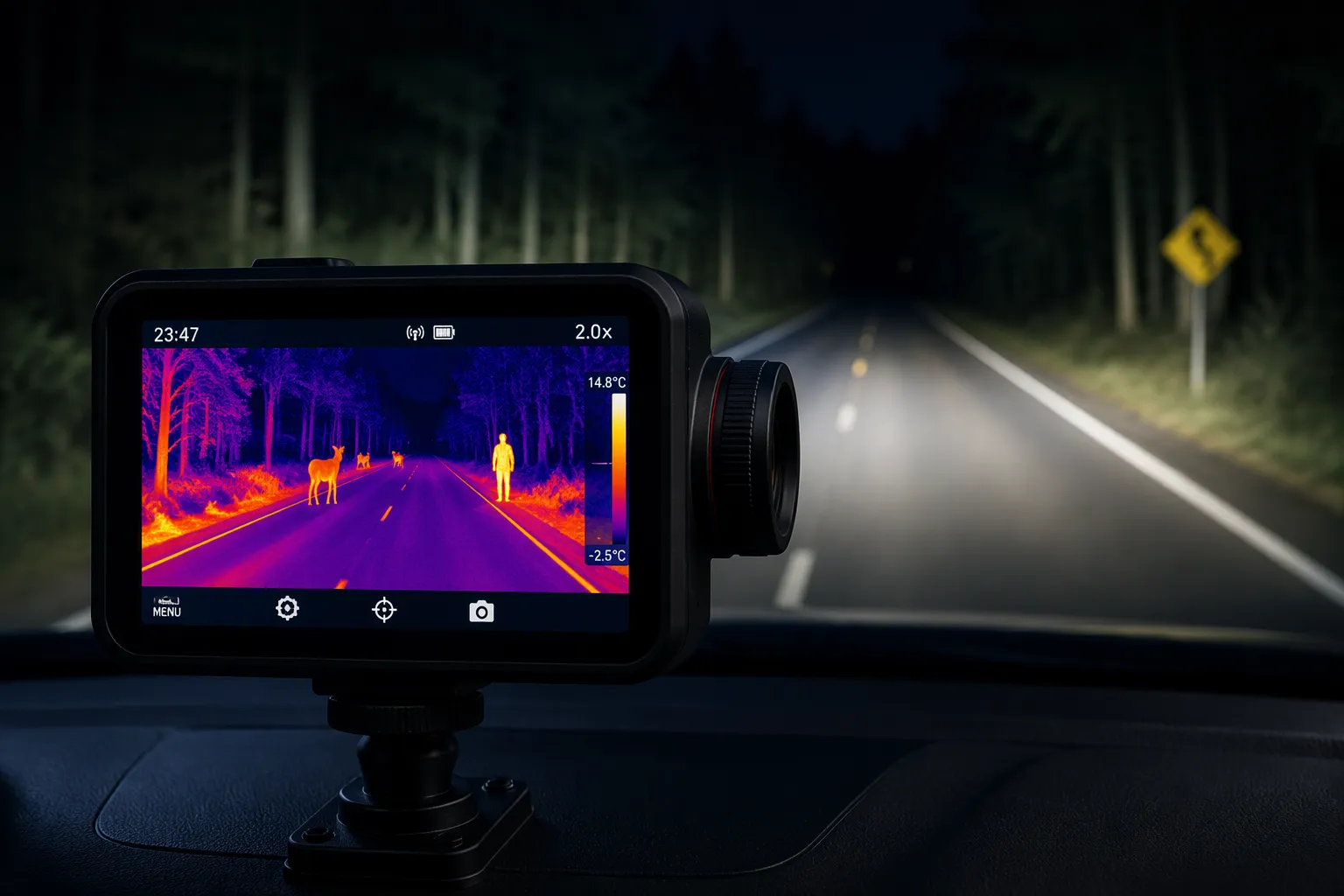
No single fov is best for every driver. A wide field of view supports urban night driving awareness, while a narrower one supports long-range highway detection, and each choice trades coverage against distance.
Picture a deer at the edge of the headlight beam on a dark rural road. A thermal imaging camera for cars can reveal that heat signature, yet the result depends on lens choice and test conditions, not on a spec sheet alone. Drivers who understand how a thermal camera performs at night, and how testers evaluate thermal cameras, can judge detection and recognition distance with confidence before they buy.
Key Takeaways
A wide FOV helps you see more around your car in cities, but a narrow FOV helps you see farther down the road.
Test a thermal camera at night on different roads to see how well it detects and recognizes warm objects.
Check both detection distance (when a warm shape appears) and recognition distance (when you can tell what it is) in test results.
Choose a camera FOV that matches where you drive most—city, highway, or mixed—to get the best warning.
Ask for a demo after sunset to see how the camera performs in real conditions before you buy.
FOV Basics for Thermal Imaging Cameras for Cars
Reading the FOV Spec
Field of view describes the angular coverage of the lens. A thermal imaging camera for cars with a wide angle sees more of the road ahead, and a narrow angle sees less area at greater distance. Focal length and FOV angle work as a pair. A shorter focal length widens the view, and a longer focal length narrows it. Together they set the imaging effect, the target recognition rate, and the temperature measurement accuracy of the system.
Buyers should read horizontal and vertical fov as two separate numbers. The horizontal fov governs how much roadside a driver sees, and the vertical figure governs how much road surface and skyline the frame captures. A 24-degree horizontal fov is one common long-range option, and wider lenses sit at the other end of the range.
A thermal camera does not depend on visible light. It reads emitted heat, so a thermal imaging camera for cars works at night, in glare, and in poor illumination. Illustrative specs show the pattern: a 640×512 resolution sensor in a compact IP6K9K package, with netd sensitivity of 20mK or better. Lower thermal sensitivity values keep warm objects distinct in a night-road scene.
Wide vs. Narrow FOV
Wide horizontal fovs favor awareness. An automotive thermal camera with a broad view covers crosswalks, curbs, and side streets in one frame. Urban drivers gain early warning of pedestrians and cyclists at the edge of the beam.
Narrow lenses favor distance. A thermal camera with a tight angle resolves a heat signature far down the lane, which suits highway speeds and rural roads. The trade-off is real: a narrow lens loses peripheral coverage, and a wide lens shortens reach.
Most thermal cameras for cars sit between these poles. Drivers should pick the fov that matches their dominant route, then confirm the choice with test data. Thermal cameras for cars vary widely, and the lens spec alone never tells the full story.
How FOV Affects Night Performance
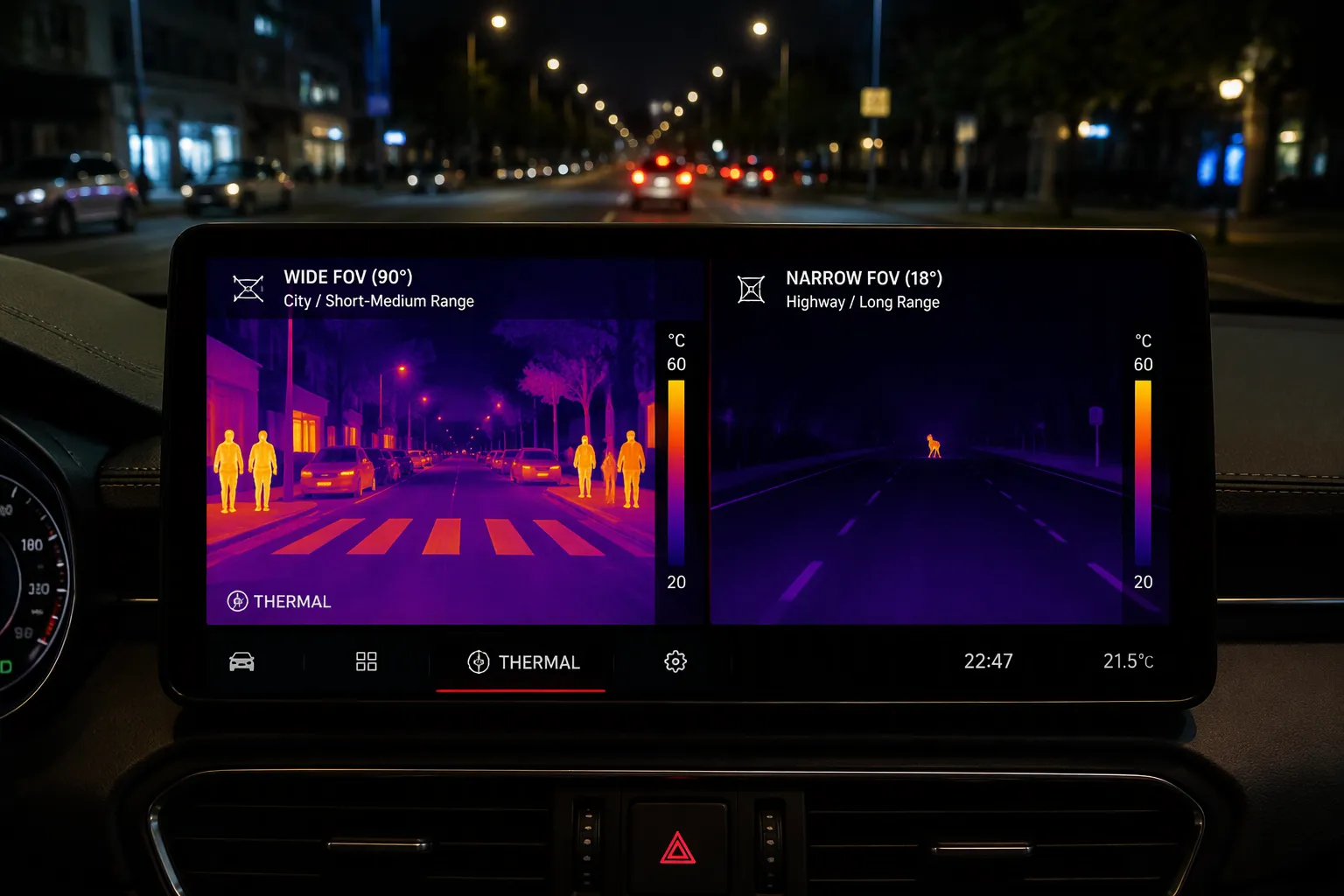
Lens choice changes what a driver sees first and how much time remains to react. A thermal imaging camera for cars turns heat into a visible scene, and the fov decides how that scene is framed. Two cameras with identical sensors can deliver very different results on the same dark road.
Wide FOV: Urban Awareness
A wide fov captures more of the scene in a single frame. The camera sees sidewalks, crosswalks, parked cars, and side streets at once. Urban drivers benefit most from this coverage. Pedestrian detection improves at the edges of the frame, where people step out between parked vehicles or wait at a corner. An automotive thermal camera with a broad view gives the driver earlier notice of a heat signature at the periphery.
The cost is reach. A wide lens spreads its pixels across a larger area, so a distant object occupies fewer pixels and appears smaller. Thermal cameras with wide optics therefore reveal nearby hazards well and distant ones less clearly. Drivers who spend most of their time in city traffic accept this trade willingly.
Narrow FOV: Long-Range Detection
A narrow lens concentrates pixels on a smaller slice of road. A thermal camera with a tight angle resolves a warm object far down the lane, which matters at highway speed. The driver gains seconds of warning instead of a fraction of one. Rural roads and unlit highways reward this reach, and pedestrian detection at long range becomes practical rather than theoretical.
Coverage shrinks in exchange. A narrow field of view misses the roadside and the adjacent lane. Thermal cameras built for distance need a disciplined scan pattern from the driver, and they suit routes with predictable geometry.
Neither design wins outright. Thermal cameras serve different missions, and the right pick depends on where the vehicle spends its nights. One aftermarket example, the VERYTek long-wave infrared system, pairs an externally mounted thermal camera with a 5-inch or 7-inch display and offers 256 × 192, 384 × 288, and 640 × 512 sensor options, plus AI recognition of pedestrians, vehicles, and animals. Its performance still depends on the chosen lens, weather, and thermal contrast, and the system assists the driver without operating braking or steering.
A useful check is the horizontal fov figure on the datasheet. Compare it against the driving environment, then confirm the choice with night-road testing. Thermal imaging rewards that discipline.
Night-Road Testing Methods
A spec sheet lists a lens angle and a sensor format. It does not show how a thermal camera behaves when a warm body appears at the edge of the beam. Testers therefore run two complementary programs: controlled track work and real-road driving. Each method stresses the hardware in a different way.
Controlled Track Tests
A closed track removes traffic and weather variables. Testers place known targets at measured distances and repeat each pass under identical conditions. Typical targets include pedestrian dummies, animal silhouettes, and roadside objects such as rocks and trees. Field tests show that thermal cameras detect heat signatures from these objects in complete darkness, even when headlights reveal nothing.
Repeatability is the point. The same target, the same distance, and the same camera setting produce a result another lab can reproduce. Testers record the distance at which the target first appears as a heat signature, then the distance at which an observer identifies it. They repeat the run across sensor options and lens choices. A 640 × 512 sensor and a 256 × 192 sensor will not score the same, and the track exposes that gap cleanly.
Track work also isolates pedestrian detection. A dummy steps from a fixed position at a fixed moment, and the test measures how early the display shows the warm shape. Thermal imaging rewards this discipline because the background stays constant.
Real-Road Tests
Public roads add the conditions a track cannot supply. Oncoming headlights create glare that saturates a visible-light camera but leaves a thermal camera unaffected. Curves hide targets until the last moment, and mixed traffic fills the frame with warm engines, exhaust plumes, and people. Testers drive fixed routes at night and log every event.
These conditions stress the system differently. A wide lens proves its worth in a busy street, where side streets and curbs matter. A narrow lens proves its worth on an unlit highway, where reach matters. Glare, rain, and fog change thermal contrast, and nighttime lighting conditions shift how much the driver relies on the display. Real-road runs reveal how the performance holds up over an hour of driving, not one clean pass.
Neither method outranks the other. Track tests give numbers a buyer can compare. Road tests show how those numbers feel behind the wheel. An automotive thermal camera that scores well on both earns trust.
One aftermarket reference is the VERYTek long-wave infrared system, which pairs an externally mounted thermal camera with a 5-inch or 7-inch display. The manufacturer lists 256 × 192, 384 × 288, and 640 × 512 sensor options, plus AI recognition of pedestrians, vehicles, and animals, adjustable warning zones, and recording. Buyers must confirm lens, defrost, and vehicle fitment for the chosen configuration. The system assists the driver and does not operate braking or steering.
Reading Test Results
Detection vs. Recognition Distance
Test reports use two distances, and drivers often confuse them. Detection distance marks the point where a warm shape first appears on the display. Recognition distance marks the point where the driver can name that shape as a person, a deer, or a parked car. The gap between the two numbers carries real safety weight.
A long detection distance gives the driver time to lift off the throttle. A long recognition distance gives the driver time to decide. Thermal detection, recognition, and identification form a chain, and a system that detects early but recognizes late leaves the driver guessing at highway speed. Testers log both figures for each target type, and pedestrian detection scores usually fall shorter than vehicle scores because a walking figure presents a smaller heat profile.
Matching Results to Driving Patterns
The biggest number on a test sheet does not always serve the buyer. A city driver needs strong near-field recognition at crosswalks and intersections. A highway driver needs detection distance measured at speed, where a few extra seconds of warning matter more than peripheral coverage. Buyers should compare results from the route type they actually drive.
Configuration matters as much as the score. Weather, thermal contrast, and lens selection all shift the outcome, so a claim means little without a stated setup. VERYTek lists 256 × 192, 384 × 288, and 640 × 512 sensor options for its aftermarket long-wave infrared system, and each option pairs with a specific lens and display. Buyers should confirm lens, defrost, and vehicle fitment for the chosen build, and treat the system as a driver aid that does not operate braking or steering.
A practical rule: read the fov, read the detection distance, then check the test conditions. Thermal cameras that publish all three let a buyer judge fit honestly. Thermal cameras that publish only a headline figure invite doubt.
Aftermarket Thermal Camera Installation Positions
Aftermarket Thermal Camera Installation
No single spot fits every vehicle. The right aftermarket thermal camera installation positions depend on vehicle geometry, target distance, camera fov, road contamination, vibration, and the role of the night vision system. A tall SUV and a low sedan present different sight lines. A system built for pedestrian warning near the bumper needs a different view than one built for highway reach.
Mounting position changes the effective fov, and that change shapes real-world performance. A camera tilted too far down shortens detection distance. A camera set too high loses near-field coverage. Installers should treat aftermarket thermal camera installation as an optical decision, not a bracket decision. Good aftermarket thermal camera installation starts with a mock fit, then a road check.
Thermal Camera Mounting Factors
Thermal camera mounting begins with camera height, pitch, yaw. These three settings decide where the frame lands on the road. Thermal camera mounting also must survive vibration, rain, and road spray. A loose bracket blurs the image, and a dirty lens hides warm targets.
The best thermal camera mounting location for an suv often sits behind the grille or near the front bumper. That thermal camera position for suvs keeps the lens low and close to the road. A thermal camera position on the roof suits long-range work, yet it collects more contamination. Each thermal camera position trades coverage against exposure.
Drivers planning an automotive thermal imaging camera retrofit should request vehicle-specific mounting guidance. A thermal imaging camera retrofit rewards careful planning, and an automotive thermal camera retrofit should end with a road test to calibrate the final fov. Thermal cameras need a clean lens and a firm mount. Thermal cameras also need a stable power path, and thermal cameras perform best when the installer documents every setting.
Board-level quality supports that hardware. VeryPCBA is a custom PCB assembly manufacturer serving automotive electronics, offering component sourcing, PCB assembly, functional testing, and X-ray inspection. That work stands as one example of the manufacturing support behind automotive camera modules.
Choosing the Right FOV
City, Highway, and Mixed Use
Drivers should start with the route they drive most. A city commuter needs a wide fov that covers crosswalks, curbs, and side streets. A highway driver needs reach, where a warm shape appears far down the lane. Mixed-use drivers face a compromise, and they should weight the choice toward the environment where a missed target carries the highest risk.
One available example is the VERYTek aftermarket long-wave infrared night-vision system. It pairs an externally mounted thermal camera with a 5-inch or 7-inch display. Camera options include 256 × 192, 384 × 288, and 640 × 512 resolutions, plus AI recognition of pedestrians, vehicles, and animals, adjustable warning zones, and recording. Buyers should treat this as one option among several and confirm lens, defrost, and vehicle fitment for the chosen configuration. The system assists the driver and does not operate braking or steering.
Demo Before You Buy
A showroom spec sheet cannot show how a thermal camera feels on a dark road. Drivers should request a demo or test drive after sunset. They can watch how early a warm shape appears, how quickly they recognize it, and whether the frame covers the hazards on their own route.
Detection claims mean little without a defined configuration and test method. Weather, thermal contrast, and lens selection all shift results, so a headline figure deserves scrutiny. A demo lets a buyer judge an automotive thermal camera against real conditions. The same discipline applies to any thermal imaging camera retrofit: test first, then commit.
A wide fov buys urban awareness, and a narrow one buys highway reach. Track tests quantify that trade-off, and real-road runs show how it feels after dark.
Drivers should match the lens to their dominant route. Detection and recognition distances from a defined test setup decide the purchase, not a headline claim. Installation position shifts the effective fov, so plan the mount before the order.
Thermal cameras reward evidence. Thermal camera buyers should book a demo after sunset and judge the view firsthand.
FAQ
Does a wider FOV always improve night driving safety?
No. A wide lens improves awareness at crosswalks and curbs, yet it shortens reach down the lane. Drivers gain near-field coverage and lose distant warning. The better choice depends on the route, not on the angle alone.
Can a driver compare detection claims across brands?
Only when each claim states its configuration and test method. Weather, thermal contrast, and lens selection all shift the result. A headline figure without a defined setup tells a buyer very little.
Which sensor resolution suits a first thermal camera?
Resolution sets how much detail the display shows at distance. VERYTek lists 256 × 192, 384 × 288, and 640 × 512 options for its aftermarket long-wave infrared system, and each pairs with a specific lens. Buyers should confirm lens, defrost, and vehicle fitment, and treat the system as a driver aid that does not operate braking or steering.
Does mounting height change the effective FOV?
Yes. Camera height, pitch, and yaw decide where the frame lands on the road. A mount set too high loses near-field coverage, and one tilted too far down shortens detection distance. Installers should mock-fit the bracket, then run a road check.
Do thermal cameras work in rain and fog?
They read emitted heat rather than visible light, so glare and darkness do not blind them. Rain and fog still reduce thermal contrast, and road spray can dirty the lens. A clean lens and a firm mount keep performance steady.
See Also
Choosing Automotive Thermal Cameras: Resolution, Field Of View, Interface Options
Top AI Thermal Cameras For Vehicle Night Vision Systems
AI Vehicle Thermal Cameras For Clear Vision In Dark Mines
Automotive Thermal Camera OEM Suppliers: B2B Engineering Checklist Guide
How To Choose High Resolution Thermal Cameras For OEM ODM Projects