
AHD and RS485 work together; they are not competitors. AHD sends the night vision vehicle camera video signal over coaxial cable. RS485 handles camera control and system integration. The better choice depends on your fleet type, your existing wiring, and your integration needs.
You can judge any setup in three ways: technical performance, application fit, and pilot procurement discipline. A long-haul fleet needs different priorities than a mixed fleet with legacy coax. This article ends with a clear recommendation framework, so you can decide without overspending or disrupting operations.
Key Takeaways
AHD sends video with very little delay. RS485 takes care of camera control and system integration. Use both together to get the best results.
Pick the camera technology that fits your fleet type and the wiring you already have. Long-haul trucking needs video with low delay. City delivery needs cameras that are small and tough.
Try a pilot with two or three units for each vehicle type. Test night clarity, delay, and false alerts on your real routes.
Check that the power range (9–24V) and the sealing (IP67) will work for you before you buy. These features ensure reliable performance in tough conditions.
Think about the full cost, not just the price of one unit. Setup, upkeep, and support all add to the total expense.
Night Vision Vehicle Camera: AHD vs. RS485
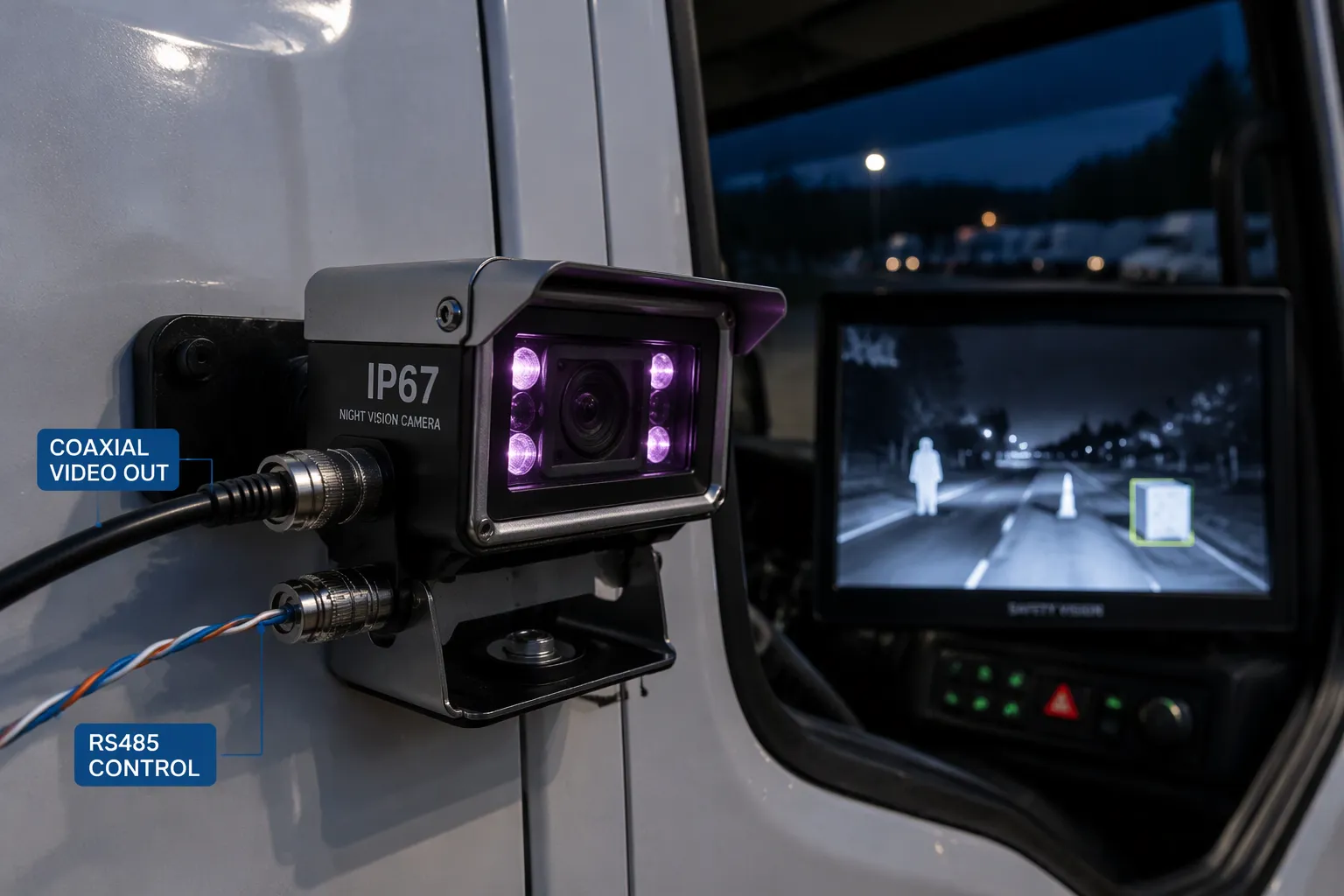
Signal, Latency and Low-Light Performance
AHD is a high-definition analog video standard. It sends video over coaxial cable. This gives you simple wiring, very little delay, and an easy upgrade wherever coax already runs through the vehicle. A night vision vehicle camera built on this standard sends images straight to the monitor with almost no processing delay.
RS485 is a different layer. It is a differential serial bus used for camera control, rs485 ptz commands, and telemetry. It usually works together with AHD or IP video instead of replacing it. Think of the two as one signal-and-control chain, not as either/or substitutes.
Practical differences matter at installation. Coax runs handle interference well and support long cable paths. RS-485 twisted pairs resist electrical noise across mixed 9–24V systems. Upgrade paths differ too: analog AHD or RTSP/ONVIF platforms each accept different head units, so check your recorder first.
Low-light performance depends on the sensor, not the transmission standard. Sensor sensitivity, IR illumination, noise handling, and exposure control drive image quality at night. A well-tuned sensor on an ahd video input can beat a weak sensor on a digital link.
Reliability and Power Compatibility
Reliability comes from the housing and the harness. Look for IP67 sealing against dust and water. Check vibration tolerance for rough routes. Verify stable signal over long vehicle harnesses, because voltage drop and connector quality affect both video and control lines.
Power compatibility deserves early attention. Mixed fleets run 9–24V electrical systems, and every camera, DVR, and control module must accept that range without extra converters.
For commercial integration, keep the video feed separate from the machine-readable detection data. Specify the receiving display and the data your warning terminal needs. One example is the VERYTek TA Series: on-camera pedestrian and vehicle detection, an AHD video output with 720p at 25 Hz as the default, and a separate RS485 interface for detection-related distance information. Its product page lists a 9–24 V DC input and an IP67 housing. Do not mistake AHD video resolution for native thermal sensor resolution. Ask for interface details and test samples before you commit an ahd or ip camera to a fleet rollout.
Application Fit for Fleets
Trucking, Delivery and Mining Use Cases
Long-haul trucking works best with low-delay video. An ahd feed gets to the driver monitor with almost no wait, so the driver sees dangers right away and the recorder saves the same frame. You team that feed with rs-485 for camera control and alert-system hookup. A gps 4g wifi truck camera then adds route details to the recording.
City delivery needs small, tough hardware. Many stops and tight turns call for small IP67 cameras with short cable runs. RS485-based switching lets the driver flip between inside and outside cameras without leaving the cab.
Mining and heavy commercial work need strong housings and 9–24V support. AI in-vehicle recognition chains use the camera feed and set off warnings. A dual-lens IR dashcam with ADAS and 4G/cloud connectivity is a good fit for this job.
Use case | Video priority | Control priority |
|---|---|---|
Long-haul trucking | Low-latency AHD to driver monitor | RS485 camera control and alerts |
Urban delivery | Compact IP67 cameras, short runs | RS485 switching between views |
Mining | Rugged housing, 9–24V input | AI alert chain integration |
Mixed Fleets and System Integration
Retrofits stick with the wiring you already have. Existing coaxial setup favors AHD, since you reuse the cable and skip a re-pull. RS485 control buses make it easier to coordinate many cameras across a mixed fleet.
Hooking up with DVRs, telematics, and AI alert platforms decides the setup. A mobile dvr or mdvr records the stream, and a fleet management system uses the metadata. Pick a vehicle mdvr cctv video recorder kit that takes your camera standard. A 4g ahd car mobile dvr kits bundle works for smaller vans, while a 4g gps hdd mdvr or sd card mdvr fits bigger builds. A video/audio ai mdvr adds detection on top of recording.
Roll it out by vehicle class in stages. Begin with the video vehicle truck cctv camera system on your highest-risk routes, then add the video vehicle truck cctv camera system dvr to the rest. Run one pilot before you commit the whole fleet, and make sure each fleets segment meets its own limits.
Pilot Procurement for Vehicle Camera Systems
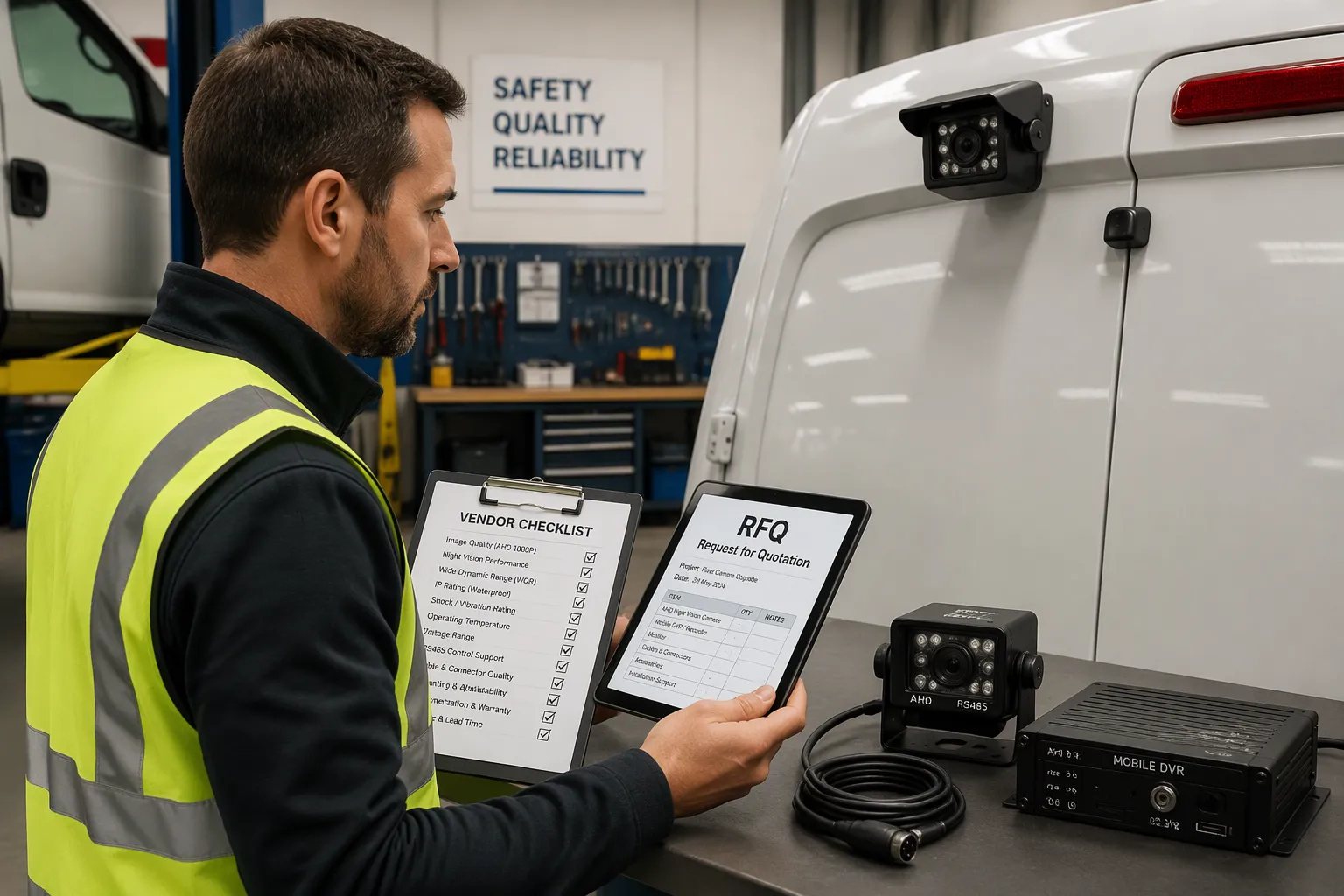
Pilot Planning and Vendor Selection
Begin by deciding what the pilot will cover. Make a list of the vehicle types in your fleet, the routes each one drives, and how much night driving each route has. Choose a realistic pilot number for each type. Two or three units per type give you useful data without using up too much money.
Make a vendor checklist before you send any request. The table below covers the basics.
Check | What to confirm |
|---|---|
Power | 9–24V works with all your vehicle types |
Sealing | IP67 rating for dust and water |
Signal | AHD video and RS485 control support |
Support | Fast technical help and spare parts in stock |
Send every vendor the same rfq and interface matrix. This document lists your camera count, cable runs, recorder model, and control needs. It keeps quotes easy to compare and shows gaps early.
Integrators who buy camera boards or assembled units need PCBA-level qualification. Ask for a design review that covers stack-up and materials. Agree on functional test steps and acceptance rules in writing. Require X-ray inspection for hidden solder joints, checking for voids, bridging, and missing connections. Write down the inspection scope at each build stage.
The VERYTek TA Series shows what a qualified unit looks like. It detects pedestrians and vehicles on the camera itself. It offers an AHD video output with 720p at 25 Hz as the default, plus a separate RS485 interface for detection-related distance information. Its product page lists a 9–24 V DC input and an IP67 housing. Do not mistake AHD video resolution for native thermal sensor resolution. Ask for interface details and test samples before you commit.
Testing Criteria and Cost Control
Set pilot acceptance rules before installation day. Test image clarity at night on your real routes. Measure the delay from camera to monitor. Track false-alert rates in any AI alert chain. Record installation time per vehicle and note the upkeep burden during the pilot.
Cost control starts with the full picture. Unit cost is only one line. Add installation labor, cabling changes, maintenance, and any technical support agreement. A cheap camera with a hard-to-fit harness can cost more than a premium unit that fits existing coax.
Set go/no-go limits for each criterion. A camera that fails night clarity on your worst route fails the pilot, whatever its price. Use the results to plan a rollout in stages by vehicle type. This approach protects operations and prevents overspending during fleet-wide procurement.
Treat the pilot as a decision tool, not a formality. Write down every result, compare vendors against the same criteria, and let the data guide your procurement. A careful pilot now saves you from a costly mistake across the whole fleet.
AHD sends HD video with very little delay. RS485 handles control and system integration. Most fleets do best by using both together in one signal-and-control chain.
Use a simple plan. Match the technology to your fleet type, your current wiring, and your environment needs like IP67 sealing and 9–24V input. Then confirm how the night vision vehicle camera feed will connect to your AI alert platform.
Test the choice with a structured pilot that has clear testing rules and cost limits. Compare recommended products and suppliers using the same data. This careful approach protects your procurement budget and keeps every vehicle rollout on schedule.
FAQ
Does a night vision camera need both AHD and RS485?
Yes, in most fleet setups. AHD sends the video to your monitor and recorder. RS485 sends control commands and integration data. Think of them as one chain. Your vehicle setup works best when both links match your recorder and your warning terminal.
Can I add night vision cameras to a fleet with existing coax?
You can reuse that coax. AHD runs over coaxial cable, so you skip a re-pull and cut installation labor. First, check each vehicle recorder for AHD input support. Then confirm the RS485 control bus reaches every camera position.
How many vehicles should a pilot cover?
Run two or three units per vehicle class. That sample gives you night-clarity and latency data without spending too much. Test on your worst night routes. A pilot on easy routes tells you little about real fleet performance.
What should I check before buying camera boards?
Ask for a design review of stack-up and materials. Agree on functional test steps and acceptance rules in writing. Require X-ray inspection for hidden solder joints. Confirm 9–24V input and IP67 housing. Request interface details and test samples before you commit.
How do I connect cameras to an AI alert platform?
Specify two things separately: the video feed for your display and the machine-readable detection data for your warning terminal. The VERYTek TA Series shows this split. It detects pedestrians and vehicles on-camera, sends AHD video at 720p and 25 Hz by default, and passes detection distance data over a separate RS485 interface. Do not confuse AHD video resolution with native thermal sensor resolution.
See Also
Top AI Thermal Cameras for Vehicle Night Vision Systems
AI Vehicle Thermal Cameras for Clear Vision in Dark Mines
Car Thermal Imaging Cameras: FOV and Night-Road Performance Testing
Automotive Thermal Imaging Camera: Resolution, FOV and Interface Selection Guide
Automotive Thermal Camera OEM Suppliers: B2B Engineering Checklist