
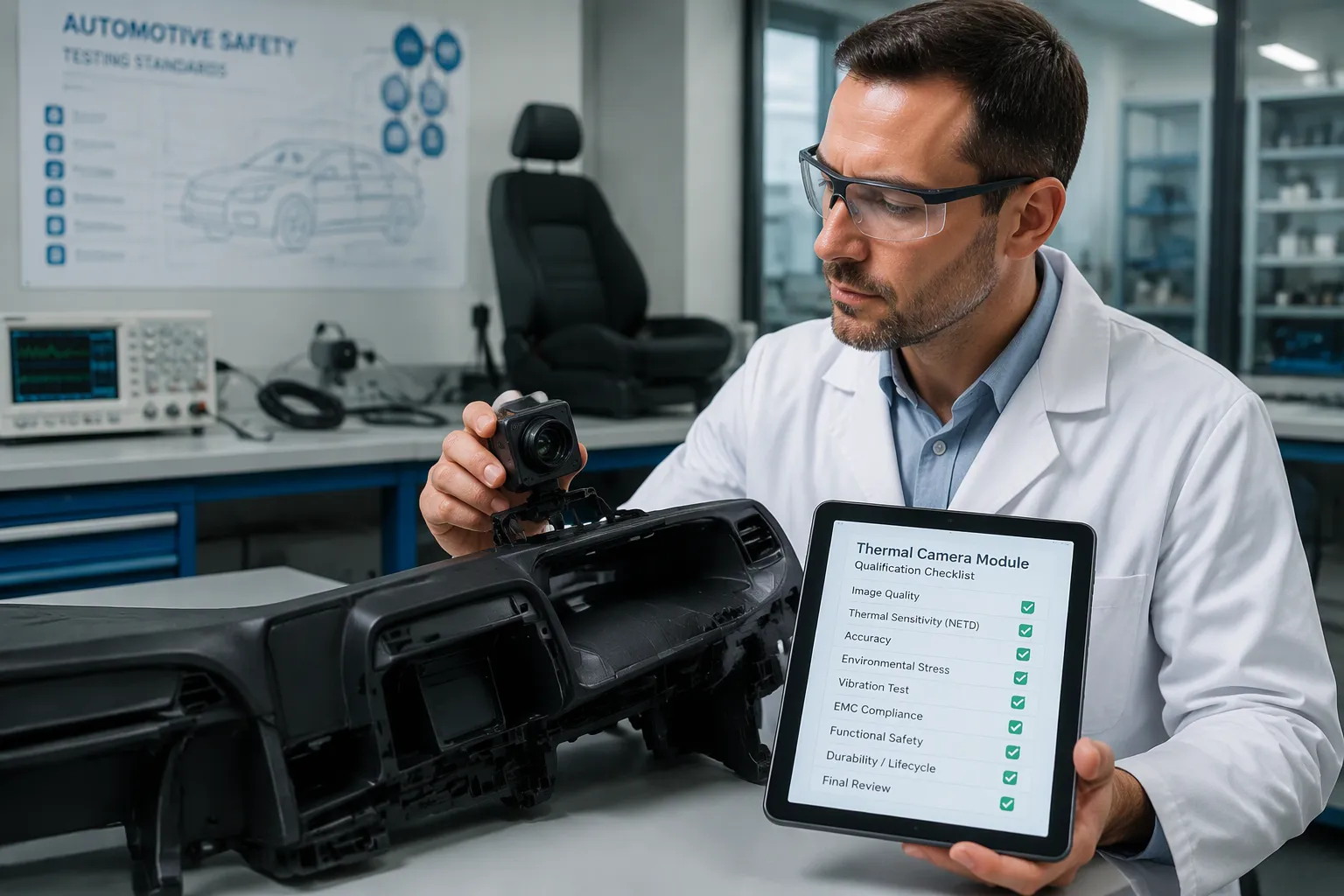
A thermal camera meets ISO 26262 only when a supplier builds it as a Safety Element out of Context (SEooC). That work must produce a written ASIL capability claim, a safety manual, an FMEDA, and assessment evidence. Claims on a datasheet alone prove nothing.
You face three decisions. First, what the standard really requires of a camera. Second, what evidence you must ask each vendor for. Third, how to compare shortlisted suppliers on equal terms.
This post gives you a practical qualification and specification checklist for your RFQs and vendor audits. Use it to determine what thermal cameras meet ISO 26262 automotive safety standards. Use it to hold every automotive OEM and OEM supplier to the same safety proof before you sign.
Key Takeaways
Ask for a written ASIL claim. It should name the safety function and the assumed operating conditions.
Get the complete safety document package. It should include the safety manual, FMEDA, assessment report, and IATF 16949 certificate.
Make sure the camera you buy is the same one that passed validation, and check that it has lifecycle support.
Compare vendors by the total cost of compliance, not just the unit price. Treat any missing documents as gaps.
Use the same proof rule for every vendor: if there is no automotive-grade paperwork, there is no certification claim.
What Thermal Cameras Meet ISO 26262 Automotive Safety Standards
ASIL Levels and Camera Claims
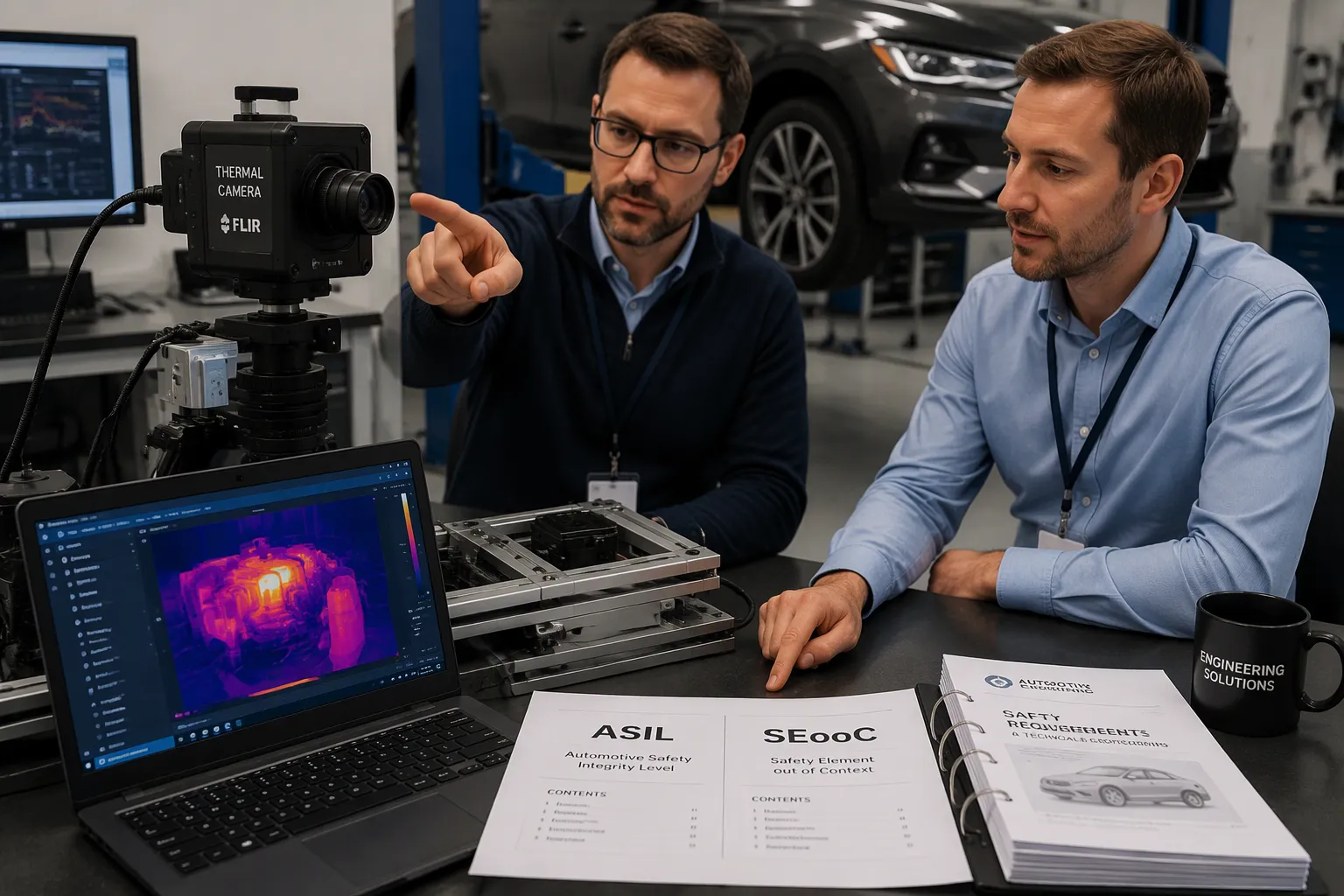
The standard defines four Automotive Safety Integrity Levels, from ASIL A to ASIL D. ASIL D has the strictest requirements. A camera does not hold an ASIL rating by itself. The supplier assigns an ASIL capability to each safety function the camera performs. That claim must match your hazard analysis.
Many thermal camera programs aim for an ISO 26262 ASIL-B minimum for the sensing channel. That target fits a camera that supports a driver warning or a backup perception path. It does not fit a camera that commands braking on its own. You must confirm the claimed level covers the exact function you plan to rely on. A vendor that says “ASIL-B ready” without naming the function gives you nothing to audit.
Ask for the claim in writing. The document should name the safety goal, the ASIL, the assumed operating conditions, and the assumptions your system must satisfy. Treat any mismatch between that claim and your vehicle-level hazard analysis as a gap. You must close that gap before design freeze.
The SEooC Development Model
A camera is rarely developed for just one vehicle program. So suppliers build it as a Safety Element out of Context. Under this model, the supplier assumes a set of safety requirements. Then the supplier develops the camera against them and documents those assumptions for integrators.
The SEooC path produces four artifacts you should demand. First, a safety plan that shows how the supplier managed functional safety across the lifecycle. Second, a safety manual that lists the assumptions of use, the diagnostic coverage, and the integration rules. Third, an FMEDA that measures failure modes and their detection. Fourth, an independent assessment report that confirms the work meets the standard.
The model shifts work onto you. You must verify that your system satisfies every assumption in the safety manual. A camera qualified for a defined temperature range, supply tolerance, and mounting orientation loses its claim outside those limits. Read the assumptions as binding constraints, not as marketing caveats.
Published supplier activity shows this model in practice. Valeo and Teledyne FLIR announced in January 2024 that they had secured a contract from a global vehicle OEM in late 2023 for automotive thermal imaging. Teledyne FLIR separately describes an ASIL-B-focused automotive product line. Imagry announced thermal-camera integration with ADASKY in January 2025. These are third-party projects, not certifications you can inherit. They show that documented automotive integration exists in this category. Your job is to request the same class of evidence from every shortlisted vendor. That includes an explicit scope statement for ISO 26262.
The answer to what thermal cameras meet ISO 26262 automotive safety standards therefore depends on documentation, not on the sensor inside the housing. Two cameras can share a detector and still differ completely in their safety case. Judge the file, not the spec sheet.
Automotive Qualification and Documentation Package
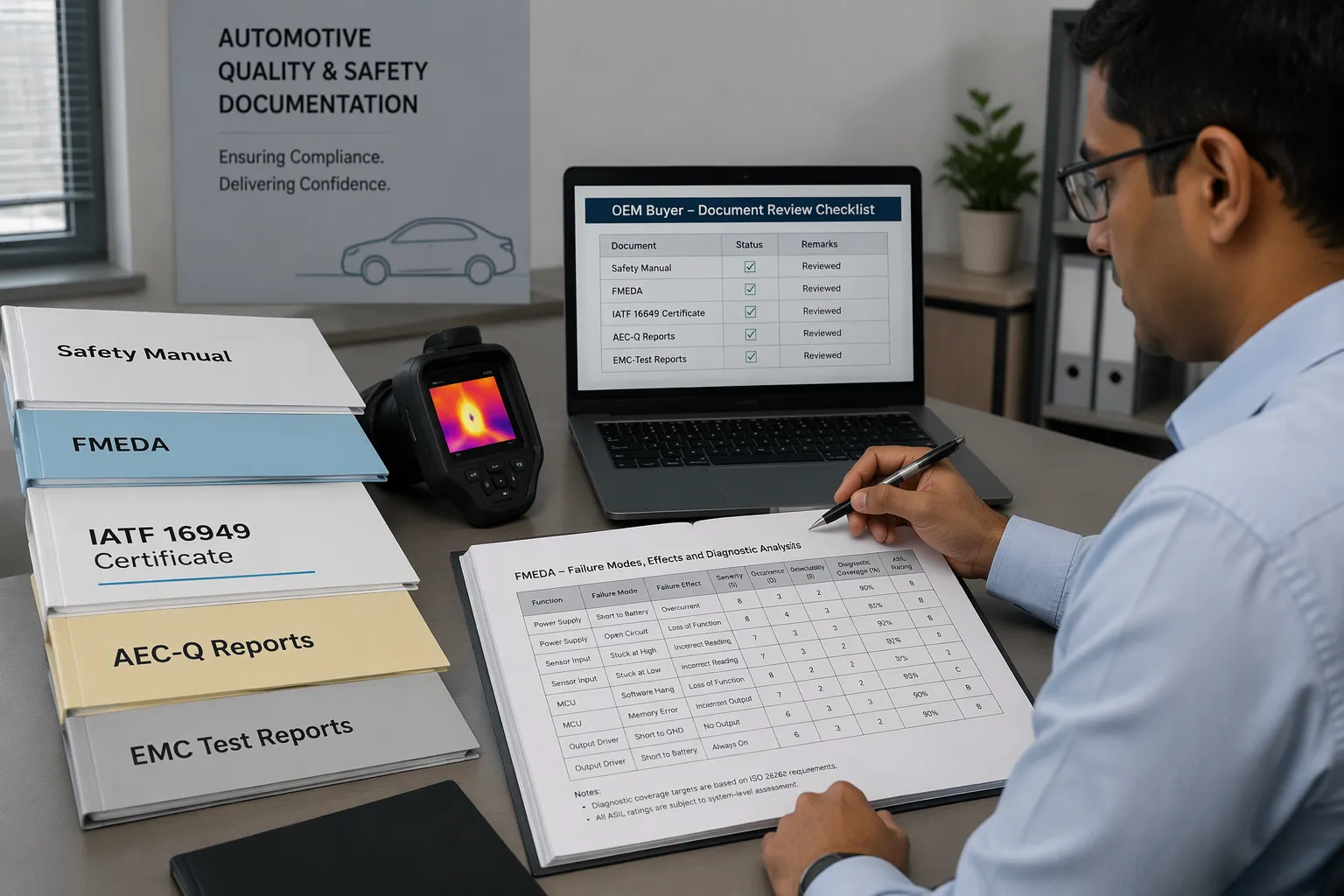
A safety claim is worthless if there is no file to back it up. You need to gather that file before you put a camera on your shortlist. The package below covers the main documents. Each item answers a specific question in your review.
Document | What it proves |
|---|---|
Safety manual | The assumptions of use and integration rules |
FMEDA | Failure modes, rates, and diagnostic coverage |
IATF 16949 certificate | The quality system scope covers automotive electronics |
AEC-Q reports | Component stress-test results |
EMC test reports | The camera meets the emission and immunity limits you specify |
Hardware Metrics and FMEDA Evidence
The FMEDA is the core of the hardware case. It lists each failure mode, its failure rate, and the diagnostic coverage your design achieves. The supplier uses these numbers to work out the hardware architectural metrics the standard requires. Ask for the FMEDA in a format you can audit. A summary table with no failure-rate sources gives you nothing to check.
Make sure the FMEDA matches your use case. Diagnostic coverage depends on how the camera is integrated. A watchdog the supplier assumes in the camera firmware may sit in your domain controller instead. Any assumption you cannot meet becomes a gap in your safety case.
Software Safety Manual and QMS Scope
The safety manual carries the software side. It should state the functional safety requirements the camera assumes, the diagnostic routines it runs, and the integration steps you must follow. Read it as a contract. Every assumption is a constraint on your design.
Check the quality management system next. Request the IATF 16949 certificate and confirm the scope covers design and manufacturing of automotive electronics. A certificate for a different site or a different product family does not support your automotive qualification.
Buyers increasingly group nearby standards into the same review. ISO 21448 addresses SOTIF, the performance limits that cause unsafe behavior without a fault. UN R155 covers cybersecurity compatibility. Ask how the camera supports both.
Many suppliers now offer a functional safety qualification kit. This kit bundles the safety manual, FMEDA, assessment report, and integration guide into one package. Request it as a single deliverable. A kit you can hand to your assessor shortens your compliance review and exposes gaps early.
Interfaces, Mass Production, and Lifecycle Validation
Validation, PPAP, and Traceability
A safety case falls apart when the camera you buy in large numbers is not the same as the camera that passed validation. You need proof that the design you get is the design that was tested. Ask for the Production Part Approval Process file. That file shows the supplier tested the part on the real production line, using the real tools and test stations.
Interface evidence matters just as much. Ask for the interface control document for power, data, and mounting. Make sure the camera meets your EMC limits with the harness length and grounding you plan to use. Plan system-level validation on your own bench, not only on the supplier’s. Run compliance testing against the limits in your specification. Record every result against the part number and software version you will release.
Good traceability records tie the whole chain together. Each camera serial number should link to its test records, its firmware version, and its component lot. That link lets you contain a defect fast during a field campaign. Without traceability, a recall turns into a recall of the whole population.
Supplier Safety Culture and Lifecycle Commitments
A qualification is a single point in time. A vehicle program runs for years. You need a supplier who will still support the safety case long after launch.
Ask how the supplier handles change. Any firmware update, part swap, or process change can make the safety analysis invalid. The supplier should tell you before the change and reissue the affected documents. Ask for a written promise on notice timing and on document revision control.
Ask about lifecycle support. Make sure the supplier will provide the camera, or a qualified replacement, for your full production and service period. Ask who owns the safety case after launch and who answers your assessor’s questions. A supplier with a named functional safety manager and a strong safety culture answers those questions directly. A supplier who sends them through sales does not.
Key Buying Criteria for Shortlisted Cameras
Performance, Application Fit, and Compliance Trade-offs
No single ranking works for every program. Instead, give each criterion a weight based on how critical your application is. A high-ASIL perception function with a long lifecycle and high volume puts different criteria at the top than a low-volume warning feature does.
Use a neutral framework to compare options side by side. Score each vendor on the same rows, then apply weights that reflect your program.
Criterion | What to weigh | Fits best when |
|---|---|---|
ASIL capability claim | Documented level and named safety function | The function sits on a critical path |
Detection range and resolution for your scene | Long-range or bad-weather sensing matters | |
Integration effort | Interface control document quality and harness assumptions | Your team has little safety engineering time |
Lifecycle support | Change notice terms and service period commitment | Production runs for many years |
Volume readiness | PPAP maturity and line traceability | You plan high unit volumes |
A camera with a strong claim but weak lifecycle terms fits a short program poorly. A camera with modest performance but a complete file fits a warning feature well. Match the option to the job.
Total Cost of Compliance and Gap Avoidance
Price per unit tells you little. Total cost of compliance covers the engineering hours you spend closing documentation gaps, the validation you rerun, and the schedule slip a missing artifact causes. A cheaper camera with an incomplete file often costs more once you pay for the gap work yourself.
Ask each vendor to price the full package. Include the safety manual, FMEDA, assessment report, and interface evidence. A qualified manufacturer answers item by item. A vendor that dodges questions on component compliance or supply risk adds hidden cost to your program.
Weigh supply risk against volume and lifecycle length. A single-source camera with a thin change-notice process threatens a long program more than a short one. Confirm the vendor will keep automotive-qualified modules available through your service period. Treat every unanswered checklist item as a cost line, not a footnote. This habit turns the key buying criteria into a strong decision your assessor can review.
Evidence Rules Before Any Certification Claim
What Counts as Automotive-Grade Proof
State the rule clearly and follow it every time: no automotive-grade paperwork means no certification claim. A logo, a press release, or a verbal promise does not count. Only a document package you can give to your assessor counts as proof.
Automotive-grade proof always has the same parts. It includes a safety manual with assumptions of use, an FMEDA with sourced failure rates, an assessment report, and a quality system certificate that covers automotive electronics. Add AEC-Q stress results and EMC reports that match your limits. Each item must name the part number and the software version you plan to release. Traceability links those records to the units you receive.
Testing evidence belongs in the same file. A supplier who ran validation on a different build, harness, or firmware version gives you a claim you cannot defend. Ask for the test report, the setup it covered, and the pass criteria. Treat any missing item as an open gap, not a small detail.
Applying the Rule to Vendors Like VERYTEK
Apply the same rule to VERYTEK. Until VERYTEK provides automotive-grade paperwork, you cannot treat its products as certified for a safety-critical program. That statement is about evidence, not about ability. Ask for a clear ISO 26262 scope, functional-safety documents, component qualification records, and interface evidence before you shortlist the camera.
Board-level suppliers such as VeryPCBA can help your safety case with manufacturing evidence. That evidence includes stack-up review, X-ray inspection of hidden solder joints for voids, bridging, and missing solder, and agreed functional test pass criteria. This material supports compliance work at the board level. It does not replace camera-level ISO 26262 evidence.
Third-party activity shows the kind of evidence to expect. Valeo and Teledyne FLIR announced a global OEM contract in late 2023, publicized in January 2024. Teledyne FLIR describes an ASIL-B-focused automotive product line. Imagry announced thermal-camera integration with ADASKY in January 2025. These facts describe those suppliers. They are not certifications or customer wins for VERYTEK, and you should not read them that way.
Follow one order for your qualification:
Get the SEooC and ASIL claim in writing.
Gather the document package: safety manual, FMEDA, IATF 16949 scope, AEC-Q and EMC reports.
Check validation and lifecycle promises.
Compare vendors using your key buying criteria and total compliance cost.
Keep one rule the whole time: no automotive-grade paperwork, no certification claim. That rule applies to every vendor, including VERYTEK, until it provides that evidence.
Now adapt this specification checklist for your next RFQ. Ask each vendor to answer every line item in writing, and treat silence as a gap.
FAQ
Does a datasheet ASIL claim prove a camera is ISO 26262 qualified?
No. A datasheet claim is just a statement, not proof. Ask for the safety manual, the FMEDA, and the assessment report. Each document must name the safety function and the ASIL level. You cannot audit a claim that names no function. Treat a claim with no proof as an open gap.
Which documents belong in a vendor’s functional safety kit?
Ask for the safety manual, the FMEDA with sourced failure rates, the independent assessment report, and the IATF 16949 certificate with an automotive electronics scope. Add AEC-Q stress results and EMC reports that match your limits. Ask for one bundled package you can hand to your assessor.
How do I judge what thermal cameras meet ISO 26262 automotive safety standards?
You judge the file, not the sensor. Confirm the SEooC assumptions, the named ASIL capability, and the traceability from test records to released part numbers. Third-party integration examples exist, such as the Valeo and Teledyne FLIR OEM contract announced in January 2024 and Imagry’s January 2025 ADASKY integration. Those examples describe other suppliers, not your vendor.
Can board-level manufacturing evidence replace camera-level safety proof?
No. Stack-up review, X-ray inspection of hidden solder joints, and agreed functional test criteria support the board-level case. They do not take the place of camera-level ISO 26262 evidence. Use them as backup material inside a larger safety case.
What should I require before I shortlist a camera?
Require a written ISO 26262 scope, the full document package, PPAP maturity, and lifecycle commitments. Ask how the camera supports ISO 21448 and UN R155. Then compare vendors on your weighted criteria and total compliance cost. Silence on any line item counts as a gap, not a pass.
See Also
Automotive Thermal Camera OEM Suppliers: Essential B2B Engineering Checklist Guide
Choosing High Resolution Thermal Imaging Camera Manufacturers for OEM ODM Projects
Key Factors Driving Thermal Camera Module Pricing for OEM Bulk Buyers in 2026
Thermal Camera Modules for Drones: A Complete UAV OEM Selection Guide
Car Thermal Camera Wholesale Guide for Distributors: Sourcing Strategies Explained