
The right resolution for a marine thermal imaging camera depends on how and where you use it. As a general rule, pick 256×192 for close-range scanning. Choose 384×288 as the practical balance for most marine users. Go with 640×512 for long-range detail and identification.
Several factors shape that choice. Image detail and detection range set the baseline. Lens choice and NETD then refine real-world performance. Regulatory compliance and cost complete the picture. Weigh these factors against your typical operating distance, and the correct resolution becomes clear.
Key Takeaways
Pick 256×192 if you need to scan things up close and want to save money.
Choose 384×288 as the best balance for most marine users.
Choose 640×512 for long-distance identification and professional use.
Pick the lens that fits how far away you usually look, so it works its best.
Think about the total cost of the whole system before you buy. This includes the display and the mounting.
What Thermal Sensor Resolution Means
Pixel Count and Image Detail
A thermal sensor works like a grid of tiny heat detectors. Each detector is one pixel. The pixel count tells you how many of these detectors sit on the sensor. A sensor with more pixels captures finer image detail. That extra image detail shows up as a sharper picture on your display.
Think of thermal sensor resolution as the size of the grid. A 256×192 sensor holds 49,152 pixels. A 384×288 sensor holds 110,592. A 640×512 sensor holds 327,680. More pixels mean smaller details stay visible. Ropes, buoys, and distant hulls become easier to separate from the background. Higher pixel counts also give you more thermal detail after you zoom in on the video.
Resolution and Detection Range
Detection means spotting a target in the scene. Field of view means the area the camera sees at one time. A wide field of view shows more water around your boat. A narrow field of view shows less area with greater magnification.
Detection distance depends on pixels on target, not resolution alone. A higher-resolution sensor paired with a short lens may not outperform a lower-resolution sensor with a longer lens. The longer lens spreads fewer pixels across a smaller field of view. Each target then covers more pixels. That is why a 256×192 camera with a long lens can match a 640×512 camera with a wide lens at range.
Judge any camera by its native pixel count and its lens together. Native detail sets the ceiling for image detail. The lens decides how much of that detail lands on your target. A higher pixel count helps most when the lens matches your typical viewing distance.
Marine Thermal Imaging Camera Comparison
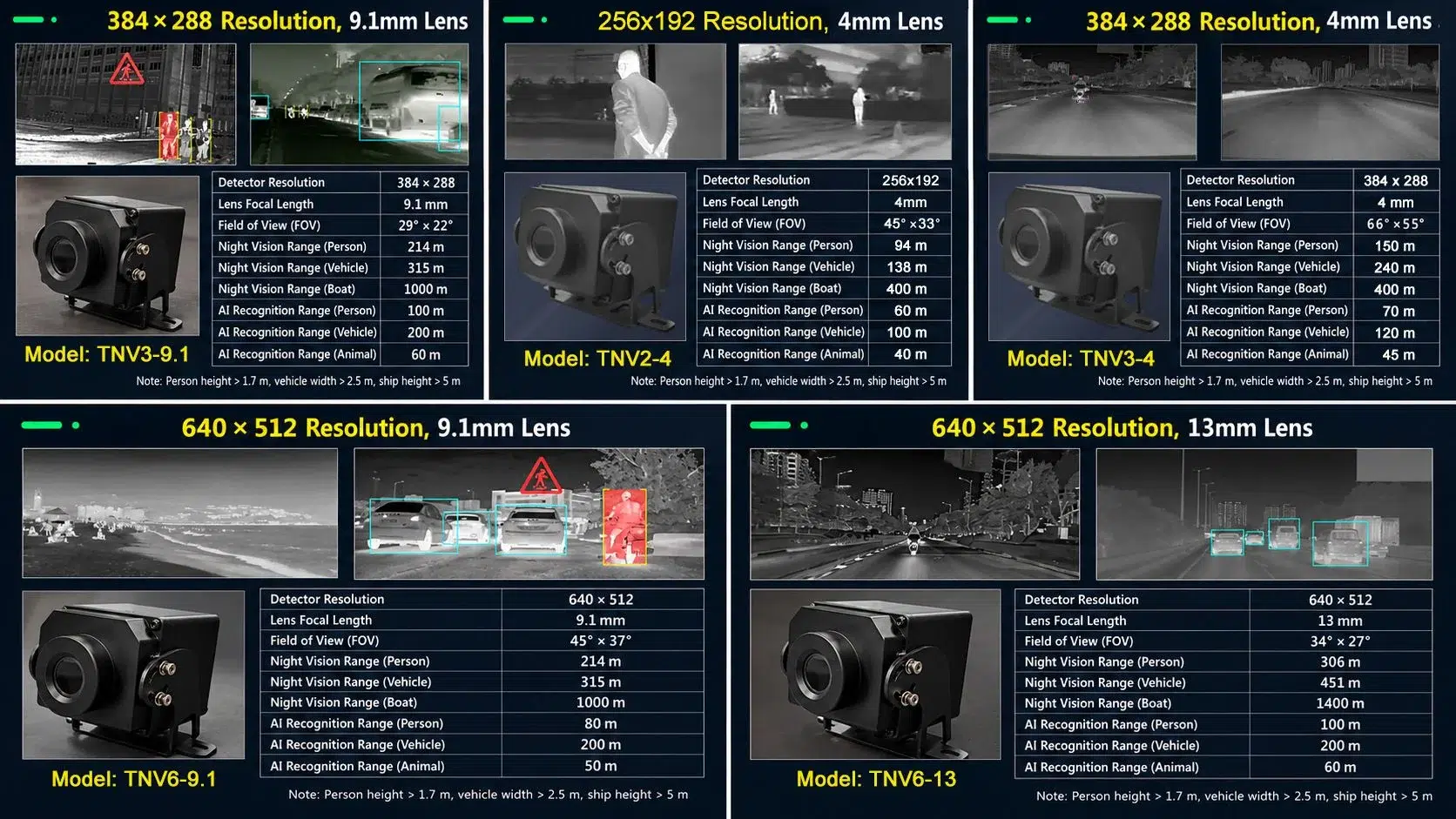
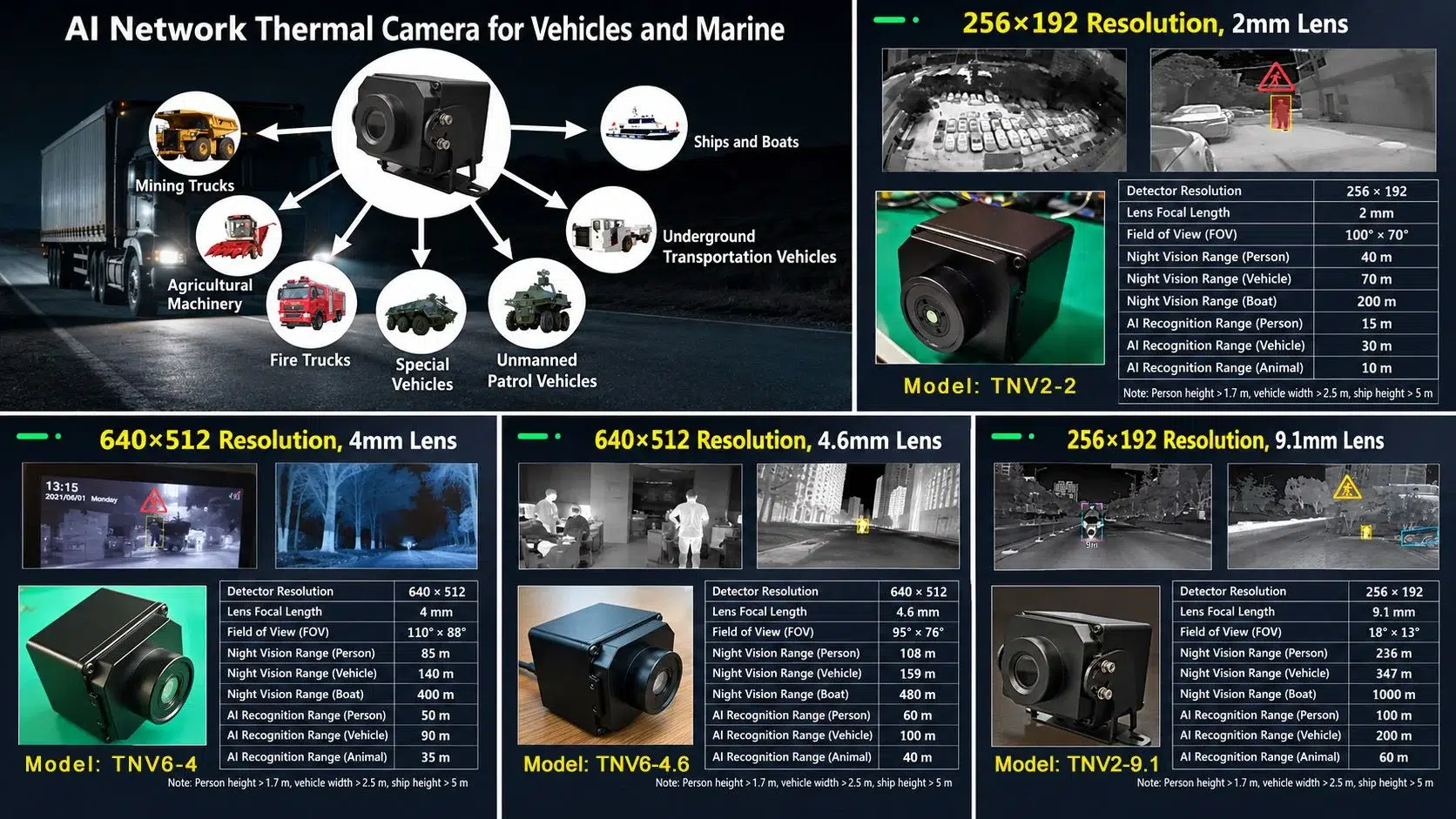
The table below puts the three options side by side. It covers technical performance, application fit, regulatory compliance, and cost. The VERYTEK TNV Series is the example family here. It comes in all three resolutions with 2–13 mm lens options, an uncooled VOx detector, and a 3 TOPS NPU for person, vehicle, and animal detection. Target ranging, configurable alarms, IP67 rating, and a −30°C to +70°C operating range complete the platform. Networking runs over RJ45 with ONVIF, RTSP, and DHCP support, optional Wi-Fi is available, and power draw stays below 6 W.
Factor | 256×192 | 384×288 | 640×512 |
|---|---|---|---|
Pixel count | 49,152 | 110,592 | 327,680 |
Image detail | Basic; large targets read clearly | Good; small targets separate well | Highest; fine detail at distance |
Typical detection reach | Short | Medium | Long |
Best fit | Docking, close scanning, tight budgets | General observation, recreational and light commercial vessels | Long-range identification, professional platforms |
Regulatory compliance | Depends on vessel class and installation | Depends on vessel class and installation | Depends on vessel class and installation |
Relative cost | Lowest tier | Middle tier | Highest tier |
Treat the TNV Series as an imaging and detection component, not a certified automotive safety system. Actual performance depends on configuration, target size, thermal contrast, and environmental conditions.
384×288 Performance and Fit
The 384×288 resolution hits a sweet spot for many skippers. It doubles the pixel count of the entry tier, so image detail improves without a big jump in cost. A 384×288 thermal sensor resolves buoys, small craft, and shoreline features at moderate range. Pair it with a mid-length lens and you get a workable balance of field of view and reach.
This 384×288 thermal scope suits fishing boats, light commercial vessels, and unmanned surface vessels that need reliable night observation. The 384×288 resolution also keeps file sizes and network load modest. That matters on smaller onboard systems. In any 384×288 vs 640×512 thermal scope debate, this tier wins on value for crews who mostly watch the water ahead.
640×512 Performance and Fit
The 640×512 resolution targets users who need long-range identification. A 640×512 sensor packs three times the pixels of the entry tier. That extra image detail lets you pick out distant hulls, channel markers, and debris well beyond close range. The 640×512 thermal scope shines on larger vessels and professional platforms where early detection pays off.
This 640×512 resolution also gives you more room to crop and zoom without losing clarity. A 384×288 vs 640×512 comparison often comes down to operating distance. If your watchkeeping happens at long range, the 640×512 thermal scope earns its higher cost. If you mostly scan nearby water, the middle tier covers you.
Lens, NETD, and Image Processing
Lens Choice and Field of View
The lens decides how much of the scene reaches the sensor. A short focal length gives you a wide field of view. You see more water around the boat, which helps with situational awareness. A long focal length narrows the field of view and magnifies the target. The TNV Series offers lens options from 2 mm to 13 mm, so you can match the lens to your watchkeeping distance.
Lens choice changes range more than pixel count alone. A long lens spreads the same pixels across a smaller area, so each target covers more pixels. That is how a modest sensor with a long lens holds its own at distance. Match the lens to your typical viewing range first, then compare sensor resolution.
NETD and Onboard Processing
NETD measures how small a temperature difference the sensor can detect. A lower NETD means better contrast in low-contrast scenes. Cold water and cool air can look flat on screen. A sensor with low NETD pulls faint targets out of that flat background. This matters more than raw image detail on dark, uniform water.
Onboard processing adds another layer. The TNV Series carries a 3 TOPS NPU for person, vehicle, and animal detection. That chip sharpens target detection and alarm reliability without changing the thermal sensor resolution. You get steadier alerts from the same sensor. Together, lens, NETD, and processing shape real performance. Native detail sets the ceiling, and these three factors decide how much of it you actually see.
Matching Resolution to Marine Use
How you keep watch on the water decides which resolution is right for your boat. Begin with the distance you scan most of the time. Then pick the sensor that fits that distance.
Close-Range Navigation and Docking
Docking and tight maneuvering call for a wide view. You need to see the pier edge, the mooring lines, and nearby hulls. A 256×192 sensor does this job well. Its pixel count is modest, but large targets show up clearly at short range. Use a short lens with it and you get a broad field of view around the boat. That wide view helps you judge gaps and spot obstacles before they become a problem.
Fishing boats working crowded harbors often fit this case. So do tight-budget setups where the camera acts as a second set of eyes at the bow. Vehicle-mounted night vision on a truck or support vehicle works the same way. Close targets fill the frame, so extra pixels add little. A 256×192 marine thermal imaging camera keeps cost down and still gives you usable thermal imaging after dark.
Long-Range Observation and Identification
Open water changes the math. Targets sit far away and cover few pixels. Here a higher resolution pays off. The 640×512 sensor packs three times the pixels of the entry tier. That extra image detail lets you pick out distant hulls and channel markers. Identification distance grows with the pixel count on target.
Larger vessels and professional platforms gain the most. A 640×512 thermal scope supports early detection on long watchkeeping legs. Unmanned surface vessels also benefit when they run beyond visual line of sight. The 640×512 resolution gives operators more confidence in target identification at range.
The middle tier covers the ground between these two cases. A 384×288 thermal scope doubles the pixels of the entry tier. That step up improves image detail without a large cost jump. Recreational craft and light commercial vessels fit here. A 384×288 thermal scope resolves buoys and small craft at moderate range. Pair it with a mid-length lens and you balance field of view against reach.
Any 384×288 vs 640×512 thermal scope decision comes down to your operating distance. The 384×288 resolution suits crews who mostly watch the water ahead. The 640×512 resolution suits crews who scan far horizons. Neither option is better for everyone. Each fits a different watchkeeping pattern.
Think about the full picture before you decide. The TNV Series offers 2–13 mm lenses across all three resolutions. A longer lens on a 384×288 thermal scope can close much of the gap at range. More pixels help most when the lens matches your typical viewing distance. Weigh your scenarios, then choose the resolution that fits them.
Budget Considerations by Resolution
Cost shows the range and detail you need, not which one is best. Each resolution tier does a different job. Spend more only when your watchkeeping distance requires it.
Entry-Level vs Professional Investment
The 256×192 tier has the lowest cost. It handles docking, close scanning, and short-range watchkeeping. A tight budget still gets you usable thermal imaging here. The 384×288 tier sits in the middle. It doubles the pixel count of the entry tier and adds moderate-range detail for a small cost increase. Most recreational and light commercial crews choose this one.
The 640×512 tier costs the most. It earns that cost through long-range identification on larger vessels and professional platforms. Pay for this resolution when early detection at distance matters to your operation. Skip it when you mostly scan nearby water.
Total Cost Beyond the Camera
The camera body is one cost. The lens is another. A longer lens adds cost, and it changes your detection reach more than pixel count alone. A lower-resolution camera with the right lens may meet your need for less money. Match the lens to your typical viewing distance before you compare resolution tiers.
Budget for the rest of the system too. A display, mounting hardware, and network setup all add to the total. The TNV Series runs on RJ45 with ONVIF, RTSP, and DHCP support, so it fits into most network video systems. Optional Wi-Fi adds a cost for wireless setups. Add these pieces up before you decide. The full system cost decides value, not the sensor alone.
Choose 256×192 for tight budgets and short-range work. Pick 384×288 as the best all-around choice for most recreational and light commercial users. Go with 640×512 for long-range identification and demanding professional use.
Before you buy, think about your typical operating distance, vessel size, and budget. Consider the full system too. Lens, display, mounting, and network integration all affect what you see on screen. A marine thermal imaging camera delivers value through the whole setup, not the sensor alone.
Let your own use case guide the decision. The highest resolution number does not promise the best fit for your boat. Match the thermal imaging spec to the water you actually watch.
FAQ
Does a higher resolution always give you better range?
No. Range depends on pixels on target. A 256×192 sensor with a long lens can match a 640×512 sensor with a wide lens at distance. Match the lens to your viewing distance first, then compare pixel counts.
Can a 256×192 camera work on open water?
It can, with the right lens. A longer focal length from the TNV Series 2–13 mm range narrows the field of view and puts more pixels on each target. You trade surrounding awareness for reach. Judge the result against your own watchkeeping pattern.
Does resolution change regulatory compliance?
Not by itself. Compliance depends on vessel class and installation. The TNV Series is an imaging and detection component, not a certified automotive safety system. Check the rules for your vessel and confirm the installation meets them.
Will the TNV Series fit my existing onboard network?
Yes, in most cases. The TNV Series offers RJ45 Ethernet with ONVIF, RTSP, and DHCP support, so it integrates into standard network video systems. Optional Wi-Fi covers wireless setups. Power draw stays below 6 W on DC 12 V.
Does the AI processor replace sensor resolution?
No. The 3 TOPS NPU improves person, vehicle, and animal detection and alarm reliability. It does not add pixels. Native resolution still sets the ceiling for image detail. Lens, NETD, and processing decide how much of that detail you see.
See Also
Choosing the Right Marine Thermal Camera for Safe Night Navigation
Selecting Automotive Thermal Imaging Cameras: Resolution, Field of View, and Interface
Key Cost Drivers for Thermal Camera Modules from 256×192 to 1280×1024 in 2026
Understanding Thermal Camera Module Pricing in 2026: Cost Factors for OEM and Bulk Buyers
How to Choose High-Resolution Thermal Imaging Camera Manufacturers for OEM/ODM Projects