
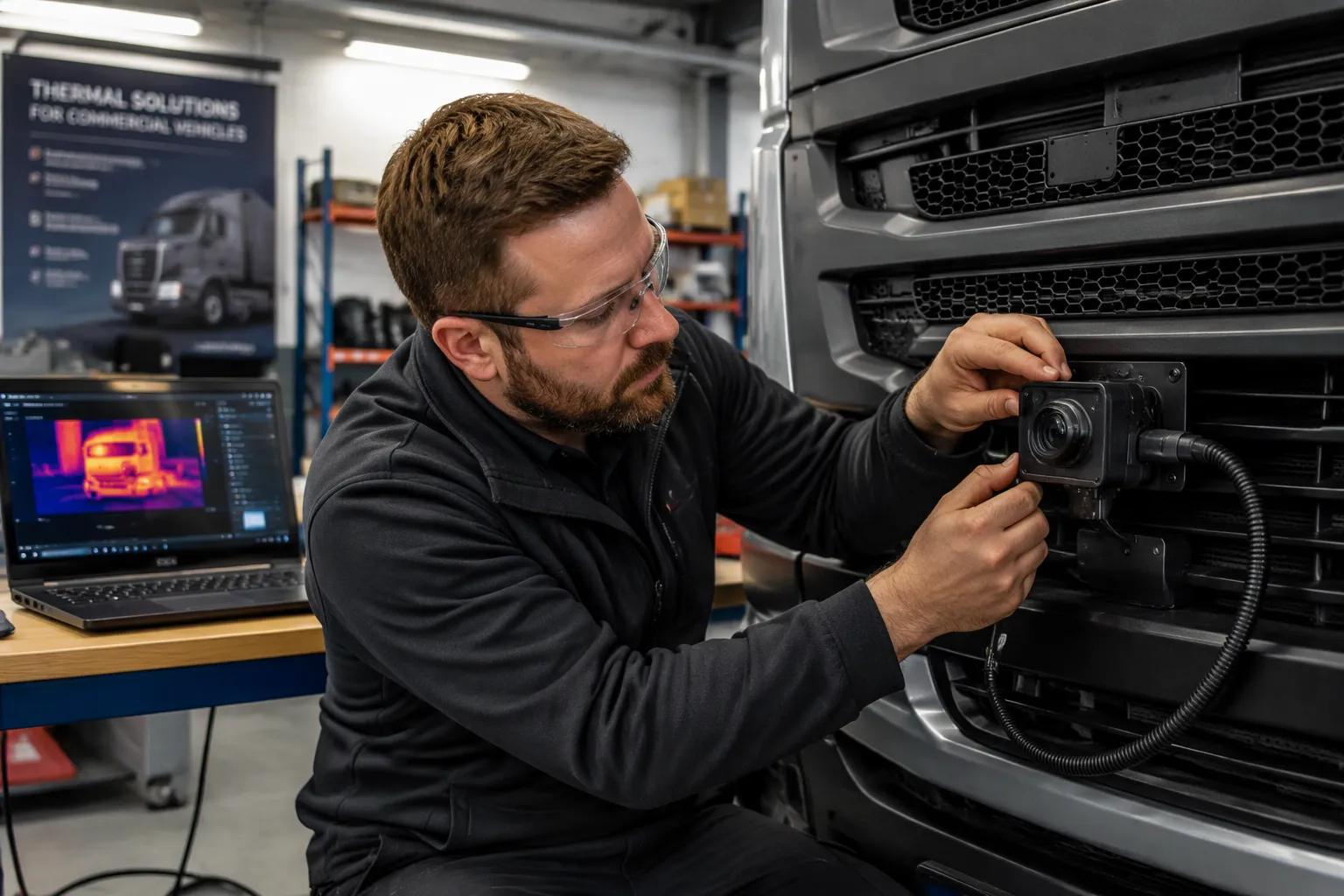
Integrators in India should select an automotive thermal camera oem on four criteria: technical performance (resolution, thermal sensitivity, frame rate, durability), application fit (detection range, field of view, integration interfaces), regulatory compliance (AIS/CMVR, IP ratings, EMC), and total cost of ownership. No single supplier leads on all four. The right choice depends on the vehicle program.
This comparison moves from performance to application fit, then compliance, cost and supply chain, and closes with a selection framework. One defined route, the VERYTek TA Series, pairs AHD video with RS485 detection data; integrators should validate compatibility on the actual display and warning host using test samples.
Key Takeaways
Choose a thermal camera based on four criteria: performance, application fit, compliance, and total cost.
Always test the camera on your actual display and warning system before buying.
Check that the camera meets Indian regulations like AIS and CMVR, and has EMC and IP certificates.
Compare total cost over the fleet’s life, not just the unit price.
Run a pilot on real routes to check alerts and supply chain before a full rollout.
Automotive Thermal Camera Performance
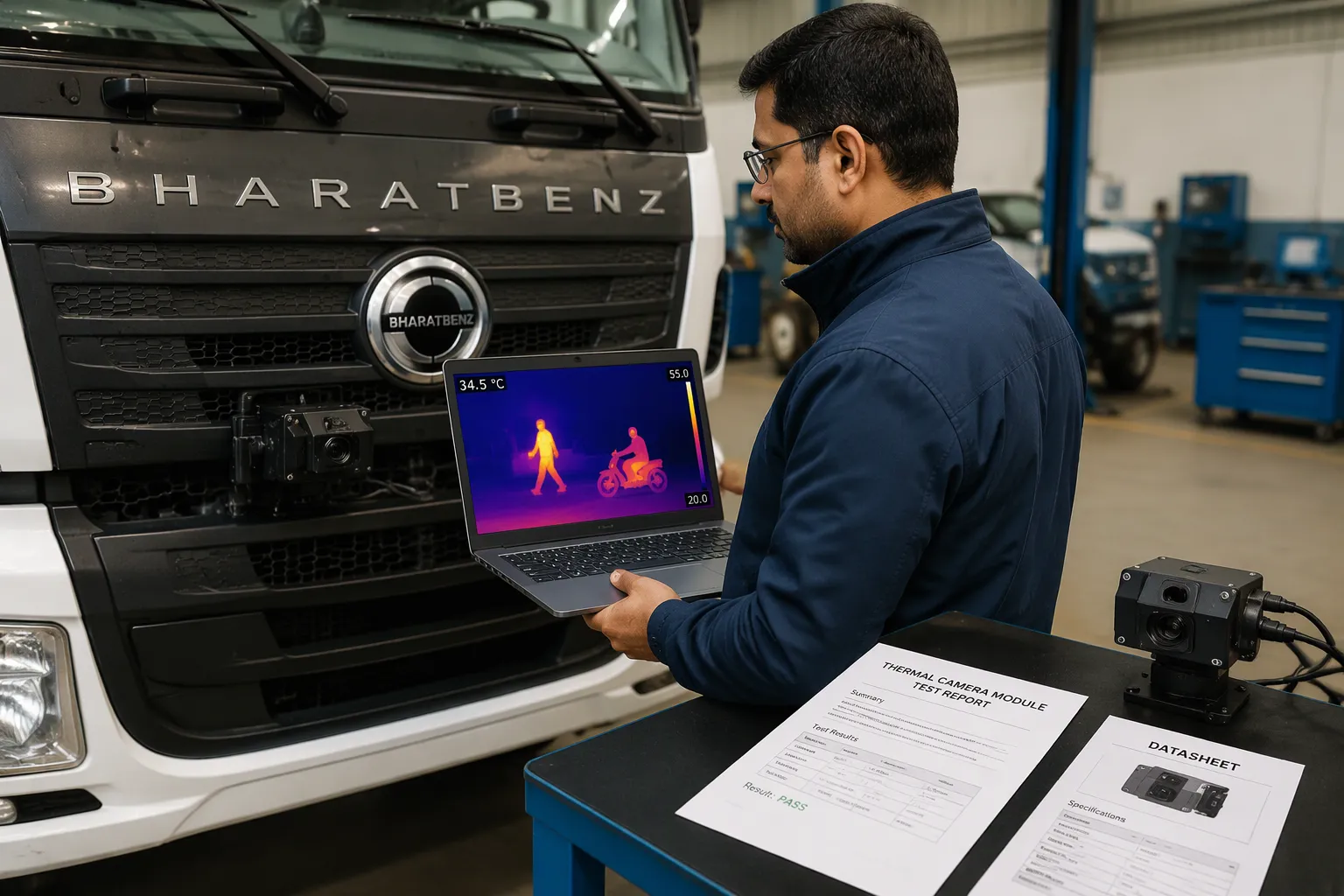
Performance separates thermal modules more sharply than any other criterion. Integrators should compare five parameters side by side: resolution, thermal sensitivity, frame rate, detection range, and durability. Each parameter interacts with the others, so a strong score on one does not compensate for a weak score on another.
Resolution and Thermal Sensitivity
Native detector resolution sets the detail a module can capture. A higher pixel count resolves distant pedestrians and two-wheelers into recognizable shapes. A lower count shows them as soft blobs. Integrators should read the detector specification, not the video output specification. An AHD stream at 720p describes the display format, not the sensor array behind it. The VERYTek TA Series illustrates this distinction: it outputs AHD video at 720p and 25 Hz by default, while the underlying detector resolution is a separate figure that integrators should confirm in writing.
Thermal sensitivity, expressed as noise equivalent temperature difference (NETD), defines the smallest temperature contrast a module can detect. A lower NETD value reveals warm bodies against cool backgrounds more reliably. Most automotive modules use an uncooled microbolometer as the sensing element. An uncooled microbolometer operates without cryogenic cooling, which suits vehicle duty cycles. Thermal sensor manufacturing maturity varies across suppliers, and NETD figures should come from a test report rather than a datasheet headline.
Frame Rate, Range, and Durability
Frame rate determines how quickly a warning system reacts. A module running at 25 Hz refreshes the scene 25 times per second, which supports timely alerts at highway speed. Slower modules suit low-speed maneuvering and yard operations. Detection range depends on resolution, lens choice, and NETD together. Integrators should request a detection range figure tied to a stated target size and a stated probability of detection.
Long-wave infrared (LWIR) is the reference technology for automotive night vision. LWIR modules sense emitted heat and need no visible light. Level 3 and Level 4 automated driving architectures raise the bar here. These levels call for redundant sensing, so a thermal channel must keep working when a camera or radar channel degrades. Redundancy demands documented failure modes, stable output under vibration, and a wide operating temperature range.
Durability closes the comparison. Commercial vehicles in India face dust, monsoon spray, and rough road inputs. An IP67 housing resists dust ingress and temporary immersion. Shock and vibration ratings should reference a named test standard. Integrators comparing thermal imaging cameras should weigh all five parameters against the actual route profile, because a city bus and a long-haul truck stress a module differently.
Thermal Imaging Technology for Night Vision ADAS
Vehicle Types and Use Cases
Trucks, buses, and last-mile delivery vehicles carry the heaviest night-time risk on Indian roads. Semi-trucks cover long highway stretches where unlit pedestrians and stalled two-wheelers appear late in the headlamp beam. City buses face crowded stops and darting riders. Last-mile delivery vans work dense urban routes after dark. Thermal imaging technology for night vision ADAS addresses all three profiles, because it senses body heat rather than reflected light.
Each vehicle type stresses a different use case. Long-haul trucks need long detection range for pedestrian detection at highway speed. Buses need wide field of view at low speed. Delivery vans need fast alerts in stop-and-go traffic. Advanced driver-assist systems built on thermal imaging technology therefore differ by lens, mounting height, and alert logic, even when the core module stays the same.
Night Vision ADAS Integration
Integration routes vary by supplier. The Valeo–Teledyne FLIR ADK automotive development kit serves as an example of an OEM thermal platform built for wider OEM integration work. STONKAM and the XY-FS200 heavy-duty commercial transport camera module illustrate the commercial-vehicle camera supplier route. These examples are illustrative, not endorsements.
The VERYTek TA Series offers a defined integration path for night vision ADAS. It provides on-camera detection of pedestrians and vehicles, AHD video output at 720p and 25 Hz by default, and a separate RS485 interface for detection-related distance information. The product page specifies a 9–24 V DC input and an IP67 housing. Integrators should not mistake AHD video resolution for native thermal sensor resolution. They should request interface details and test samples, then validate compatibility on the actual display and warning host. Thermal imaging technology for night vision ADAS also feeds multispectral sensor fusion systems, where thermal data joins radar and visible cameras to strengthen automotive safety across passenger and commercial vehicles.
Onboard Power and Data Interfaces
9–24V Input and Protection
Trucks and buses in india run on 24 V systems, while many light commercial vehicles use 12 V. A module rated for 9–24 V DC input covers both without a separate converter. The VERYTek TA Series specifies this input range, which simplifies stocking for fleets that mix vehicle classes.
Protection matters as much as range. Load dump, reverse polarity, and cranking dips can damage an unprotected board. Integrators should confirm the module’s protection circuitry in writing before fitting it to a bus electrical system. A fused, ignition-switched supply line protects the camera and the harness. The IP67 housing on the TA Series resists dust and water ingress on exposed mounting points.
AHD Video and RS485 Data Direction
AHD video carries the thermal image to a display or recorder over a coaxial cable. The TA Series outputs AHD at 720p and 25 Hz by default. RS485 carries detection-related distance information in the opposite direction, from camera to host. Integrators should map the data direction clearly during integration, because crossed wiring stalls the alert path.
CAN and Ethernet appear on other modules and suit vehicles with an existing network backbone. Standard interfaces like these reduce harness complexity on new builds. The TA Series keeps its route simple: AHD for video, RS485 for detection data. Integrators should validate compatibility on the actual display and warning host, and request interface details and test samples. AHD video resolution is not native thermal sensor resolution.
Mounting varies by vehicle type. Long-haul trucks favor a high windshield or bumper position for range. Buses need a wide, low view of crowded stops. Delivery vans benefit from a forward position above the bumper.
Pedestrian and Two-Wheeler Detection
AI Prompt Functions and Alerts
Pedestrians and two-wheelers dominate the risk picture on Indian roads. These vulnerable road users move unpredictably, often without lights at night. A thermal module with on-camera detection shortens the path from sensing to warning. The VERYTek TA Series provides on-camera detection of pedestrians and vehicles, and it sends detection-related distance information over a separate RS485 interface. The host system can then trigger a cab alert, a haptic seat warning, or a speed governor input.
Alert logic deserves careful design. A prompt that fires too often trains drivers to ignore it. Integrators should set confidence thresholds and distance gates against the route profile. A city bus needs short-range alerts at low speed. A highway truck needs earlier warnings at higher speed. Thermal imaging technology supports this logic because body heat stays visible against dark backgrounds. Automotive safety systems that combine thermal prompts with radar confirmation cut false alerts further.
Mounting and Field-of-View Planning
Installation position shapes detection quality more than any software setting. A forward bumper mount gives a low, clear view of the road ahead. A high windshield mount extends range but loses nearby ground. Side mounts help buses watch stop areas and blind spots. Field-of-view planning should start from the target zone, then work back to lens choice and mounting height.
Aftermarket mounting guidance varies by vehicle type, so integrators should confirm bracket options and sight lines on the actual chassis. The TA Series ships in an IP67 housing and accepts a 9–24 V DC input, which suits mixed 12 V and 24 V fleets in India. Integrators should validate compatibility on the actual display and warning host, and request interface details and test samples. AHD video resolution is not native thermal sensor resolution. Cost context matters too: TI’s low-cost ADAS demonstration at Electronica India 2026 showed how affordable automotive safety hardware is reaching commercial vehicles.
Automotive Thermal Imaging Compliance in India
AIS/CMVR and Homologation
Commercial-vehicle integrators in india must fit thermal cameras within the Central Motor Vehicles Rules (CMVR) framework. The Automotive Industry Standards (AIS) issued under CMVR define the test procedures that type approval bodies apply. A thermal camera that feeds a driver warning falls under the electrical and electronic component requirements of the vehicle type approval. Integrators should confirm the camera’s position in the approval scope before quoting a fleet.
The homologation path starts with a documented component specification. The integrator submits test reports, drawings, and a bill of materials to the test agency. The agency then issues a compliance report that supports the vehicle type approval. Thermal cameras in india often enter as aftermarket safety devices, and that route carries a different documentation burden. Procurement teams should ask the supplier for the AIS reference list at the quotation stage.
EMC, IP, and Certification Support
Electromagnetic compatibility (EMC) testing proves that the camera neither emits excessive interference nor fails when exposed to vehicle-level noise. Automotive safety functions that depend on the camera output raise the assurance bar. Programs targeting automotive safety integrity level (ASIL) B need documented development evidence, not just a passing test report. Suppliers should state whether their module supports an automotive safety integrity level (ASIL) B claim or only a general EMC pass.
Environmental protection follows the IP rating. The VERYTek TA Series carries an IP67 housing, which resists dust ingress and temporary immersion. Integrators should pair that rating with vibration and temperature test evidence for the mounting position. A capable OEM supplies the EMC report, the IP certificate, the environmental test summary, and a declaration of conformity. Automotive thermal imaging procurement in india should treat missing documentation as a schedule risk, because retesting delays the pilot.
Cost and Supply Chain in India
Unit Cost, Volume, and TCO
Unit price tells only part of the story. Integrators in india should compare quoted cost against annual volume, then weigh total cost of ownership (TCO). TCO adds harness changes, bracket fabrication, installation labor, warranty claims, and replacement units over the fleet life. A cheaper module with a short service life can cost more per vehicle-kilometer than a durable one.
Volume changes the equation. Small pilot orders carry higher per-unit prices, while fleet-wide rollouts unlock tiered pricing. Indian buyers should request a price break schedule at the quotation stage. The automotive sensor and camera market is growing from USD 24.64B in 2025 to USD 76.53B by 2035, a neutral signal that supply capacity is expanding alongside demand.
Lead Times and Partnership Models
Lead time decides whether a pilot meets its schedule. Integrators should ask for standard lead time, expedited options, and buffer stock terms in writing. Local support shortens repair cycles. A regional spare-parts pool and a documented after-sales support process keep buses and trucks on the road.
Warranty terms vary by supplier. Integrators should confirm the coverage period, the claim process, and the party that handles returns. Partnership models fall into three routes: direct purchase from the OEM, supply through an indian distributor network, and design-in support where the OEM assists with integration. Each route suits a different program size. An indian distributor network helps smaller fleets avoid import complexity, while direct engagement suits high-volume programs.
For custom builds, integrators building their own camera boards can use VeryPCBA as a PCBA manufacturing partner. VeryPCBA offers component sourcing, turnkey and consigned assembly, functional testing, X-ray inspection, and design review. The TA Series remains a defined AHD and RS485 route; integrators should validate compatibility on the actual display and warning host.
Selecting an Automotive Thermal Camera OEM
Matching OEM Strengths to Needs
A selection framework turns four criteria into a shortlist. Integrators should score each candidate against performance, application fit, compliance, and cost, then weight the scores by program priority. A long-haul fleet weights detection range and durability heavily. A city bus operator weights field of view and alert speed. The framework below shows where each route fits best.
Integrator need | Best-fit route | Why it fits |
|---|---|---|
Defined AHD and RS485 route with on-camera detection | VERYTek TA Series | 720p at 25 Hz default output, 9–24 V DC input, IP67 housing, separate RS485 distance data |
Wider platform development work | Valeo–Teledyne FLIR ADK | Built as an automotive development kit for OEM integration programs |
Commercial-vehicle camera supply | STONKAM and XY-FS200 | Established commercial transport camera supply |
No route wins on every row. An integrator comparing an automotive thermal camera should match the module to the vehicle program, not to a generic ranking. The TA Series suits programs that want a defined integration path with on-camera pedestrian and vehicle detection. Integrators should validate compatibility on the actual display and warning host, and request interface details and test samples. AHD video resolution is not native thermal sensor resolution.
Evaluation and Pilot Programs
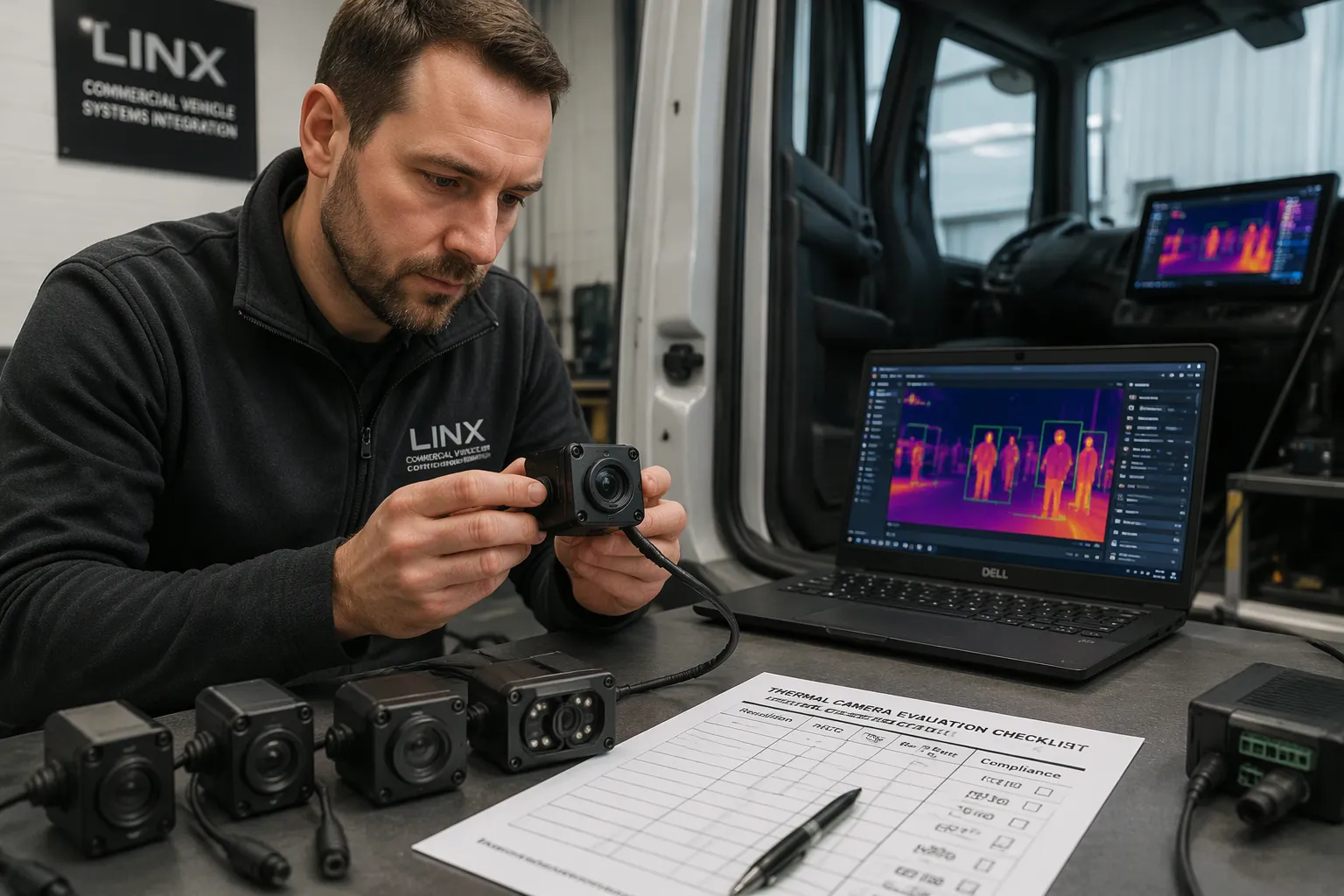
An evaluation checklist keeps the shortlist honest. Integrators should confirm native detector resolution and NETD from a test report, not a datasheet headline. They should verify frame rate, detection range at a stated target size, IP rating, shock and vibration evidence, and the 9–24 V input range. Compliance documents belong on the same checklist: the AIS reference list, the EMC report, and the IP certificate. Cost items follow, including price breaks by volume and warranty terms.
A pilot program then tests the shortlist on real routes. Integrators in india should fit two or three modules across mixed vehicle types, log alerts over several weeks, and compare false-alert rates against driver feedback. India fleets mix 12 V and 24 V vehicles, so the pilot should cover both. ADAS warning hosts vary too, so each candidate must prove its data path end to end.
The pilot also exposes supply chain reality. Integrators should confirm lead times, local support, and spare-parts availability before scaling. Manufacturers that answer engineering questions early reduce integration risk. Automotive safety programs in india reward this discipline, because a retest delays the fleet rollout.
The final step is commercial. Integrators should request samples, technical documents, and share annual demand volumes with each shortlisted automotive oem. A tailored supply proposal follows from those volumes. For programs building custom camera boards, VeryPCBA supports component sourcing, turnkey and consigned assembly, functional testing, X-ray inspection, and design review. An automotive oem partner that documents decisions early supports the next build stage. ADAS programs benefit most from this early clarity.
Four criteria decide the choice: technical performance, application fit, regulatory compliance, and total cost of ownership. Integrators in india should shortlist against AIS/CMVR and EMC/IP requirements first. Next, match interfaces and AI prompt needs to the vehicle program. The VERYTek TA Series offers a defined AHD and RS485 route, with 720p at 25 Hz default output, 9–24 V DC input, and an IP67 housing. Validate compatibility on the actual display and warning host. Finally, confirm cost and supply chain through a pilot. Integrators in india can request samples, technical documents, and share annual demand volumes for a tailored automotive thermal camera supply proposal.
FAQ
Which interfaces should integrators confirm before ordering a thermal camera?
Integrators should confirm the video output, the data interface, and the input voltage range in writing. The VERYTek TA Series pairs AHD video at 720p and 25 Hz by default with a separate RS485 interface for detection-related distance information. It accepts a 9–24 V DC input, which suits mixed fleets in india.
How should integrators validate a thermal camera before a fleet rollout?
A pilot on real routes settles the question. Integrators in india should fit test samples across mixed vehicle types and validate compatibility on the actual display and warning host. They should log alerts over several weeks and compare false-alert rates against driver feedback. Both 12 V and 24 V vehicles belong in the pilot.
What compliance documents should a supplier provide in india?
Suppliers should provide the AIS reference list, the EMC report, the IP certificate, and the environmental test summary. Programs targeting ASIL B need documented development evidence, not just a passing test report. Procurement teams in india should treat missing documentation as a schedule risk, because retesting delays the pilot.
Does AHD output resolution equal native thermal sensor resolution?
No. AHD at 720p describes the display format, not the detector array behind it. Integrators in india should request the native detector resolution and the NETD figure from a test report. The VERYTek TA Series carries an IP67 housing, and integrators should confirm sensor specifications separately.
How do integrators manage cost and supply chain risk in india?
Integrators should weigh total cost of ownership against unit price, then request price breaks by volume. Lead times, local support, and spare-parts availability belong in the same review. For custom camera boards, VeryPCBA offers component sourcing, turnkey and consigned assembly, functional testing, X-ray inspection, and design review. Fleet programs across india benefit from documented decisions early.
See Also
OEM Automotive Thermal Camera Suppliers: B2B Engineering Checklist Guide
UK Distributor Auto Thermal Cameras: OEM Kits and Technical Selection
Wholesale Car Thermal Camera Buying Guide for Distributors
Top AI Thermal Cameras for Vehicle Night Vision Systems
Automotive Thermal Imaging Camera Selection: Resolution, FOV and Interface