
If you want the best thermal monocular in 2026, you should pick one that fits what you need and uses the latest technology. A thermal monocular helps you see heat in the dark, fog, or smoke. Many people use a thermal monocular for hunting, missions, watching animals, or fun. You should choose a thermal monocular with a long detection range, clear pictures, strong battery, and tough build. More people buy thermal monoculars as new features come out. The Verytek MV Series is a top thermal monocular for 2026.
Key Takeaways
Pick a thermal monocular that matches what you need. You might use it for hunting, security, or watching animals.
Find models with high resolution and long range. This helps you see clear images and works well.
Think about battery life and how strong the device is. Choose one that can handle rough use and lasts a long time.
Use smart features like Wi-Fi and AI detection. These make it easier to use and let you share things right away.
Always check if the monocular feels good and is not too heavy. Make sure it fits you well for long use.
Best Monocular Thermal Picks 2026
Top Overall Models
When you want the best monocular thermal device in 2026, you need one that shows clear pictures and can spot things from far away. Many companies made their technology better this year. You can see the main details for top models in the table below:
PRODUCT | THERMAL SENSOR RESOLUTION | DETECTION RANGE | REFRESH RATE |
|---|---|---|---|
Burris Thermal Handheld | 400×300 | 750 yards | 50Hz |
ATN OTS LT | 320×240 | 1700 m | 60Hz |
AGM Taipan TM15-384 | 384×288 | 708 m | 50Hz |
ATN OTS-XLT 160 | 160×120 | 670 m | 50Hz |
AGM Asp-Micro TM160 | 160×120 | 611 meters | 25/50Hz |
FLIR Breach PTQ136 | 320×256 | Unspecified | 60Hz |
ATN Odin LT 320 2-4x | 320×240 | 535 meters | 60Hz |
You can also look at the chart below to compare how far these models can detect:
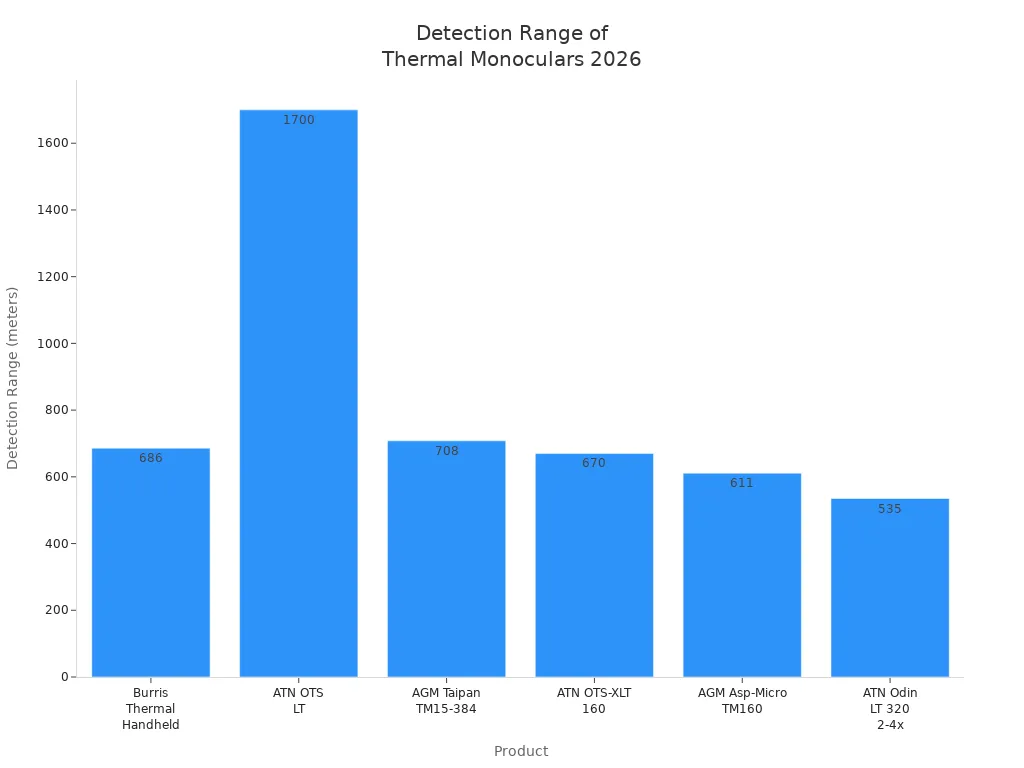
The ATN OTS LT is special because it can see far and refreshes fast. Burris gives you clear pictures and is built strong. AGM models work well and do not cost too much. FLIR is known for being reliable and having a fast refresh rate. Pulsar models, like the Axion series, have sharp screens and can record what you see.
Tip: When you pick a thermal monocular, always check how far it can detect and how clear the picture is. These things help you find what you are looking for outside.
Best Budget Choices
You do not have to spend a lot of money to get a good thermal monocular. Many brands sell cheaper models that still work well when tested. Here is a quick list of some of the best budget choices for 2026:
Model | Price | Detection Range | Key Features |
|---|---|---|---|
FLIR Scout TK | $600 | Up to 100 yards | Compact, intuitive interface, high-resolution display |
ATN OTS LT 320 | $1,000 | Up to 750 yards | Advanced image processing, lightweight design |
Pulsar Axion Key XM30 | $1,500 | Powerful zoom | Video recording, Wi-Fi connectivity |
Sightmark Wraith HD | $500 | N/A | Day and night vision, user-friendly controls |
The FLIR Scout TK is great for people just starting out. It is small and simple to use. The ATN OTS LT 320 can see farther and has more features for a good price. Pulsar Axion Key XM30 lets you record videos and use Wi-Fi to share. Sightmark Wraith HD works both during the day and at night, so it is very useful.
Best for Hunting and Tactical
If you hunt or need a thermal monocular for tactical work, you want one that is strong and works every time. Tests and reviews show these models are best for hunting and tactical use:
Model | Best For | Key Features |
|---|---|---|
Axion XQ19 | Hunters and outdoor explorers | 19mm f/1.0 lens, 1.5–6x digital zoom, high-resolution thermal sensor, bright AMOLED display |
AGM Taipan V2 | Outdoor, hunters, security | 12μm VOx sensor, 256×192 resolution, IP67-rated body, built-in 16GB storage, Wi-Fi connectivity |
Burris Thermal Handheld | General use | High performance, user-friendly design |
ATN OTS LT | Handheld use | Compact, versatile features |
AGM Taipan TM15-384 | Coyote hunting | Long-range detection capabilities |
ATN OTS-XLT 160 | Budget-friendly | Smart features at a lower price |
FLIR Breach PTQ136 | Tactical use | Rugged design, advanced thermal imaging capabilities |
Experts tried these devices outside. They found that the Axion XQ19 and AGM Taipan V2 are great for hunters and people who like to explore. Burris and ATN models are easy to use and work in many situations. FLIR Breach PTQ136 is best for tactical use because it is tough and has advanced imaging.
Note: Many of these models were shown at CES 2026. Brands like Burris, ATN, FLIR, Pulsar, and AGM keep making their products better with new sensors and smart features.
When you choose the best monocular thermal device, think about what you will use it for most. If you want to see far, pick one with a strong sensor and lens. If you want to save money, look for simple buttons and a clear screen. For hunting or tactical work, get a tough model that has worked well for others.
Verytek MV Series Overview
MV2, MV3, MV6 Features
You want a thermal monocular that shows clear pictures. It should work in many places. The Verytek MV Series has three models: MV2, MV3, and MV6. Each one has special features to help you see heat in the dark, fog, or smoke. You can use these for night vision, security, rescue, watching animals, or checking machines.
Here is a table with the main features of the MV Series:
Feature | Description |
|---|---|
Shows clear thermal pictures in dark, foggy, or smoky places. | |
Built-in Laser Rangefinder | Measures how far things are, up to 1000 meters. |
Wi-Fi Connectivity | Lets you send pictures and videos right away to share or save. |
Compact and Lightweight | Easy to hold and carry outside because of its shape and weight. |
Pick the MV2 if you want something simple. Choose the MV3 for more features. Get the MV6 for the best performance. MV2 costs the least, MV3 is in the middle, and MV6 is the most advanced. This way, you can find one that fits your money and needs.
Tip: Every MV Series model has a sharp display and video recording. You can save and watch what you see later.
Laser Rangefinder and Wi-Fi
The laser rangefinder in the Verytek MV Series checks how far things are, up to 1000 meters. You can use it to find and check targets fast. This helps you make good choices during patrols, rescues, or animal tracking. The Wi-Fi lets you send pictures and videos to your phone or tablet. You can share with your group or keep them for later. It makes saving and sharing thermal data quick and easy.
Ergonomics and Durability
You need a device that feels nice to hold and lasts a long time. The Verytek MV Series is small and easy to carry. It weighs less than 400 grams with the battery. You can use it for hours without getting tired. The device has IP65 protection, so it keeps out dust and water. You can use it in rain, mud, or dusty places.
Here is a table with durability and comfort features:
Feature | Description |
|---|---|
Portable Handheld Design | Small, light, and shaped for easy holding for a long time. |
Encapsulation | IP65 rating keeps out dust and water. |
Weight | Less than or equal to 400g (with battery). |
How the MV Series Compares
The Verytek MV Series is different from other brands. It gives you advanced thermal imaging, a laser rangefinder, and Wi-Fi in every model. Many other brands do not have all these together. You also get a sharp display and video recording, making the MV Series a smart choice. The MV2, MV3, and MV6 are priced so you can pick one that fits your budget and still get good features.
You can use the MV Series for night vision, security, rescue, animal watching, and checking machines. It works well in total darkness, fog, and smoke. You get clear pictures, good distance checks, and easy sharing. This makes the Verytek MV Series a great choice for anyone who needs strong thermal imaging in 2026.
What Is a Thermal Monocular?
How It Works
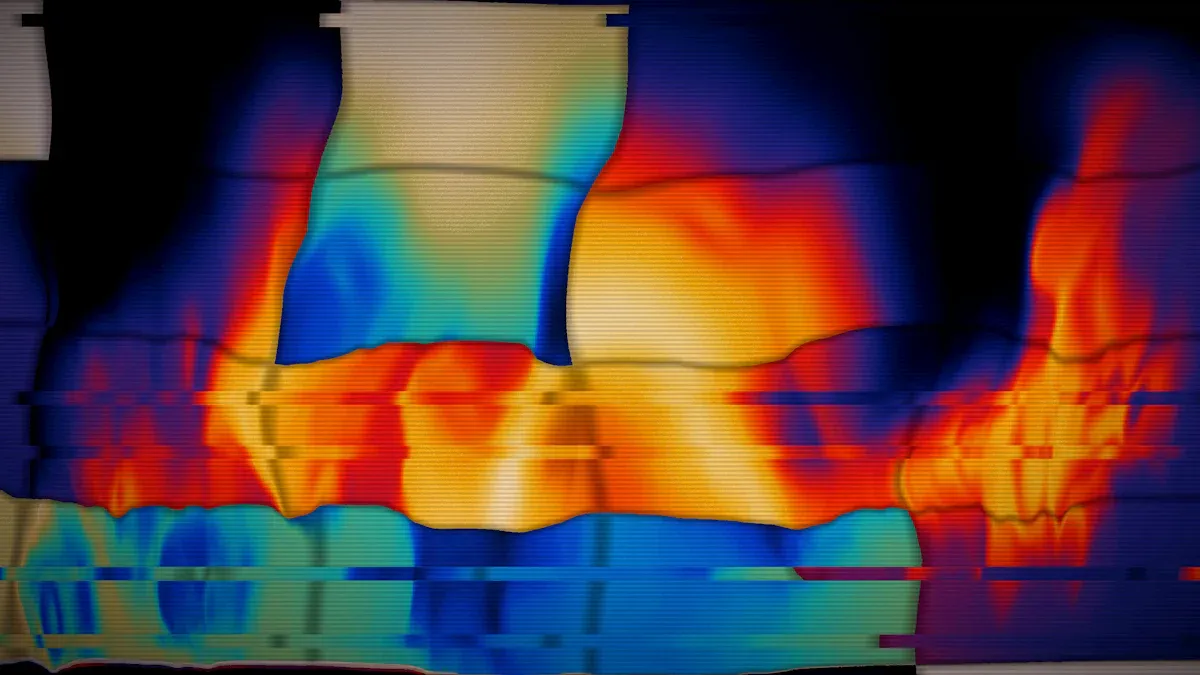
A thermal monocular helps you see things that give off heat, even when you cannot see with your eyes. You hold the monocular up to your eye and look through it, just like a small telescope. The device picks up heat from people, animals, cars, or anything warmer than its surroundings.
A thermal monocular detects heat from objects and turns it into a picture you can see.
It works by sensing infrared radiation, which all objects above absolute zero give off.
The warmer something is, the more infrared radiation it gives off. The monocular uses this difference to show shapes and outlines.
You can use thermal monoculars in total darkness, fog, or smoke because they do not need any light to work.
This technology lets you spot living things or hot objects, even when it is pitch black outside. You can use it for hunting, security, or finding lost animals. Thermal sensitivity is important because it shows how well the monocular can pick up small changes in temperature.
Thermal vs Night Vision
You might wonder how thermal monoculars compare to night vision devices. Night vision makes things brighter by using any light around, like moonlight or streetlights. It cannot work well in complete darkness. Thermal imaging works differently. It finds heat, not light, so you can use it day or night.
Thermal imaging lets you see heat signatures in any lighting. Night vision only works when there is some light to boost. If you need to see in smoke, fog, or total darkness, a thermal monocular gives you a clear advantage. Night vision can show more detail when there is enough light, but it does not work as well when there is none.
Tip: If you want to see through darkness, fog, or smoke, choose a thermal monocular. It works in places where night vision cannot.
Key Features to Consider
Image Clarity and Range
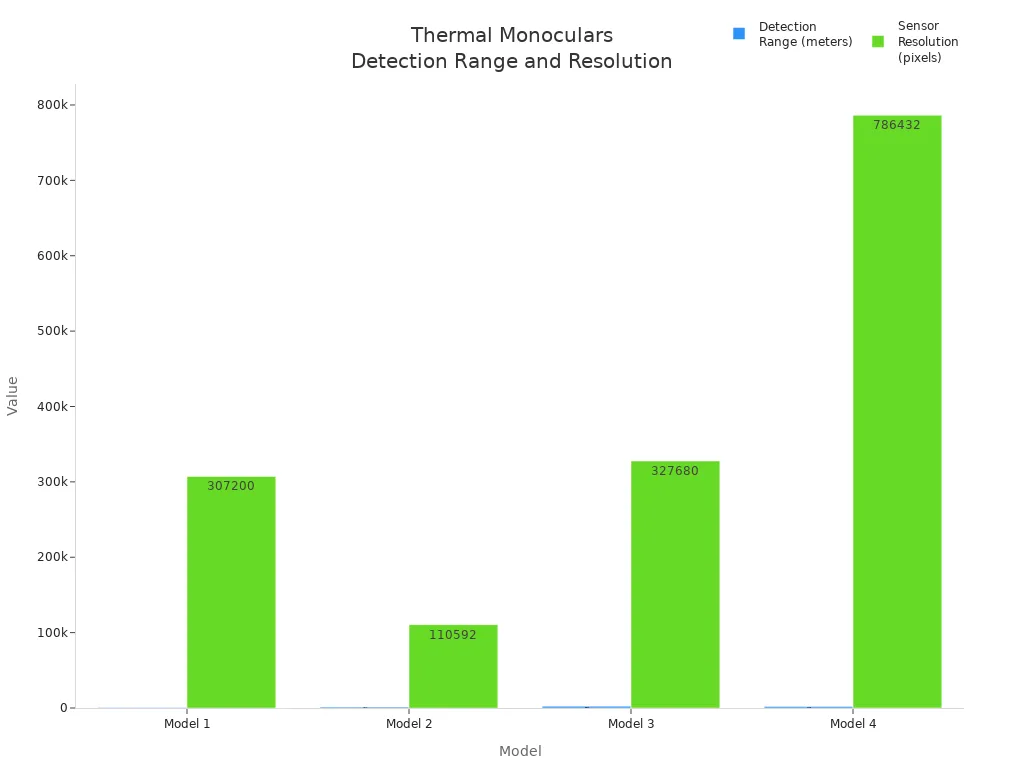
When you pick a thermal monocular, you want clear pictures. You also want to see things from far away. The sensor and display resolution decide how much detail you see. Most new models have a sensor resolution of 640×512 or higher. This gives you better and sharper images. Some expensive models now have 1024×768 resolution. This makes it easier to tell if you see an animal or a person far away. The detection range tells you how far you can spot heat. Some devices can see up to 2,600 yards. Others work best at about 700 meters. Always check the official datasheet for native resolution and NETD. NETD shows how well the device finds small temperature changes. If the NETD is lower, the device works better at spotting tiny differences.
Model | Detection Range | Sensor Resolution | Display Resolution |
|---|---|---|---|
Model 1 | 709 meters | 640×480 | 640×480 |
Model 2 | 1,300 meters | 384×288 | 640×400 |
Model 3 | 2,600 yards | 640×512 | 1440×1080 |
Model 4 | 2,300 yards | 1024×768 | 1024×768 |
Tip: Try holding the device for five minutes with gloves on. See if it feels good in your hand and is not too heavy.
Battery Life
You want a thermal monocular that works long enough for your needs. Battery life can change if it is cold or if you use the device a lot. Some brands say their batteries last a long time, but cold weather can make them run out faster. Look for models with smart power saving and extra batteries you can swap. USB-C PD charging helps you charge the battery faster and easier. Check how the battery is built and if you can change it quickly outside. Real battery life is more important than what the box says.
Note: Devices that use regular batteries are easier to use outdoors.
Ruggedness and Weatherproofing
A tough thermal monocular works well in hard places. Many 2026 models use magnesium alloy and strong plastic to last longer. You want a device with an IP rating to keep out dust and water. Some, like the Opti Scope Monocular, have grips that do not slip and are tested for tough weather. The Pulsar Axion series is small but can still see far. About 20% of new models are lighter, so they are easier to carry. Check the lowest temperature the device can handle and how fast it turns on. This helps you know if it will work in the cold.
Magnesium alloy and plastic bodies help protect from drops.
Grips that do not slip help you hold it in rain or mud.
IP ratings keep out dust and water.
If you want to use your monocular outside, pick one that is tough and keeps out water and dust.
Advanced Technology in 2026
Smart Connectivity
You want your thermal monocular to connect with your other devices. In 2026, many thermal monoculars have smart connectivity. You can use Wi-Fi or Bluetooth to link your monocular to your phone or tablet. This makes sharing pictures and videos easy. You can use a mobile app to control your device. This makes it simple to use. Many people want their thermal monocular to work like an IoT device. You can stream live video to your phone for quick viewing. Most brands work with both iOS and Android, so you do not have to worry about what phone you have. Some models let you change display modes and color palettes. This helps you see better in different places. You can also save your pictures and videos on the device or send them to your phone.
Wi-Fi and Bluetooth help you share data fast.
Mobile apps let you control your device from far away.
Real-time streaming lets you see what is happening right now.
AI Detection
AI detection changes how you use your thermal monocular. You get better sensitivity and more accurate results. The device can tell if something is a person, animal, or vehicle. This is called automatic target recognition. It helps you follow moving things without much work. AI removes things that do not matter, so you only see what is important. This makes it easier for new and experienced users. You do not have to guess what you are looking at because the device helps you know. AI detection also keeps you safer by giving you clear alerts.
Object recognition helps you know what you see.
Target tracking follows moving things for you.
AI lowers mistakes in busy places.
Real-Time Sharing
You can show what you see to others right away. Real-time sharing lets you send live pictures or videos to your team or friends. This feature helps when you work in groups, like search and rescue or watching animals. You can show others what you find without waiting. Real-time sharing also helps because everyone can react fast to changes. You do not need special skills to use this feature. Just connect your device and start sharing.
Tip: Real-time sharing makes teamwork easier and helps everyone stay up to date.
Application Advice
Hunting
You want a thermal monocular to help you find animals. The Verytek MV Series lets you see clearly, even when it is dark or foggy. You can use the laser rangefinder to check how far things are, up to 1000 meters. This helps you plan your hunt and stay safe. The Wi-Fi lets you share what you see with your friends. The MV2, MV3, and MV6 all have sharp screens and batteries that last a long time. These things make the MV Series a good pick for hunting.
Tip: Change the settings on your device to get the best picture for different weather or land.
Tactical
You need a device that works well in hard places. A strong thermal monocular for tactical use has a tough body and a bright screen. You can see details in smoke or darkness. Many 2026 models let you pick different color palettes to see better. Built-in storage and Wi-Fi help you save and share pictures. The table below shows important things for tactical use:
Feature | Description |
|---|---|
High-resolution display | Makes it easier to see in many conditions. |
Customizable thermal palettes | Lets you change settings for the best view. |
Rugged design | Stays strong in rough places. |
Built-in storage | Lets you record and stream easily. |
Wi-Fi connectivity | Lets you control the device from far away. |
You should also look for high sensitivity (NETD under 35 mK) and different lens choices for your needs.
Wildlife
You want to watch animals without scaring them away. Some thermal monoculars can see as far as 3,620 yards. Models like the Pulsar Axion XQ19 and RIX Pocket K3 can show small heat changes, so you can spot animals in low light. The ATN BlazeSeeker-210 helps you find animals and lets you change color palettes. A small design makes it easy to carry on long walks.
Night Vision Thermal Imaging Monocular: Sees far, has an OLED screen.
Pulsar Axion XQ19: AMOLED screen, finds small heat changes.
ATN BlazeSeeker-210: Lets you pick color palettes, finds animals well.
RIX Pocket K3: Small, has a fast frame rate.
Recreation
You can use a thermal monocular for fun, like exploring at night or camping. Pick one with a strong sensor and a good screen. You want to see far and get clear pictures. Many models have different color palettes, Wi-Fi, and video recording. The table below lists features that help with fun activities:
Feature | Description |
|---|---|
Sensor and Display | Sees over 750 yards for long distances. |
Palette Options | Has White Hot, Black Hot, Red Hot, Iron, Blue Hot. |
WiFi Compatibility | Connects to apps for easy use and viewing. |
Extra Features | Hot Track, rangefinder, PIP mode, video and photo options. |
Tripod Receiver | Makes it steady and easy to use. |
Battery Life | Lasts more than five hours with power saving. |
Warranty | Three-year warranty for peace of mind. |
Note: Try using a tripod to keep your view steady during long times.
How to Choose a Thermal Monocular
Selection Checklist
You should check many features before you buy a thermal monocular. Each feature helps you get better results for what you want to do. Use this checklist to help you pick the right one:
Resolution: Higher resolution means the picture is clearer. You can see small things better.
Detection range: This tells you how far you can see heat. A longer range is good for hunting or rescue.
Battery life: Long battery life is important if you are outside for hours.
Magnification: Zoom helps you see things closer. Check if it uses optical or digital zoom.
Refresh rate: A high refresh rate makes pictures smoother. This helps when things are moving.
WiFi connectivity: You can connect your monocular to your phone or tablet. This makes sharing easy.
Video recording: You can save what you see and watch it later.
Multiple color palettes: Different colors help you see better in different places.
Laser rangefinder: This tool tells you how far away things are.
Waterproof rating: A good rating means you can use it in the rain.
Durability: Pick one with a strong body. It should not break if you drop it or use it in bad weather.
Tip: Use this guide to compare models. Find the one that works best for you.
Common Mistakes
People sometimes make mistakes when they buy a thermal monocular. You can avoid these problems if you know what to look for:
Ignoring resolution: Low resolution makes it hard to see small things.
Overlooking battery life: If the battery is short, your trip might end early.
Forgetting about durability: Weak devices can break outside.
Not checking waterproof rating: Some do not work well in the rain.
Choosing the wrong magnification: Too much zoom can make things blurry.
Not thinking about refresh rate: Slow refresh rates make it hard to follow moving things.
Skipping WiFi or video features: These help you share and save pictures.
Not testing comfort: Heavy or odd-shaped devices are hard to use for a long time.
Note: Always hold the device before you buy it. Make sure it feels good and fits what you need.
Maintenance Tips
Cleaning and Storage
You want your thermal monocular to work well every time. Cleaning and storing it the right way keeps it in good shape. Here are some easy steps to help you take care of your monocular:
Wipe the lens often. If dirt or fingerprints get on it, pictures can look fuzzy. Use a soft cloth and be gentle when you clean the lens. Do not use strong cleaners because they can hurt the lens.
Use a dry cloth to clean the outside. This gets rid of dust and helps your device look nice.
Put your monocular in a case when you are not using it. The case protects it from getting scratched or bumped.
Keep your device in a cool and dry place. Wet air can damage the inside parts.
Charge the battery all the way before you store it for a long time.
Update the firmware when there is a new version. Updates can make your device work better and add cool features.
If something seems wrong, ask an expert to look at your device.
Tip: If you clean the lens and store your monocular the right way, you will get clear pictures and your device will last longer.
Battery Care
If you take care of the battery, your thermal monocular will last longer and work better. Here is a table with simple battery care tips:
Aspect | Recommendation |
|---|---|
Charging Best Practices | Use smart chargers so you do not overcharge. Try to let the battery charge all the way and then use it. |
Temperature Management | Keep batteries at normal temperatures. Wrap them in cold weather to help them work up to 30% better. |
Storage Protocols | Store batteries half full in a cool, dry place. This helps them stay strong. |
Do not leave your battery in places that are too hot or too cold. Always check how much battery you have before you go outside. If you will not use your monocular for a while, charge the battery halfway and keep it somewhere safe.
Note: If you take care of your battery, your thermal monocular will always be ready when you need it. 🛠️
Trends for 2026
New Tech Highlights
You will see many new features in thermal monoculars in 2026. Companies now focus on making devices lighter and easier to carry. Many brands use magnesium alloys or strong polymers. This change means you can hold your monocular for hours without feeling tired.
Battery life has improved a lot. You can use some new models for more than eight hours on one charge. You do not need to bring many extra batteries on your trips. This helps you stay focused on your activity.
Sensor quality has also moved forward. Most thermal monoculars now use 640×480 sensors. Some high-end models even offer 1280×1024 HD sensors. You will notice sharper images and more detail when you look through these devices.
Smart features are now common. Many thermal monoculars include AI for target tracking. You can also find Wi-Fi and Bluetooth in most new models. These features let you share images and videos quickly with your phone or tablet.
You can check the table below to see the main trends:
Trend | Description |
|---|---|
Lightweight Designs | Compact and portable with new materials. |
Improved Battery Efficiency | |
Higher Resolution Sensors | 640×480 is standard; 1280×1024 HD available. |
Smart Features | AI target tracking, Wi-Fi, and Bluetooth are standard. |
On-board Video Recording | Most models can capture and save pictures or videos. |
Tip: Look for a model with both smart features and a high-resolution sensor for the best experience.
Market Shifts
You will notice some big changes in the thermal monocular market in 2026. More people now use these devices for outdoor fun, not just for hunting or security. Prices have become more friendly, so you can find good models even if you have a small budget.
Brands compete by adding new features and making their devices tougher. You will see more models with weatherproof bodies and easy-to-use controls. Companies also focus on making their apps better. You can now control your monocular and share images with just a few taps.
Many users want devices that work well with their phones. This demand pushes brands to improve Wi-Fi and Bluetooth connections. You can expect even more smart features in the future.
Note: The market now offers more choices for every user. You can find a thermal monocular that fits your needs, whether you want it for work or fun.
Choosing the best thermal monocular in 2026 means you need to:
Decide what you want to use it for.
Check the features that matter most to you.
Compare top models for image clarity, range, and battery life.
Remember: The right device fits your needs and helps you succeed outdoors. Explore innovative options like the Verytek MV Series. Start your search today and invest in a thermal monocular that works for you.
FAQ
What is the main use of a thermal monocular?
You use a thermal monocular to see heat from people, animals, or objects. It works in darkness, fog, or smoke. Hunters, security teams, and wildlife watchers use it to spot things that are hard to see with your eyes.
How far can a thermal monocular see?
Most thermal monoculars can detect heat from 100 yards up to 2,600 yards. The exact range depends on the model and sensor. Always check the product details for the detection range before you buy.
Can you use a thermal monocular during the day?
Yes, you can use a thermal monocular any time. It does not need light. It shows heat, so you can use it in daylight, at night, or in bad weather.
Is a thermal monocular better than night vision?
A thermal monocular works in total darkness, fog, or smoke. Night vision needs some light to work. If you want to see heat, a thermal monocular gives you more options.
How do you care for your thermal monocular?
Always clean the lens with a soft cloth. Store your device in a dry case. Charge the battery before long trips. Update the firmware when needed. This keeps your monocular working well.
See Also
The Importance of Thermal Imaging Cameras in 2025
Utilizing Thermal Imaging Cameras for Rescue Operations in 2025
Vanadium Oxide Thermal Imaging Cameras for Effective Rescue