
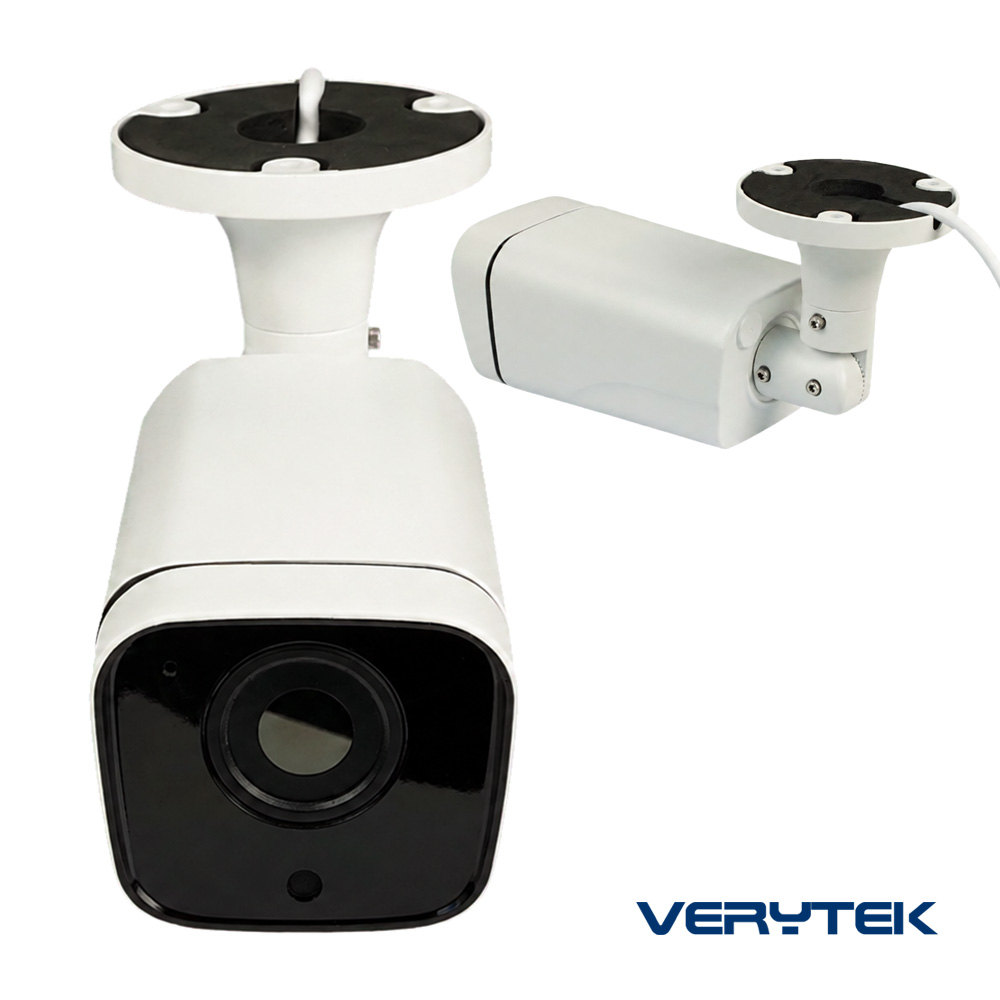
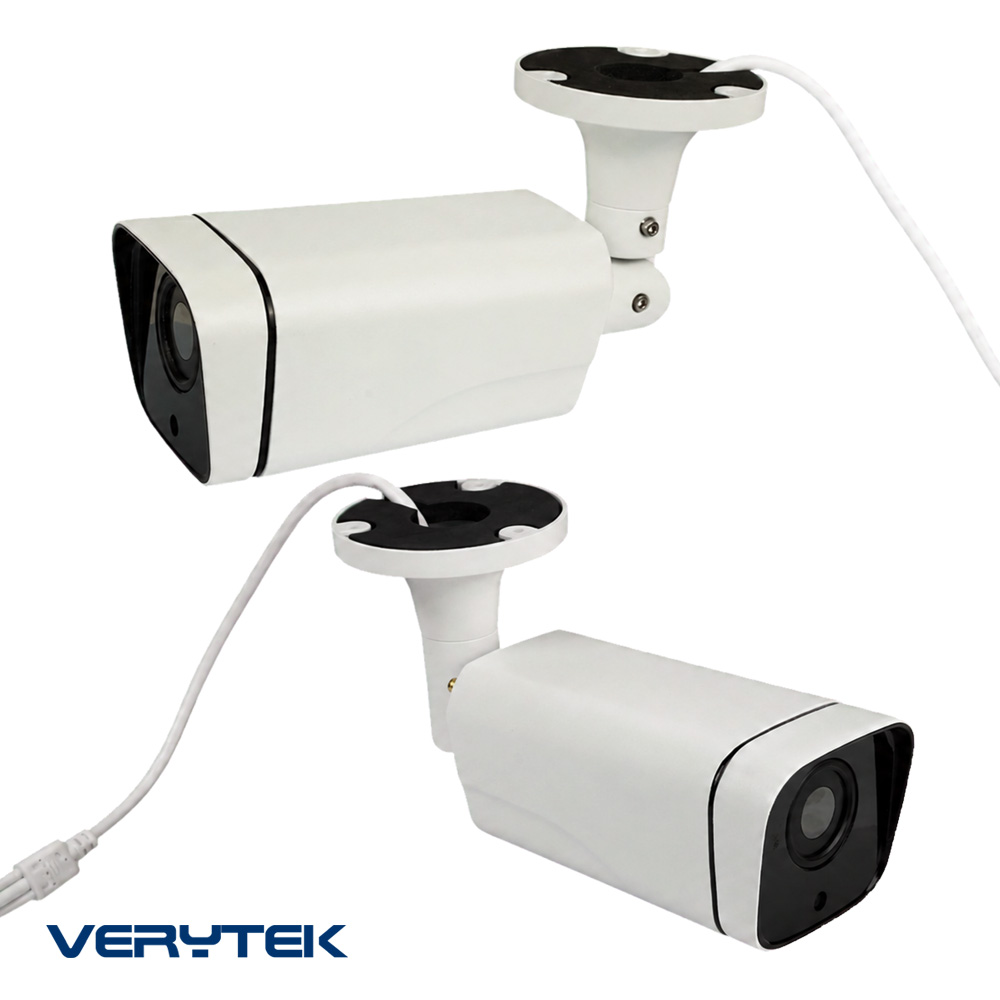
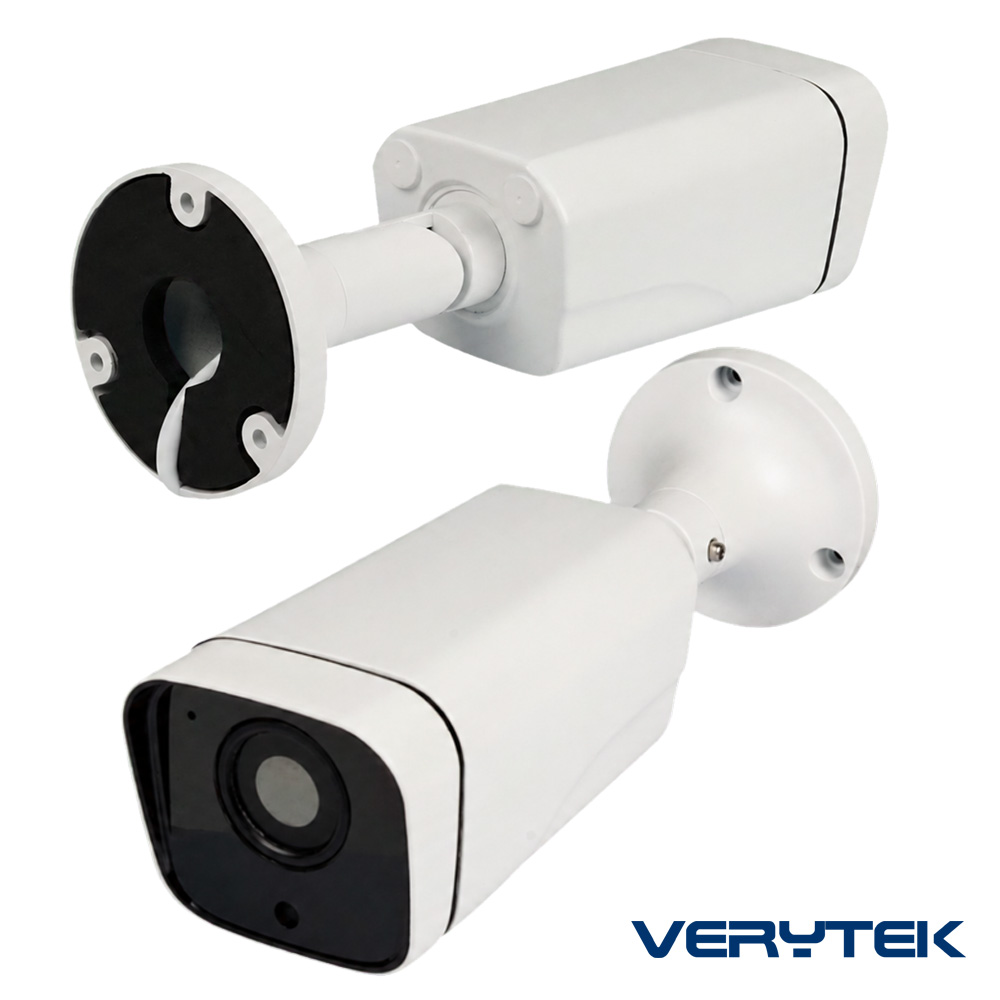
TN Series Smart Security Network Thermal Camera for Person, Vehicle and Animal Detection
Thermal Security Monitoring for Unattended Sites
Identification type: Human, vehicle, animal (Rangeable)
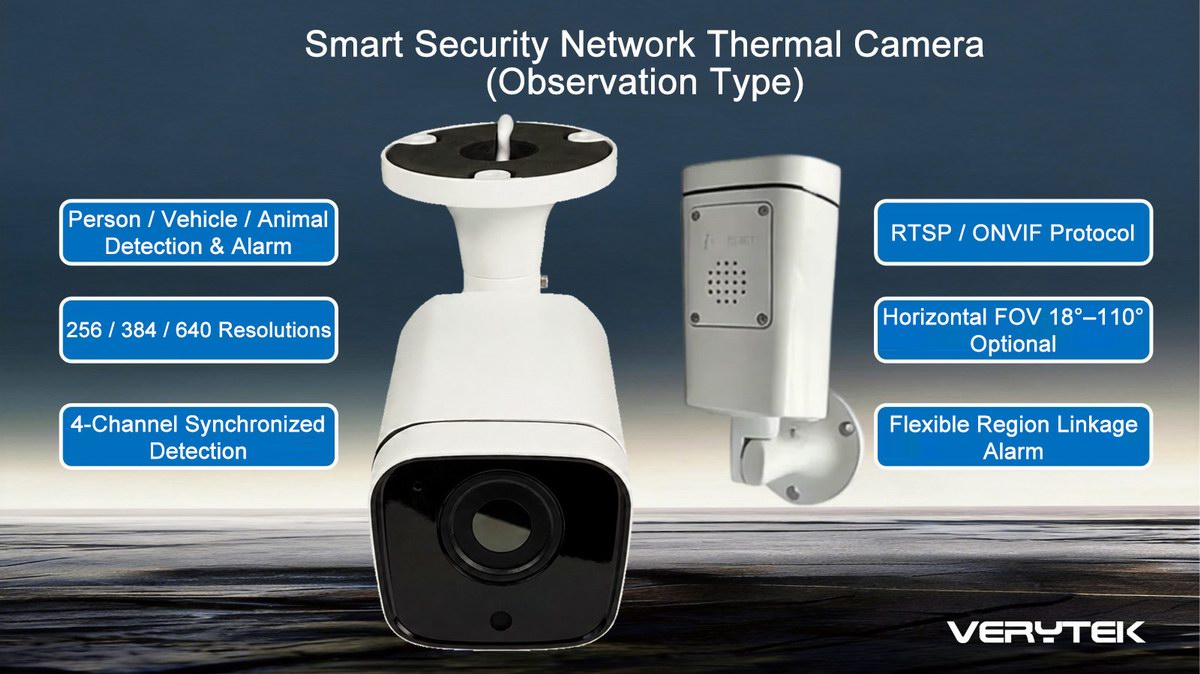
The VERYTEK TN Series is an observation-type AI thermal network camera for monitoring people, vehicles and animals. It combines a 12 μm uncooled VOx infrared detector with a 3 TOPS NPU, network video connectivity and configurable alarm functions.
Thermal imaging forms an image from infrared radiation and temperature differences on object surfaces. It does not require visible illumination, providing an additional monitoring channel for dark sites where ordinary visible-light surveillance may struggle.
With three resolution options and horizontal fields of view from 18° to 110°, the TN Series allows installers to select a configuration for broad scene coverage or more concentrated observation. RTSP and ONVIF support provide integration options for compatible surveillance platforms.
TN Series AI Thermal Network Camera for Person, Vehicle and Animal Detection

Key Features
| Item | Specification |
|---|---|
| Product Name | Smart Security Network Thermal Imaging Camera |
| Video Output | Ethernet (RJ45); optional Wi-Fi customization |
| AI Recognition | Person, vehicle and animal recognition with distance estimation |
| Image Palettes | White Hot, Black Hot, Ironbow, Hot, Rainbow, Lava and Red Hot |
| Additional Features | Multiple resolution and lens options; integration with in-vehicle infotainment systems and mobile apps |
| Supported Resolutions | 256 × 192, 384 × 288 and 640 × 512 |
| Supported Protocols | ONVIF, RTSP, DHCP, RTMP and more |
Person, Vehicle and Animal Detection
The onboard AI supports person, vehicle and animal detection. Operators can configure alarm regions to focus monitoring on relevant parts of the scene.
Applications include observing people approaching restricted areas, monitoring vehicle access and detecting animal activity within a selected viewing area. Actual detection performance depends on the camera model, lens, target size, installation and thermal contrast.
Custom Alarm Regions and Multi-Region Linkage
Custom alarm regions and multi-region linkage alerts allow monitoring rules to follow the layout of the site.
This is useful when different parts of a scene require different attention—for example, an access route beside a pasture boundary or a restricted area near a reservoir.
The product literature also lists four-channel synchronized detection. Confirm the channel configuration and supported linkage behavior for the intended project.
Multiple Alarm Outputs
The TN Series provides three listed alarm methods:
- Built-in alarm speaker
- Browser alarm
- High-level alarm output
These options support local notification and integration with compatible external equipment. Confirm the alarm output’s electrical characteristics and the receiving system’s requirements before connection.
RTSP and ONVIF Network Integration
RTSP and ONVIF support make the TN Series a candidate for integration into compatible network surveillance systems. DHCP support assists network address configuration.
For an existing VMS or NVR installation, verify video compatibility, supported ONVIF functions and alarm-event handling with the selected camera firmware. Protocol support does not guarantee that every receiving platform supports every camera function.
Three Thermal Resolutions and Multiple Lens Options
Choose from:
- TN2 models: 256 × 192
- TN3 models: 384 × 288
- TN6 models: 640 × 512
Lens options provide different fields of view and listed AI detection distances. Wide-angle configurations cover more of the surrounding scene, while narrower configurations concentrate image detail within a smaller area.
Select the resolution and lens together according to the site layout, target type and required monitoring distance.
Thermal Sensitivity and Image Controls
The TN Series has a specified NETD of ≤40 mK at 25°C and F/1.0. This describes thermal sensitivity rather than absolute temperature measurement accuracy.
White-hot is the default image mode. Seven palettes and adjustable brightness and contrast allow users to adapt the image presentation to their monitoring preferences.
Local Recording and Remote Upgrade
Local recording and remote upgrade functions are supported. Optional Wi-Fi is available for projects requiring wireless connectivity.
Confirm the recording medium, storage capacity, wireless configuration and upgrade procedure for the selected version before deployment.
Selected Window and Defrost Configurations
Window and defrost support are available on selected models. The 100°, 110° and 95° horizontal wide-angle configurations do not include this support.
For cold-weather installations, check the required model and defrost configuration during selection.
Thermal Camera Model Selection
| Model | Resolution | Lens | Field of view H × V | AI person range | AI vehicle range | AI animal range | Window / defrost |
|---|---|---|---|---|---|---|---|
| TN2-2 | 256 × 192 | 2 mm | 100° × 70° | 15 m | 30 m | 10 m | Not supported |
| TN2-4 | 256 × 192 | 4 mm | 45° × 33° | 60 m | 100 m | 40 m | Supported |
| TN2-9.1 | 256 × 192 | 9.1 mm | 18° × 13° | 100 m | 200 m | 60 m | Supported |
| TN3-4 | 384 × 288 | 4 mm | 66° × 55° | 70 m | 120 m | 45 m | Supported |
| TN3-9.1 | 384 × 288 | 9.1 mm | 29° × 22° | 100 m | 200 m | 60 m | Supported |
| TN6-4 | 640 × 512 | 4 mm | 110° × 88° | 50 m | 90 m | 35 m | Not supported |
| TN6-4.6 | 640 × 512 | 4.6 mm | 95° × 76° | 60 m | 100 m | 40 m | Not supported |
| TN6-9.1 | 640 × 512 | 9.1 mm | 45° × 37° | 80 m | 200 m | 50 m | Supported |
| TN6-13 | 640 × 512 | 13 mm | 34° × 27° | 100 m | 200 m | 60 m | Supported |
AI ranges are reference values from the product specifications. The stated target dimensions are a person 1.7 m tall, a vehicle 2.5 m wide and an animal 1.5 m tall. Actual performance varies with weather, thermal contrast, obstructions, target orientation and installation. Animal ranges should not be interpreted as guaranteed detection distances for smaller animals.
How to Choose a TN Series Camera
For Broad Scene Coverage
Consider TN2-2, TN6-4 or TN6-4.6 when broad coverage is the main requirement. Their horizontal fields of view range from 95° to 110°.
These configurations have shorter listed AI ranges than narrower options and do not include window/defrost support.
For Access Routes and Defined Boundaries
TN2-4, TN3-4 and TN6-9.1 provide intermediate fields of view for monitoring selected access areas or boundaries.
Compare the actual scene width, target distance and required detail before choosing a model.
For More Concentrated Observation
TN2-9.1, TN3-9.1 and TN6-13 offer narrower fields of view, with listed AI person ranges up to 100 m and vehicle ranges up to 200 m under the specified target conditions.
These figures describe individual configurations and should be verified in the intended environment.
Applications
Pasture and Livestock Monitoring
Use thermal imagery and animal detection to observe activity within selected pasture areas. Configurable alarm regions can help focus attention on access points and boundaries.
The listed animal detection distances use a 1.5 m tall target. Evaluate performance separately for smaller livestock or other animals.
Aquaculture and Fishing-Site Security
The TN Series can support observation of people, vehicles and animals around aquaculture facilities, fishing sites and access areas.
For coastal installations, confirm enclosure protection and suitability for salt exposure before selecting the installation location.
Oilfield and Reservoir Surveillance
Thermal imaging provides an additional observation channel for unattended areas, including oilfield access points and reservoir boundaries.
Use the camera as part of a wider monitoring system, with the lens and alarm regions selected for the site layout.
Zoo and Animal-Facility Observation
Animal detection and thermal imagery can support nighttime observation within suitable enclosures and monitoring areas. Target size, vegetation, fencing and thermal background should be considered during evaluation.
Transport and Restricted-Area Monitoring
Person and vehicle detection can support observation of restricted areas near transport infrastructure. System integrators should validate coverage, alarm behavior and operational requirements before deployment.
Technical Specifications
| Parameter | Specification |
|---|---|
| Product type | Observation-type AI thermal network camera |
| Detector | Uncooled VOx infrared focal plane array |
| Resolution options | 256 × 192 / 384 × 288 / 640 × 512 |
| Pixel pitch | 12 μm |
| Spectral band | 8–14 μm |
| NETD | ≤40 mK at 25°C, F/1.0 |
| Lens options | 2 / 4 / 4.6 / 9.1 / 13 mm, depending on model |
| Horizontal field of view | 18°–110°, depending on model |
| AI processing | 3 TOPS NPU |
| AI functions | Person, vehicle and animal detection; ranging; custom alarm regions; multi-region linkage alerts |
| Alarm methods | Built-in speaker, browser alarm and high-level alarm output |
| Network protocols | RTSP, ONVIF, DHCP |
| Local recording | Supported |
| Image modes | Default white-hot; seven palettes |
| Image adjustment | Brightness and contrast |
| Remote upgrade | Supported |
| Wi-Fi | Optional |
| Power supply | DC 12 V |
| Listed power consumption | <6 W |
| Operating temperature | −30°C to +70°C |
| Storage temperature | −35°C to +75°C |
| Dimensions | 235 × 75 × 70 mm |
| Weight | Approximately 500 g |
Confirm the final camera configuration, interfaces and installation requirements when ordering. The product is specified for observation; calibrated temperature measurement accuracy is not provided.
Integration and Purchasing Information
For model selection, provide VERYTEK with:
- Target type: people, vehicles or animals
- Required monitoring distance and scene width
- Installation height and site layout
- Expected weather and environmental exposure
- Existing VMS or NVR platform
- Required alarm interfaces and recording functions
- Wi-Fi requirements
- Evaluation quantity and expected project volume


Frequently Asked Questions
What is the VERYTEK TN Series AI thermal network camera?
It is an observation-type thermal security camera with onboard person, vehicle and animal detection. It offers three thermal resolutions, multiple lenses, configurable alarms and RTSP/ONVIF connectivity.
Can it operate in complete darkness?
Yes. Thermal imaging does not require visible illumination. Image quality and AI detection performance still depend on thermal contrast, weather, obstructions and installation conditions.
What resolutions are available?
The TN2 models use 256 × 192 detectors, TN3 models use 384 × 288 detectors and TN6 models use 640 × 512 detectors.
How far can it detect people and vehicles using AI?
The listed AI ranges reach up to 100 m for people and 200 m for vehicles on selected models. These reference values use a person 1.7 m tall and a vehicle 2.5 m wide. Other configurations have shorter listed ranges.
Does the camera detect small animals at 60 m?
The listed maximum 60 m animal range applies to selected models using an animal target 1.5 m tall. It does not establish the same range for smaller animals.
What is the difference between night range and AI range?
The datasheet lists separate night-observation and AI range values. They should not be treated as equivalent. Use the AI range table when selecting a camera for automatic target detection and alarms.
Does it work with an ONVIF NVR or VMS?
The camera supports ONVIF and RTSP. Verify video reception, supported functions and alarm-event compatibility with the intended NVR or VMS before deployment.
Can it measure temperature accurately?
The datasheet identifies this as an observation-type product and does not specify calibrated temperature measurement accuracy. NETD is a thermal sensitivity specification, not a temperature accuracy rating.
Does every model support defrost?
No. TN2-2, TN6-4 and TN6-4.6 are the wide-angle configurations excluded from window/defrost support in the specifications.
Does the system support recording and Wi-Fi?
Local recording is supported, and Wi-Fi is optional. Confirm recording storage and wireless configuration for the selected version.
Does thermal imaging see through walls or all weather conditions?
No. Thermal imaging observes infrared radiation from surfaces within its view. It cannot see through walls, and dense fog, heavy rain, obstructions or low thermal contrast can reduce performance.
Request a TN Series Configuration and Quote
Contact VERYTEK to discuss your monitoring site, target types, required coverage and integration requirements.
Send your preferred resolution, lens requirements, order quantity and project schedule to sales@verytek.com for configuration review and quotation.


