
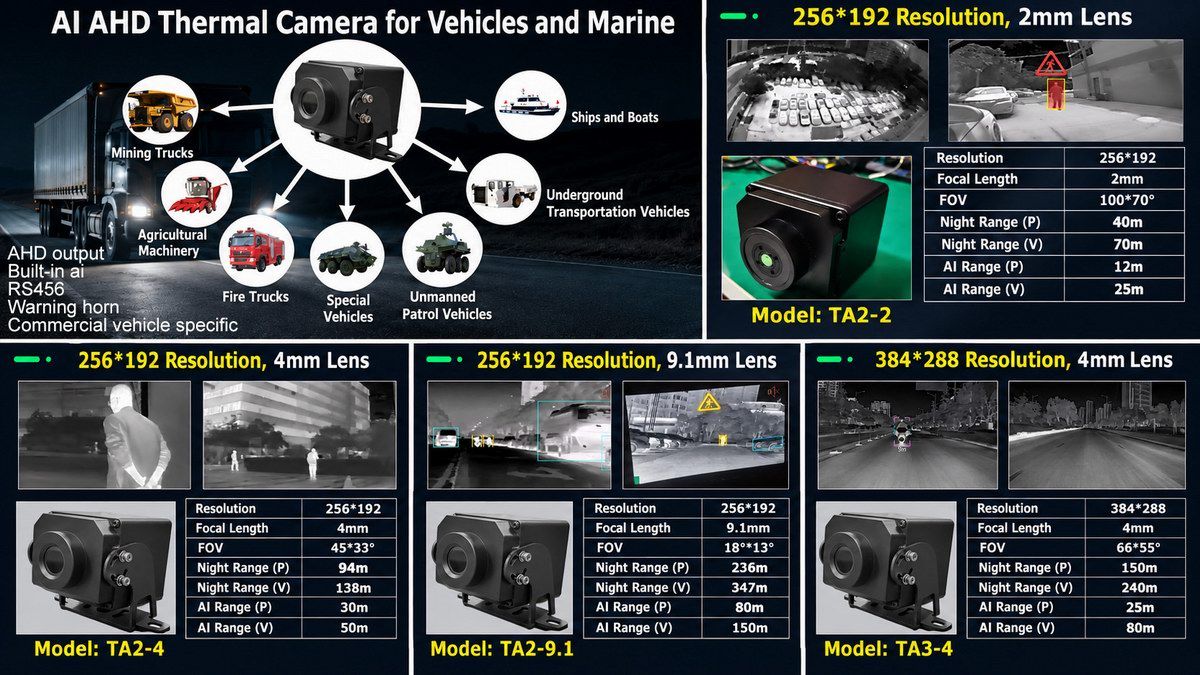
An AI vehicle thermal camera reads heat signatures, not visible light. Thermal cameras show people, machinery, and hazards in total darkness, where headlights fail.
Underground mining is hard on normal optics. Dust clouds the lens, glare washes out screens, and unlit tunnels kill visibility. A vehicle mounted thermal imaging camera cuts through all three. It sends AHD Video and RS485 Distance Output to your cab display.
Thermal imaging works on heat. Warm bodies and running engines stand out against cold rock. That contrast matters when you move heavy mining equipment through cramped drifts.
Fit matters more than raw specs. The right setup depends on your fleet and your drifts.
Key Takeaways
Thermal cameras pick up heat instead of light, so they can spot people and machines even in complete darkness.
The built-in AI recognizes people and vehicles, and it shows alerts and distances on the screen.
Thermal imaging lowers the risk of close calls and helps find equipment problems early.
Dust and water can make the picture blurry, so clean the lens every shift.
Combine thermal cameras with radar and LiDAR to get full safety coverage.
How AI Vehicle Thermal Cameras Work
Reading Heat, Not Light
A vehicle mounted thermal imaging camera makes its picture from heat, not from light that bounces off things. The main sensor is an uncooled VOx detector. VOx stands for vanadium oxide, a material that changes its electrical resistance when its temperature changes. That change becomes the signal behind every pixel.
The detector uses a 12 μm pixel pitch. A smaller pitch fits more sensing elements into the same space, and that helps the thermal image show sharper detail. The sensor works in the 8–14 μm spectral band. This is the long-wave infrared window where objects near room temperature and above give off strong heat. You get clear thermal signatures from people, engines, and warm machinery in complete darkness.
No lighting is needed. A thermal camera sees body heat against cold rock walls. Dust and glare do not blind it the way they blind visible-light optics. This is why vehicle mounted thermal imaging technology fits underground mining so well. The physics of thermography work in your favor when the tunnel goes black.
The AI Detection Layer
Raw heat video is useful. Labeled heat video is better. Built-in AI target recognition algorithms scan each frame for pedestrians, bicycles, e-bikes, motorcycles, and vehicles. The camera then puts detection boxes, alert icons, and distance labels right on the video feed. Your operator sees not just a warm shape but a classified object with a range estimate.
This detection layer turns a passive thermal inspection tool into an active warning aid. The ai vehicle thermal camera flags a person walking near the haul route before the operator spots them by eye. Distance labels help the operator judge closing speed and stopping room. Alert icons draw attention to the highest-priority targets.
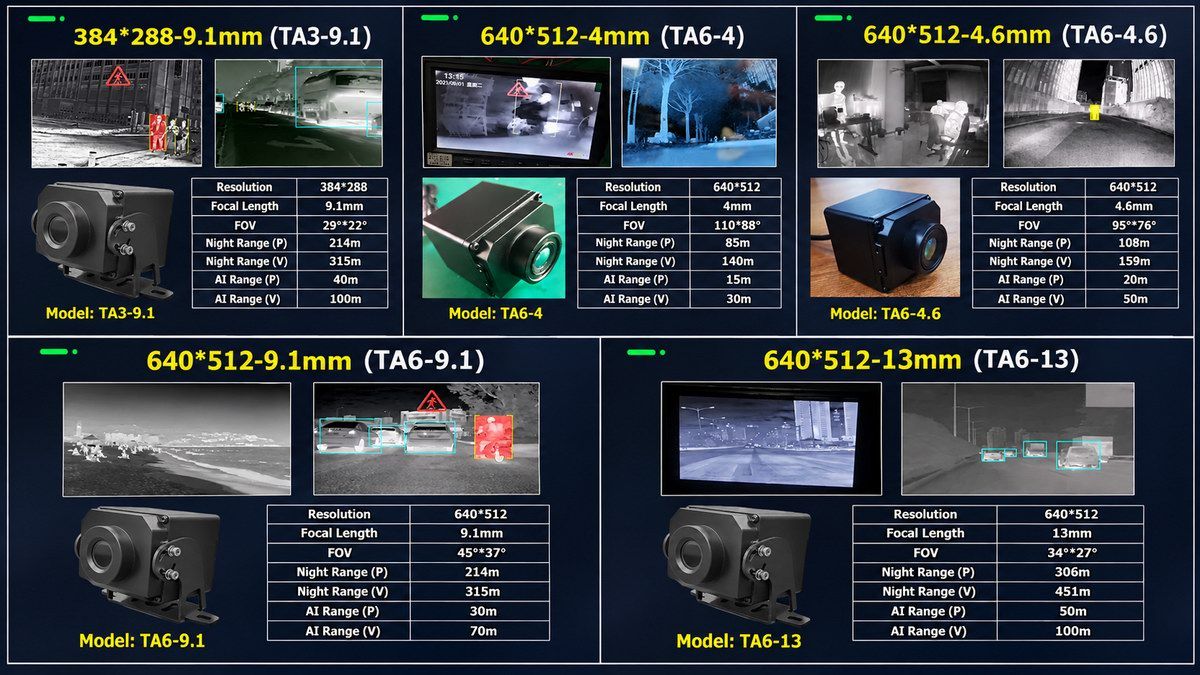
You can adjust the hardware to the job. Three thermal resolutions are available: 256×192, 384×288, and 640×512. Lens options range from 18° to 120° horizontal field of view. A narrow lens reaches farther down a drift. A wide lens covers the close-in zone around a loader. Each setup serves a different monitoring need, and the right choice depends on your vehicle type and roadway geometry.
Thermal Resolution | Typical Role |
|---|---|
256×192 | Close-range awareness on compact vehicles |
384×288 | Balanced coverage for general fleet use |
640×512 | Long-range detection and wider scene detail |
Lens choice pairs with resolution. Match the field of view to the zone you must watch. A wide 120° lens on a loader covers the bucket area and nearby walkways. An 18° lens on a haul truck extends detection down the tunnel. Neither option is better in general. Fit is everything.
The ai vehicle thermal camera combines both layers, sensor and software, in one sealed unit. Thermal cameras of this class give your fleet a detection capability that works in zero light, dust, and glare. That combination defines modern vehicle mounted thermal imaging camera performance for mining equipment.
Thermal Imaging for Mining Equipment Mounting
Mounting on Loaders and Haul Trucks
The camera body is compact and lightweight. That small size gives you flexible placement options on mining equipment. A sealed aluminum housing rated IP67 protects the optics from dust and water. Power runs on DC 9–24 V, and the unit starts on its own when powered. You wire it once and the camera comes up with the vehicle.
Placement decides how much value you get from thermal imaging for mining equipment. Gemini Optics recommends mounting on the cab roof just ahead of the operator on loaders, with a small hood against glare and rain. On mining trucks, front corners and rear bumper positions cover the critical blind zones. Use stiff, short mounting arms and avoid thin sheet-metal plates that resonate. Heavy-duty trucks generate more vibration than light vehicles, and Distar Mobility notes that shock testing checks image quality after sudden impacts.
Alerts Inside the Operator Cab
AHD video output runs at 720p and 25 Hz by default, with optional 1080p formats. Standard vehicle displays and DVRs accept this signal, so you keep your existing cab setup. Aotop advises matching the camera signal, monitor input, connector pinout, voltage, and cable configuration before ordering. The RS485 interface sends detection-related distance data at a 115200 baud rate for integration with warning platforms.
An alarm speaker interface adds an audible cue alongside the on-screen alert icons. IR remote configuration lets you adjust settings without opening the housing. Optional defrost on selected models helps in cold, damp drifts. Each vehicle mounted thermal imaging camera in your fleet becomes part of a practical thermal inspection routine, and the inspection data supports faster decisions in low visibility.
Benefits of Vehicle Thermal Imaging Cameras in Dark Mines
Spotting People and Equipment in Zero Light
A vehicle mounted thermal imaging camera gives your operator a clear view where headlights fail. People and equipment give off heat signatures that stand out against cold rock. Dust, smoke, and light fog do not block the long-wave infrared band. This advantage matters in harsh, low-visibility places where normal light-based optics struggle.
A FLIR Systems case study from a large copper mining operation shows the pattern. Dispatchers used thermal cameras to track shovels and haul trucks across the site, even in the deepest parts of the mine. Perimeter cameras pointed inward and watched equipment through total darkness. The same study notes that mining operations value clear vision through dust, smoke, and light fog. Your operator gains the same benefit at the vehicle level. A pedestrian near a haul route shows up as a bright heat source before the eye can find them.
Thermal imaging in mining also helps with equipment checks. A hot bearing or a dragging brake shows up as a warm patch on the feed. Your team can act on that signal during a routine inspection rather than after a breakdown.
Reducing Downtime and Near-Miss Risks
Better visibility means fewer near-misses. An operator who sees a person or a parked vehicle early has more time to slow down and stop. That extra margin supports vehicle safety across the fleet. The camera provides observation and warning assistance. It does not brake or steer for the operator, so your drivers stay in control.
Thermal inspection also protects uptime. KVR Infrared reports that unplanned downtime at a mine site can cost up to $180,000 in lost production per incident, according to Gates Corporation. The same source lists faults that thermography caught before failure:
Detected fault | Equipment/context | Consequence avoided |
|---|---|---|
Voltage regulator termination near failure | Substation feeding vital operations | Unplanned shutdown; lost revenue could have reached millions of dollars |
480 V contactor termination near failure | MCC bucket feeding a VFD processing motor | Lost processing revenues of up to $100K |
Overheating boom cylinder from lack of grease | Rope shovel | Fix during a 12-hour shift vs. losing $180,000 per hour in production |
Those examples come from fixed and vehicle-mounted thermal cameras feeding a central monitoring station. KVR Infrared notes that condition monitoring data helps mines predict failure and schedule shorter maintenance windows. Thermal cameras on mining trucks and mining equipment bring that same early-warning logic to the mobile fleet. A warm wheel hub or an overheating brake assembly shows up on the cab display during a normal pass.
The payoff stays practical. Your operators gain situational awareness. Your maintenance team gains a thermal inspection routine that flags trouble early. Fewer surprises mean less unplanned downtime and a safer shift for everyone underground.
Limitations of Thermography in Mining
Dust, Water, and Environmental Interference
Think of the camera as a tool that helps you observe and warns you of danger. It does not brake or steer the vehicle for you. Your operator still makes every driving decision, and the system never takes over that job.
Dust, water, and extreme temperatures all affect how clear the image is. The sealed aluminum housing is rated IP67, which keeps out dust and water jets. Optional defrost on some models clears frost and fog from the lens. These features help, but they do not solve the whole problem. A thick dust cloud still scatters infrared energy and makes the image less sharp. Water sitting on the lens blocks the view until it clears. Make cleaning part of every shift, and check the lens before each run.
Range, Cost, and Operator Training
Detection range has limits. A narrow lens sees farther down a tunnel, and a wide lens covers the close area around a loader. Resolution and lens choice also affect cost, so match the optics to the area you need to watch. A vehicle mounted thermal imaging camera with a 640×512 sensor costs more than a 256×192 unit, and the extra detail may not be worth it on a loader that only makes short trips.
Training decides how much value you get. Opticomtech stresses that your staff must know how to read thermal imaging data and take quick corrective actions. The Canadian Mining Journal adds that staff must understand how to interpret thermal data and how to respond when alerts go off. Build that training into deployment.
Thermography in mining also helps with tire checks. Watch haul truck tire surface temperatures on the display. Rising tire surface temperatures can signal heat build-up from underinflation, and unusual heat patterns may point to tire tread separation. Record the outside tread surface temperature during each thermal inspection, and compare readings across the fleet. A thermal camera makes this inspection fast, and early warning protects both tires and uptime.
Fitting Thermal AI into Mining Safety Systems
Pairing with Radar, LiDAR, and Proximity Detection
No single sensor can see everything underground. Radar does a good job tracking distance and closing speed. LiDAR uses laser pulses to map shapes and works in the dark. Proximity detection tags warn when two units get too close. Each tool has a job, and each one has conditions that make it weaker. Distar Mobility notes that thick fog, heavy rain, and dust in the air may weaken LiDAR signals, and visible-light cameras can struggle in bad conditions too. Thermal imaging works in a different way. It reads heat signatures and keeps useful detection ability where light-based sensors have trouble.
That difference makes thermal imaging a partner, not a replacement. Sensor Micro describes modern systems as sensor fusion, where cameras, radar, LiDAR, GPS, and thermal data blend into one picture. An infrared camera adds a separate source of information and gives backup when other sensors reach their limits. Blended data improves object recognition and lowers the risk of false detections or missed hazards. Match the mix to your site. A wide, dusty drift may depend on thermal and radar. A clean, mapped decline may depend on LiDAR. Choose by purpose, not by rank.
Deployment Lessons from Underground Operations
Start with the display. The vehicle mounted thermal imaging camera sends AHD video at 720p and 25 Hz by default, with optional 1080p formats. Make sure your monitor and DVR accept that signal before you order. Check connector pinouts, voltage, and cable routing at the same time.
Then plan the data path. The RS485 interface carries detection-related distance data into your warning platform, so your software team can log alerts and trigger cab cues. Wire the alarm speaker interface to an audible device the operator can hear over engine noise. Run a thermal inspection of the lens and housing each shift, and log readings for continuous thermal inspection records. Treat mobile equipment inspection as a routine, not an event. Thermal imaging for mining equipment pays off when crews trust the alerts, so train operators to read detection boxes and distance labels. Thermography supports mining operations best when it feeds a planned system, and mining teams that test one unit first learn the fit before scaling across the fleet.
An AI vehicle thermal camera combines heat detection with built-in AI. Your mining vehicles get clear vision where headlights and normal cameras fall short. Thermal imaging shows people, machinery, and hazards through dust and total darkness.
The real-world payoff is real and easy to measure. Operators spot heat signatures sooner, close calls drop, and unexpected downtime goes down. Some limits still exist, so plan your lens and resolution choices and train your crew to read alerts.
Check out a vehicle thermal imaging camera for your fleet. Ask for a pilot deployment consultation, and test thermal imaging on your mining equipment in real conditions. Better visibility starts with one unit.
FAQ
Does a thermal camera work in total darkness underground?
Yes. The camera reads heat instead of visible light. Its uncooled VOx detector works in the 8–14 μm band with a 12 μm pixel pitch. People, engines, and warm machinery stand out against cold rock. Dust and glare do not blind it the way they blind headlights.
Which resolution and lens should you choose?
Match the optics to the zone you watch. Three resolutions are available: 256×192, 384×288, and 640×512. Lens options span 18° to 120° horizontal field of view. A narrow lens reaches down a drift. A wide lens covers the area around a loader.
Will the camera connect to your existing cab display?
The camera sends AHD video at 720p and 25 Hz by default, with optional 1080p formats. Standard vehicle displays and DVRs accept this signal. The RS485 interface carries distance data to warning platforms. Check connector pinouts and voltage before you order.
Does the camera brake or steer the vehicle?
No. The system provides observation and warning assistance only. Your operator keeps full control of braking and steering. Detection boxes, alert icons, and distance labels support faster decisions. They do not replace the driver.
How does thermal imaging fit a broader safety plan?
Thermal imaging adds a heat-based layer that radar, LiDAR, and proximity detection cannot provide. Pair it with those tools for sensor fusion. Build a lens and housing inspection into each shift. Train operators to read alerts. Fit each technology to its purpose in your mining operation.
See Also
Top AI Thermal Cameras for Vehicle Night Vision Systems
Choosing the Right Marine Thermal Camera for Night Navigation
Selecting High Resolution Thermal Imaging Camera Manufacturers for OEM/ODM Projects
Guide to Selecting Thermal Camera Modules for Drone UAV OEMs
Key Factors Driving Thermal Camera Module Prices for OEM and Bulk Buyers in 2026